“You’re the Translator. Translate!”

stargate

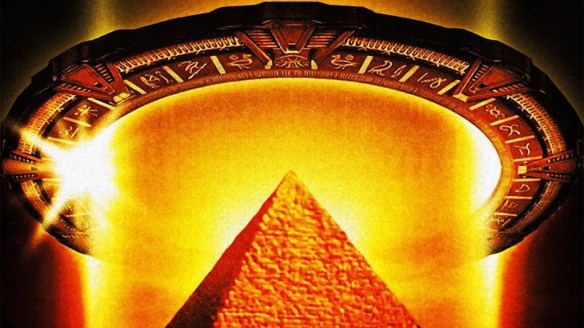
Stargate is a film about an immigrant’s love for America. It has a wonderment, a fascination with the American way that seems almost undimmed by the history of the 20th century. Stargate is what happens when the Prime Directive of Star Trek meets the Manifest Destiny of the real world.

It’s also about a bunch of American soldiers getting bogged down in a desert war about a mysterious, magical resource, fighting a power that is almost unknowable. Stargate was made in 1994, right after the First Gulf War, and it ends with this terrible realisation that they have only fought one battle, and that their enemy has many allies, that will be coming for them next.

That’s not all. Stargate is adored by translators all over the world, because it’s one of only a handful of films in which the translator is the hero.

stargate3

I have been in those situations. No, not quite brought back from the dead and forced to debate politics in a recently learned dead language with an immortal alien… but close. I have been dumped into negotiations way over my head, in a language or dialect I don’t even speak, and had to muddle through. I have turned up in the middle of fights threatening to escalate into real trouble, and they’ve said to me “You’re the translator. Translate!” I have stared at a blackboard where someone has tried to have a crack at my specialist subject, and said: “Who wrote this crap?”

You can thank Roland Emmerich for that, I imagine. This is a man who grew up speaking German. He knows whereof he speaks. There’s a great scene in Stargate when Daniel Jackson is in a cave with his love interest, Sha’uri; Daniel points at hieroglyphs and reads out the pronunciations, and she tells him what the vowel mutations and consonantal shifts are. If you learn to speak Mandarin first, that’s how you learn to convert it into Cantonese! Although sadly not every language course supplies a Sha’uri to jolly things along.

I think that at its deepest level, the thing that really strikes home in Stargate is that Daniel Jackson isn’t just a translator. He’s a writer in Hollywood. He’s the weedy, wimpy specky guy with the big ideas that nobody wants to hear, dragged off to the middle of nowhere by a bunch of bullies and told to twist his skills in new and unexpected directions. The soldiers hate him. They’re all producer types who just want car chases and boobs, but he’s there with his books in the desert, wide-eyed with amazement at this incredible thing, that is all his dreams coming true, as long as the producers don’t ruin it. And at the end, he gets the girl!

Well, at the end of the movie, anyway. In the TV series… well, there’s some small print…

Jonathan Clements has translated Sun Tzu’s Art of War, among other things.

Available Deaths

I once wrote the script for a military sci-fi computer game, only to find that the producers had put dancers in the motion-capture suits. All the soldiers marched like ballerinas. Easier on the eye in the studio, perhaps, less fun in the finished product.
Continue reading

Art Beat

When Satoshi asked me if I’d go to the hospital with him, I felt like I’d been punched in the stomach. He was so young! My Japanese ability wasn’t even equipped to find out why. I asked him what was wrong and got a series of staccato jigu jago Japanese syllables. It’s easy to get mixed up if the vocabulary isn’t familiar. Shuy? is a tumor. Sh?yu is soy sauce, and I didn’t want to press him for clarification. Meekly, I said I’d be there for him, and tagged along.
Continue reading

Perceived Value

This article first appeared in Neo #50, 2008.

Back in April 2003, I attended the Tokyo demonstration of Blu-ray. I rushed home trilling about the benefits of an entire TV series on a single disc! Except this was precisely what the Japanese TV industry didn’t want. At meetings with expensive biscuits all over Tokyo, people fretted about Perceived Value. It’s all very well, they said, to cram the entirety of Schoolgirl Milky Crisis onto a single disc, but how much can we charge for it? Will our target 16-year-old buyer really drop £100 all at once on that single disc, particularly if he’s never seen an episode beforehand?
Continue reading

Hyena Poo

The sight of my gurning face on Right Stuf’s podcast, backed by multiple images of Schoolgirl Milky Crisis made me laugh. Not because of my freakish appearance, but because I knew where that photograph of me was originally taken: at the cave complex in Zhoukoudian, China, at the site where archaeologists first discovered Peking Man. It’s a long way from anime; it’s a long way from anything.

Continue reading

Pod People

I am now available in pod form, courtesy of the people from the Right Stuf, who interview me on their latest Anime Today show about anime, manga, and the difficulties of getting Chinese waiters to sing Help Me Rhonda.

Click here to listen

As part of their very professional and diligent set-up, they put together the above picture of me in front of a bunch of Schoolgirl Milky Covers. Next blog entry, I’ll tell you where I really was when that photo was taken. Really, you’d never guess.

Meanwhile, it’s time to announce the winners of the Big Giant Heads’ competition to win a free copy of Schoolgirl Milky Crisis. Readers of this blog were asked to come with their own name for a stupid anime show, causing much mirth at Titan Books with their ideas for hundreds of truly awful, teeth-itchingly unpleasant titles.
Continue reading

Good Mourning

This week began with two Oscar wins with an anime/manga connection. La Maison en Petit Cubes won the Best Animated Short, while Departures (Okuribito), won Best Foreign Film. Albeit not as widely celebrated in the fan community, the film release of Okuribito was preceded by a manga adaptation in Big Comic Superior magazine, which I covered in issue 49 of Neo last year:
Continue reading

The Blu-Ray Blues

I tried to say it politely. The Japanese author had spelt two names wrong, misdated a crucial release, and assigned a famous quote to the wrong director. For no extra charge, I had footnoted those problems on the translation and sent it off.

A curt missive arrived from Big Anime Company telling me to put the mistakes back in. It turned out that the author was someone’s uncle and very high up in the company. He’d thought that “TENTACLY YUM YUM BYATCH” was the perfect tagline to use on the box for a U-rated fairy tale about a girl and a pony. And nobody was going to tell him that he was wrong.

It’s a symptom of a disease that many people don’t even know they’ve caught. I call it the Blu-ray Blues and it’s taken five years to take hold. Because, you see, now we can fit 30 languages on a single disc, it makes sense for it to be a single release, mastered in Japan. In theory, this is great news for anime. In practise, however, right now there are a dozen people in Tokyo offices saying that foreigners are stupid and don’t know how to sell anime. If anime has not lived up to the unrealistic sales predictions of its marketers, then someone must surely be to blame, and the blame traditionally falls on anyone who isn’t Japanese. If the Japanese only get to micromanage every part of the business themselves, surely international sales will suddenly go through the roof?

There are people who think they can do a whole lot better if they just run everything out of Japan. But that brings an irresistible temptation to treat the rest of the world in the same way that Japan is treated. That means much less material on each disc, and sold at a higher price. It means attempts by PR personnel to censor magazine articles. And while it might mean better control of translation, in my experience so far it has merely meant that an entire echelon of useless stuffed shirts have been able to fiddle with localisation.

These people are known as the Window Tribe. The guys passed over in promotion who are just marking time in the office. Fiddling with foreign deals is their sole pleasure, because they can do it without attracting attention on their home turf. Once, they were only able to dicker with contracts or haggle over royalties. With localisation now based in Japan, those self-same ditherers will have a new opportunity to justify their jobs, by offering their worthless opinions on translation.

There have been a lot of lay-offs in the anime business this year, and they have largely come from the gaijin middlemen – the human buffer zone between you and the Japanese corporations. They were the ones who shook your hand at conventions, and they were the ones who tried to make sure that scripts, taglines and extras were not… well, laughably inappropriate. And they were the first up against the wall when the Blu-ray revolution came.

I hope this all works out, really I do. Because there is a very real risk that the centralisation of the anime business back in Japan will actually hurt it far more than it helps.

Jonathan Clements is the author of Schoolgirl Milky Crisis: Adventures in the Anime and Manga Trade. This article first appeared in NEO magazine #51, 2008.