Our Boys in the Air (1934)

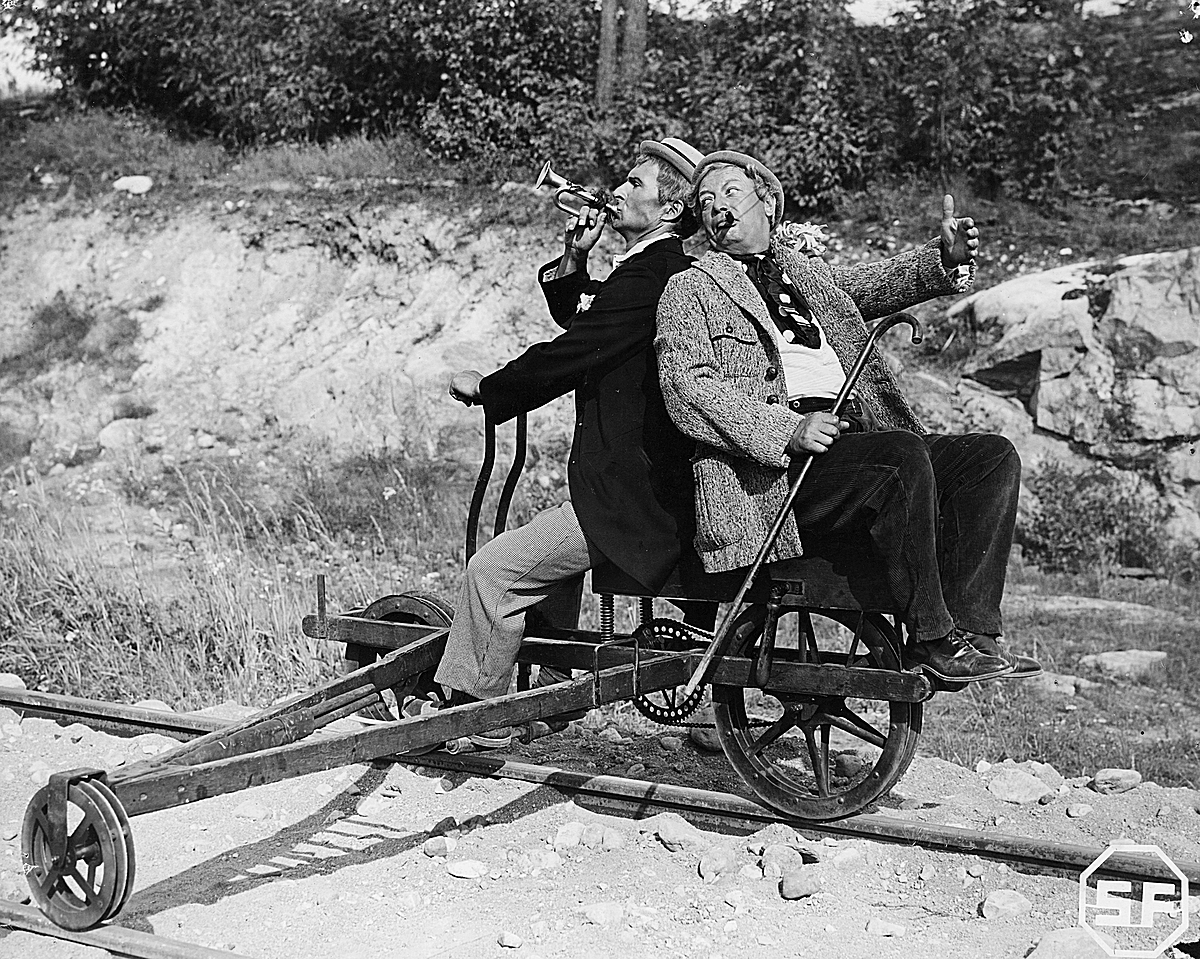
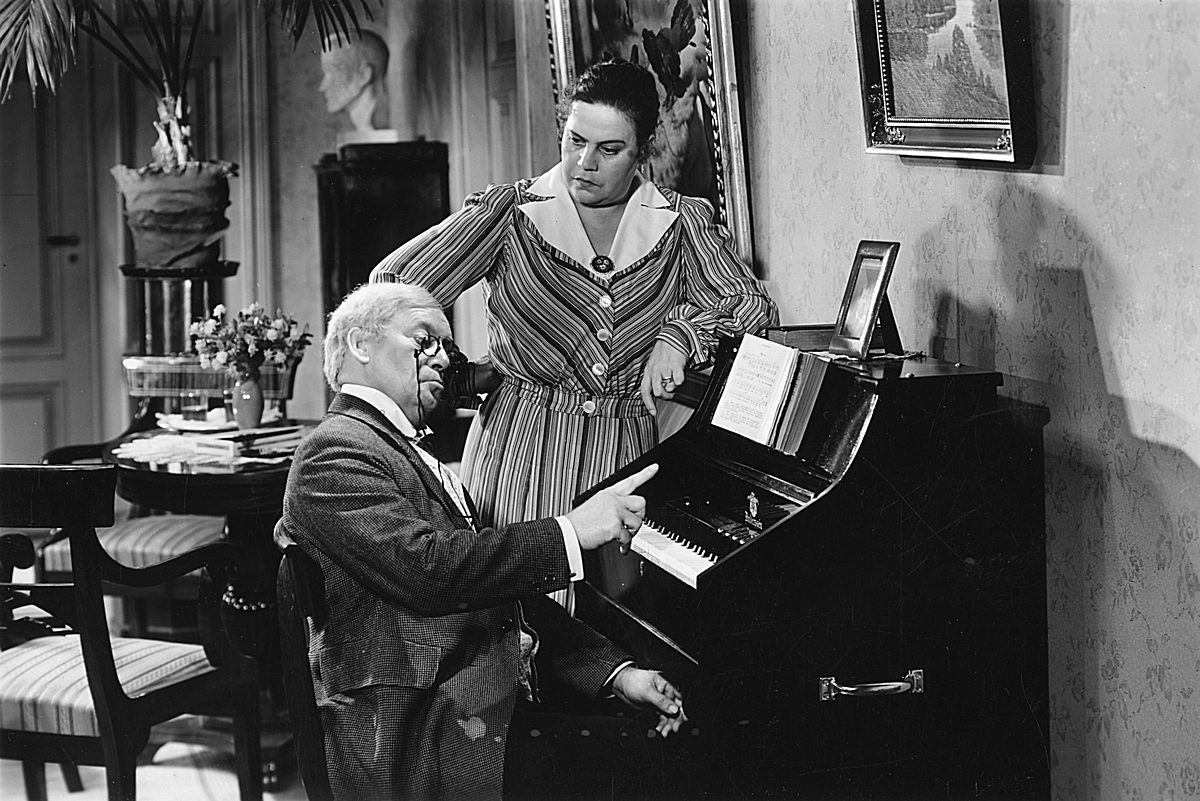
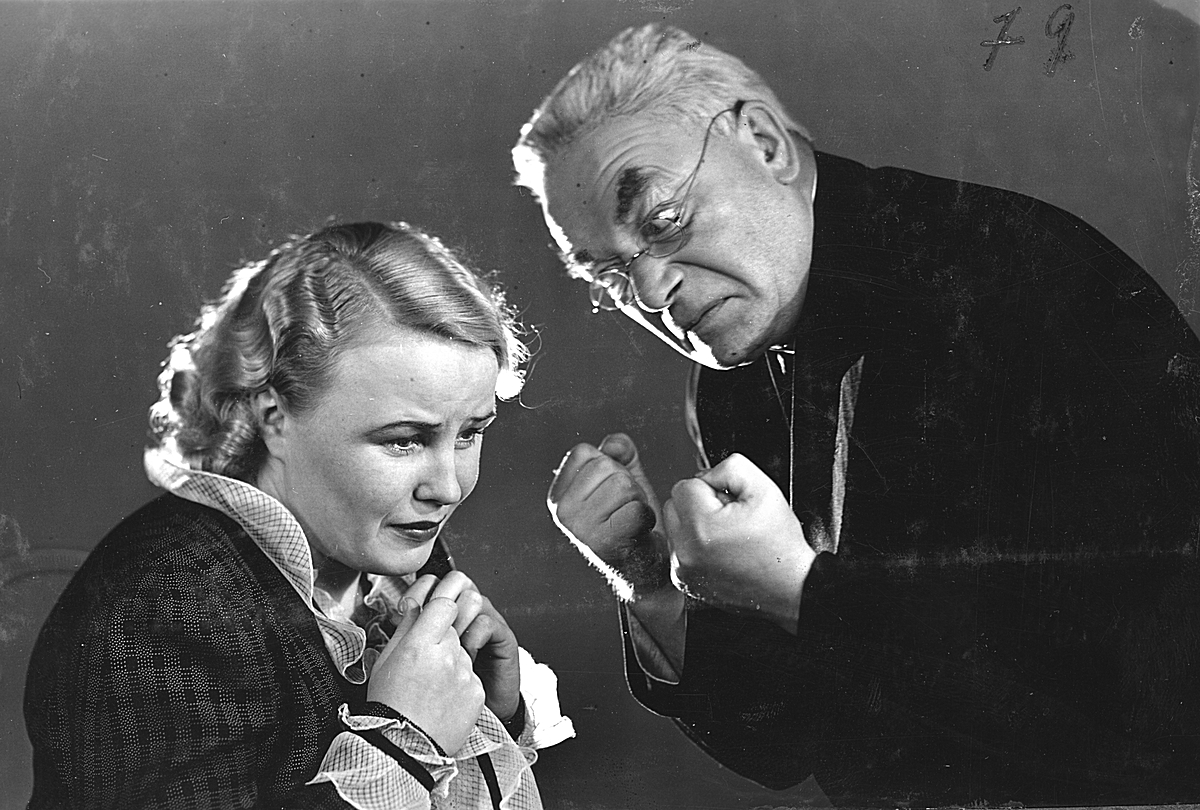
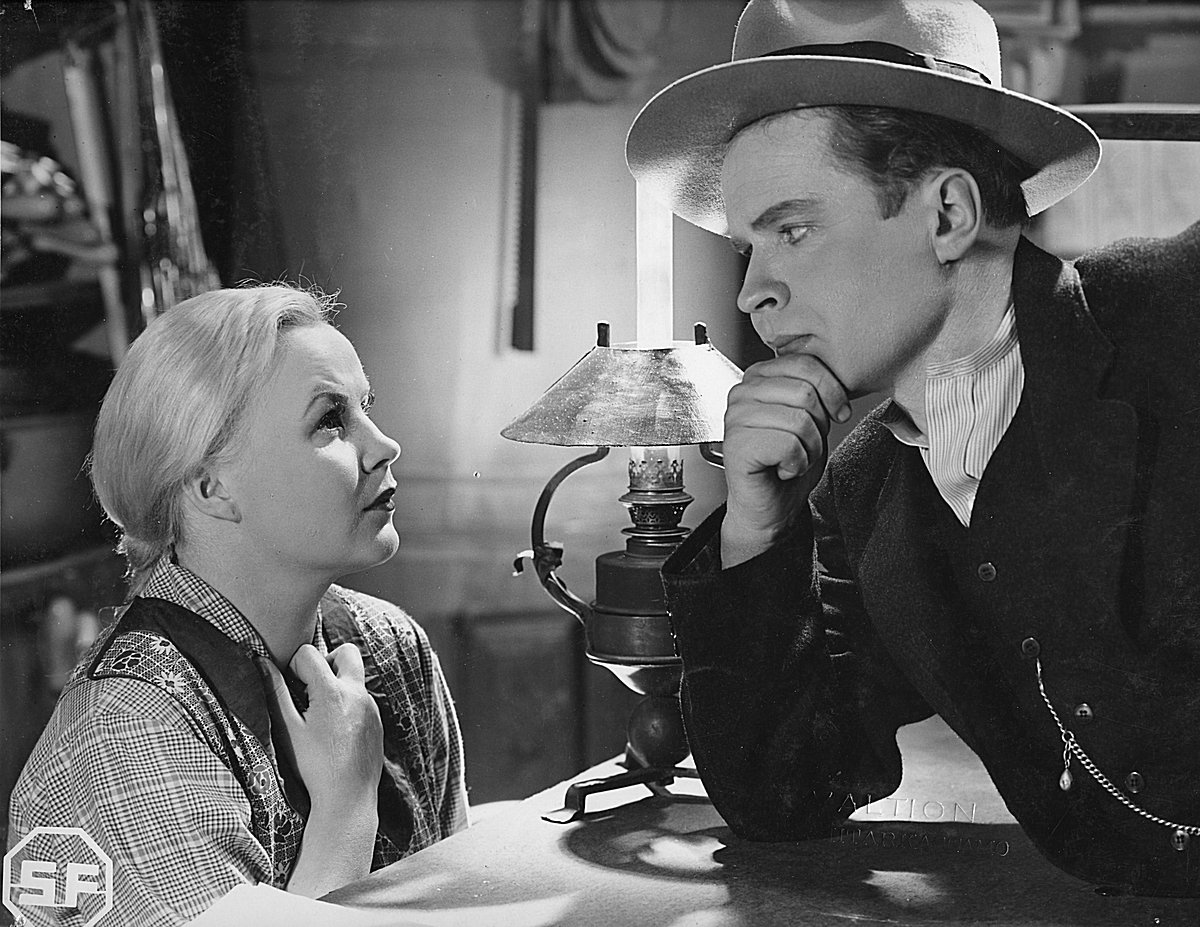
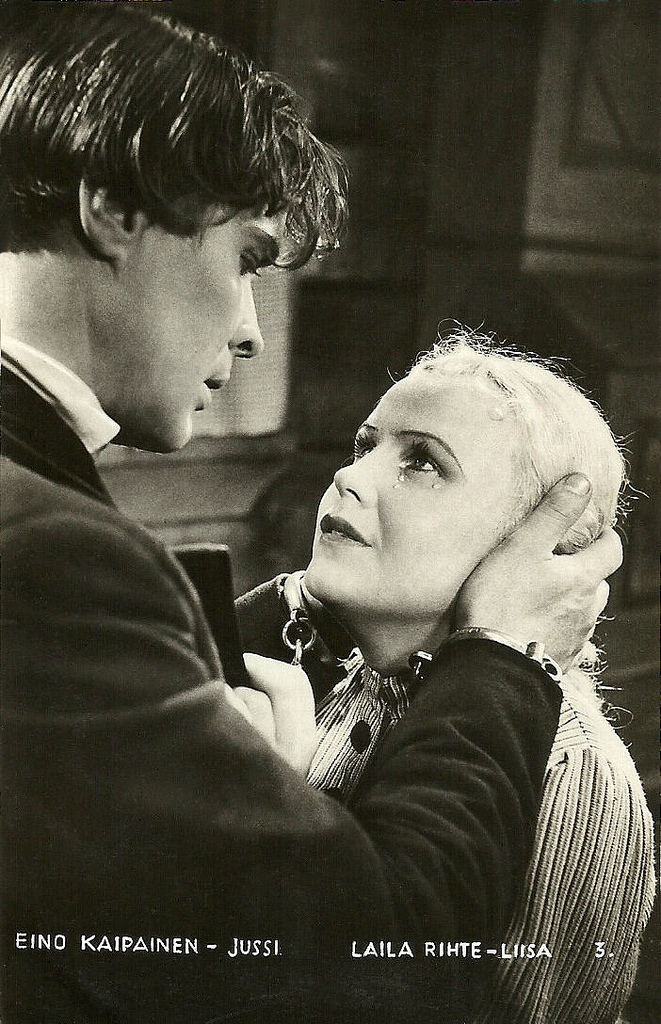
The men of the Finnish air force push their planes to their limits in long-distance tests, and train in preparation for future conflict. Pilots Jarmo (Joel Rinne, who would star three decades later as Inspector Palmu in the movie series of the same name) and Kalle (Fritz-Hugo Backman), are ahead in the distance challenge, but are forced to put their sea-plane down outside Vyborg for repairs. They are helped by local girl Kerttu (Marta Kontula, in legally actionable hotpants), with whom Jarmo soon falls in love. Kerttu happens to be the sister of his fellow pilot Erkki (Kaarlo Angerkoski), who himself is sweet on the starey-eyed Aino (Irja Simola, who looks at him the way a hungry dog looks at a sausage roll).

The pilots are roped into air reconnaissance during a forest fire, during which Erkki saves Aino’s sister Mirja from a burning building. In the process, he is hit on the head by a falling plank, and dreams of a future air assault on Finland. He wakes up to discover that all is well, although the storm clouds of war are gathering.

The first of the films included in the monster 232-disc Suomen Filmi Teollisuus box set, Our Boys in the Air, Us on the Ground (1934, Meidän poikamme ilmassa – me maassa) was actually the third in a trilogy of propaganda films made by director Erkki Karu, following on from Our Boys (1929) and Our Boys at Sea (1933). It presents a fascinating glimpse of Finland in the inter-war period, but has an impossible hill to climb in narrative and technical terms, since it was made in the shadow of Wings (1929), an American film on a similar topic, rightly lauded for incredible achievement – the winner of history’s first Oscar.

Karu had been forced off the board of Suomi Filmi, the company he had run for over a decade, unjustly carrying the blame for a slump in cinema attendance brought on by the Great Depression. With plenty to prove, he leapt back into action for his newly formed company with Our Boys in the Air, although it would prove to be one of his final films; he died in 1935, aged just 48. One of his leading men, Kaarlo Angerkoski, would not last much longer, dead from a heart attack at 33 four years later – the press blamed cigarettes and coffee.

Our Boys in the Air was made during the tense 1930s, during which the smart money in Finland was sure that the Soviet Union would stage an attack. It is hence less of a war film than a pre-war film, informing the population about military preparations and developments in technology. Under the guise of a lecture attended by the pilots, what appears to be an actual military training cartoon about relative bomb strengths is spliced directly into the film. Made with the cooperation of the actual Finnish Air Force, the film features prolonged aerial sequences, including a beauty pass across Hamina, the symmetrical, radial streets of which make for an attractive view, and Finland’s second city of Vyborg, fated to be lost to Russia in WW2.

There are many elements that mark the film out as a product of its age. The cast occasionally spring into song in exactly the same way that Finns don’t. The soundtrack is oddly lacking, with silent engines, slamming doors that make no noise, and very little foley – sometimes, all you hear are the actors’ voices. There is also a clear demarcation between actors trained in the theatre, who mug and twitch like they are on drugs, and stiffer amateurs who, ironically, come across as more naturalistic. One of these is Miss Finland 1933 (and Miss Europe 1934), Ester Toivonen, who was a teenager working in a bread shop only a couple of years earlier, but has been propelled in front of the camera by her beauty-queen career, and here plays a nurse, ahead of her first true starring role the following year, in Karu’s Scapegoat.

The film was praised in its day for the flying sequences, which even critics unswayed by its preachy nature had to admit were compelling. Today, however, it is most remarkable for  the 25-minute dream sequence in its final act, in which the unconscious Erkki experiences a prophetic vision of bombing raids, anti-aircraft batteries, civilians in gas masks running for an air-raid shelter, and firemen digging survivors from the rubble.

“Thank God it was just a fever-dream, and not real,” observes Erkki’s father when he wakes, although it would all prove to be far too real in 1939, when Soviet planes bombed Helsinki. They are not bombs, joked the Russian minister Vyacheslav Molotov, they are just bread baskets. The Finns would respond in kind, claiming that the petrol bombs they threw at Russian tanks were just cocktails for Molotov.

Jonathan Clements is the author of An Armchair Traveller’s History of Finland.  

Remembering Paku-san

Look for the term Paku-san (“Mr Munchy”) – an affectionate nickname born of the late Isao Takahata’s habit of scoffing his toast on his early-morning studio rounds. It’s a common occurrence in Japanese-language reminiscences and studio memoirs. And reference to it often separated the wheat from the chaff in last month’s rondo of Takahata obituaries.

You’re in safe hands with NEO magazine, for which Andrew Osmond has fashioned a loving tribute this issue, but the coverage of Takahata in other publications has been of variable quality. It’s an interesting sampler not only of how far we’ve come (a lovely Guardian piece by Jasper Sharp, I see!), but of how far we haven’t – far too many clueless paste jobs from Wikipedia. Sadly, they don’t know who they are. Few obituarists, for example, noted that Takahata worked as a producer on both Nausicaa and Castle in the Sky, many accounts of his box-office “failure” Little Norse Prince, made under hostile studio conditions and effectively buried by its own distributors, were hopelessly garbled, seemingly by writers who thought it would be easy to cram such a full life of achievements into a simple list of films he directed.

One news-hound from a well-known British broadcaster inadvisably spammed anyone on Twitter who had mentioned Takahata, asking them if they wanted to come in for an interview. Unfortunately for him, this was all publicly visible, so would-be pundits could see him sucking up to Some Guy With a Blog with precisely the same enthusiasm as he was to Respected Filmmaker. In a marvellous gaffe, he also tried to get an interview with Roger Ebert, who has been dead for five years.

In obituary terms, Takahata might look like an easy grade. There is, after all, a lot of secondary material about him. It’s not like Akira Daikuhara, who died without half of the anime industry even knowing how to pronounce his name. But Takahata is still oddly under-represented in English-language interviews and books. At least one attempt to write a book-length study of Takahata’s work was thwarted in the early noughties by studio recalcitrance – it is not necessarily the fault of English-language authors that some figures are under-represented. Whatever the reason, there’s no BFI classic on Grave of the Fireflies or Princess Kaguya. There’s no translation (yet) of his collected essays, Things I Thought While Making Films. In criticism, as in life, Miyazaki got the attention first, and his friend and mentor was all too often tabled for later.

Jonathan Clements is the author of Anime: A History. This article first appeared in NEO #176, 2018.

Sheriff

The Finnish police are left baffled by a double murder in a Turku house – a former cop ritually sacrificed and his girlfriend shot in the head. Private investigator Jussi Vares (Antti Reini) is hired by the dead girl’s godmother to look for clues, and soon deduces that everybody has been looking in the wrong place. The police assume that the female victim was merely collateral damage; Vares realises that she was the real target, and her mutilated boyfriend merely a smokescreen. But why would anyone want to kill a highly-respected accountant?

The latest, and so far, last of the Vares films displays a visible stylistic shift from Hannu Salonen, a Germany-trained thriller director who would go on to make Arctic Circle (2018). It restores the comic-book freeze frames and mottos from the earliest films, and has a super-processed, enhanced look that fiddles with odd lens choices to stretch human figures or flatten out backgrounds. Audi is one of the film’s sponsors, but I don’t see any Audi product placement – perhaps it is worth more to the company to pay the Finns to repeatedly abuse, blow up and roll a bunch of Volvos.

Vares does some actual detective work, being ideally placed to notice that, like him, the murders sit on the borderline between the everyday and the criminal underworld. Through his druggie associate Antidote (Jasper Pääkkönen, presumably just before he got his role in Vikings), he is introduced to a council of criminal kingpins who bankroll ventures that fall outside the scope of the mainstream economy – deposits for contraband smuggling, down payments for getaway cars, and, if my own bitter experiences are anything to go by, mortgages for expats. His quest drags him into Finland’s black economy, with its own set of rules and protocols, and surreal daytime speakeasies where men sit on leather sofas and listen to Puccini. In other words, this the Vares series’ answer to Shadow Line, caught between the police and the criminals, each using their own methods in the pursuit of the murderer.

The new look and new director, not to mention the introduction of Shostakovich (Jukka-Pekka Palo), Vares’ self-styled patron from the underworld, could amount to a soft reboot for the whole series, since the novel Sheriff was the first of a sub-trilogy within the long-running novel sequence. Writer-director Salonen has made some brutal decisions with the regular cast, relegating Vares’ usual drinking buddies to a couple of cameos in the closing scenes, and recasting the journalist Ruuhio. Previously played by the clean-cut, ever-youthful Mikko Lempilampi, who presumably has better things to do shooting the same year’s Girl-King, he has suddenly been switched for my favourite Finnish actor, Mikko Kouki, who looks utterly ridiculous here as a gum-chewing slob with a man-bun. I don’t understand why they bothered to say this character was Ruuhio at all; it would have been surely been less disruptive to just give him a different name.

They certainly didn’t keep the original name of squeeze-of-the-week Milla (Karoliina Blackburn), a motorcycle-riding hacker who is swift to reveal to Vares that she only pretends to be a lesbian to hold off unwanted suitors. In the original book, she was known by the actionable pseudonym Harriet “Harry” Potter, the now-obscured origin of a joke in the script that points out the only thing she has in common with the schoolboy wizard is that they both like girls.

The publication of the English translation of the Sheriff book in 2015 permitted me the chance to read a Vares novel and to notice some asides that are not repeated in the film. For example, in the book Vares is momentarily troubled by a vision of himself, strapped to a bed in an asylum, while a nurse reads out newspaper headlines about catastrophic flooding on the Finnish coast. Is this a nightmare? Or is it a premonition about the events of the science fiction coda, Hard Luck Café? He is also brooding about a case that he failed to solve, the death of Mirjam in the snow a decade earlier, as chronicled in Frozen Angel. Meanwhile, an aside reveals that his friend, the author Luusalmi has only ever published a single book, making a mockery of numerous past claims about his erudition. It’s almost as if the chickens are coming home to roost in this late addition to the Vares canon, as both author and hero look back over their past adventures and try to make sense of them all, dredging up some of their earlier claims for a bit of tardy due diligence.

Sheriff, as the book repeatedly reminds the reader, is the Finnish title of the film better known in English as High Noon – one of many Western references buried within the Vares books. But Sheriff also seems like an attempt by author Reijo Mäki to engage with something that has been lurking at the edges of his world for years. Every now and then in Vares stories we get a glimpse of the wider criminal underworld, an entire wainscot society with its own rules, regulations and regulators. In Sheriff, Vares finds himself digging into the mechanics of one of the institutions of this shadow world, a criminal bank prepared to loan money at high rates to high-risk, illegal propositions. It’s not quite The Wire, but more John Wick, as Vares comes to realise the subtle codes he has ignored, inscribed on the very walls of some of the criminals he is chasing.

Jonathan Clements is the author of An Armchair Traveller’s History of Finland.

Civilisation

“Aboard the Dingyuan, the wounded, half-blind William Tyler stumbled through the carnage. His ears were still ringing from the blast, and would continue to do so for the rest of his life. Up ahead, he saw a friend of his, Lieutenant Wu. Even as they exchanged greetings, a man standing nearby was torn apart by an enemy shell, smearing gore and entrails across the deck.

“‘So this is civilisation,’ said Wu. ‘This is what you foreigners are so keen to teach us.’”

From Admiral Togo: Nelson of the East, by Jonathan Clements.

From Truant to Anime

Up on the All the Anime blog, my review of Mari Okada’s memoir of dismal schooldays and her escape to the not-that-glamorous world of anime screenwriting.

“Mari Okada’s memoir of two decades in the anime business begins and ends with the disastrous premiere screening of Anthem of the Heart in her hometown of Chichibu – a huge event in the middle of nowhere, inconvenient for all attendees, with a film that stops playing halfway. As the screenwriter, she fumes impotently as the patrons wait and flunkies try to look busy, and watches with head-shaking resignation as the celebratory fireworks, timed to coincide with the end of the film, are launched too early while the audience is still waiting for it to restart.

“From Truant to Anime Screenwriter: My Path to Anohana and The Anthem of the Heart is her account of how she got to that place, as the writer of a standalone film. Her writing is distinguished by a constant resistance to the performativity of Japanese life, refusing to play the game of empty accolades and fake-news proclamations that all is well. Instead, she presents a compelling portrayal of a life (and industry) that constantly ‘fails up’, until she becomes one of modern anime’s rare hyphenate talents.”

Tango of Darkness

At least, for once, we aren’t looking for someone who’s killed a girl. The six-year-old cold case Jussi Vares (Antti Reini) rakes over in Tango of Darkness (2012) is the murder of crooner Harry Koivikko (Jani Muurinen), found on the floor of a seedy flophouse in Turku. Like the partitive grammar case that fixes Finnish nouns if no other declension is available, Vares shambles through this movie picking up other people’s mess. His drinking buddy, journalist Ruuhio (Mikko Lempilampi) has already solved the mystery, but has disappeared under suspicious circumstances. Vares must solve the case again in order to find out what has happened to Ruuhio, turning even the drama in this film into a case of reheated leftovers. Meanwhile, hard-man Veikko Hopea (Jussi Lampi), last seen locked in a fridge in Frozen Angel (2007) gets out of prison. “Hmm,” I said to the sofa, “I wonder if we’re going to watch him travel across Finland at occasional intervals throughout the film, only to arrive in the nick of time to save Vares from a bunch of other criminals?” No spoilers; I’ll let you guess. He also orders a room-service haircut from a Russian hooker called Olga, and then inveigles her into a blowjob, so… you know, that’s a bit of comedy business.

The film permits a brief glimpse into Finland’s tango culture, an odd relic of fifties nightclubs and dance-hall customs that continues to flourish in the domestic music scene. It does, indeed, launch a number of local pop stars, including Jari Sillänpää, a man with whose work I have become familiar with over the years because I am often mistaken for him by drunken Finnish cougars. The Finnish tango scene is big enough to support a number of artistes touring small-town venues with CDs in boxes, as long as they keep more or less to a repertoire that neither scares off the young nor annoys the old. Their lives, loves and scandals also seem to form the main material for the blue-collar press whenever a week goes by in which a ski-jumper hasn’t beaten his wife. Ballroom dancing’s enduring popularity, even in the 21st century, is a quaintly unifying element of Finnish life, responsible for, among other things, a bunch of guaranteed cross-generational floor-fillers at Finnish parties, as well as a talent show on Finnish television that I call Pixie Ballgown Accordion Smackdown. The quintessential Finnish dance-hall classic is “Satumaa” (The Fabled Land) written by Unto Mononen in 1955 and most famously sung by Reijo Tapale in 1962. It’s become a doleful staple of the male tango singers, and is a lament for a fairytale paradise forever beyond a man’s reach. At Kalevalanmaa, the centenary celebration of Finnishness put on by the Finnish National Opera in 2017, a performance of “Satumaa”, set at a country dance, was the cue for an audience singalong. In this film, it also lends its name to the hostel where Koivikko’s body was found, which has become a place of pilgrimage for his female fans.

The book on which this film is based, Pimeyden tango (1997) was published the year before the novel that was previously adapted into Kiss of Evil. In other words, beneath the skin, we are still dealing with a younger author writing a younger Vares, seemingly the sub-set of stories in which his job is to saunter in years after the police have given up, and inadvertently tie together the vital loose strands. Sometimes, as here, this is simply by presenting himself as bait to lure the criminals out of hiding, like a beer-soaked, gumshoe Christ. True to Reijo Mäki’s original novels, Vares is not present in several scenes in which motivations are explained and seemingly random deus ex machina events are set up. We, the viewers, know why certain events occur, but he presumably wanders off simply baffled by what has just happened to him.

As for the regulars, the biggest continuity change comes in the form of Vares’ neighbour Anna (Maria Järvenhelmi), a sometime stripper and formerly his driver of choice, who is now apparently in a relationship with Ruuhio the journalist. Vares tools around town in another Volvo, suspiciously like the one that got blown up in Garter Snake (2011). “I wonder,” I said to the sofa, “if this Volvo will meet a similarly explosive fate.” No spoilers, right? Vares is tracking the supposedly unfaithful wife of a local businessman, unaware that his client is a nutjob liable to want him dead if he doesn’t deliver the right evidence. “I wonder,” I said to the sofa, “if the client will try to have him killed, but accidentally kill someone else who has just killed another person who was going to kill Vares?” Perhaps I am getting a feel for the way that plots work in the Vares films, but if so, I have miscalculated the degree of screwing that goes on in this one, with Vares failing to bed absolutely anyone on camera. He does spend a while flirting with the sassy back-up singer Donna (Lolla Wallinkoski), a woman whose sole job in this movie is to convincingly hold a tune, at which she spectacularly fails. “Do you want to hear my new single?” she says to Vares as they drive along in his doomed Volvo, before turning on the stereo and subjecting us all to a caterwauling crime against music. She’s the 1997 Miss Scandinavia, although Finland isn’t in Scandinavia, so your guess is as good as mine how that happened.

Jonathan Clements is the author of An Armchair Traveller’s History of Finland.

Solo

Budgets were cut back for the tail-end of the Dredd audios. In order to have full casts in some of the other episodes, Big Finish asked me how small I could go. I wrote Pre-Emptive Revenge for just three actors, but there had always been a running gag that Toby Longworth could do all the voices himself… and then the director John Ainsworth said: well, why not? So I wrote Solo, in which Toby plays literally every part, and that freed up a couple of actors to bulk out the casts on someone else’s script.

It began as a pastiche of Chinatown, but then I was inspired by a powerful image in the Korean movie Joint Security Area (a body lying on the border, since ripped off by The Bridge and The Tunnel), and something I read in a book called Rattling the Cage, about the case for animal rights. The rest just happened… It’s really Toby’s masterpiece, right down to the moment when the Solo tries to cross the border towards the end, and I wrote the direction: “Solo replies, with the voice of Toby Longworth.” That’s the only time you’ll ever hear him out of character… or characters…

Ignoring Anime

Eiga Geijutsu (Film Arts) magazine is not afraid to call a spade a spade, infamously publishing both a Ten Best and Ten Worst list each year about Japanese movie releases. But in this year’s round-up of the highs and lows of 2017, editor Haruhiko Arai has refused to consider animated works.

The films that have particularly irritated him will be familiar to many readers of NEO magazine. One is Makoto Shinkai’s Your Name, which prompted Arai to ponder at a screening whether the enthusiastic movie-goers enjoying themselves around him had seen any other films recently.

Well, no they hadn’t. The huge box office figures for Your Name imply that many people who went to see it were either coming back for seconds or had not been to a cinema for a while. But how on Earth is that a reason to exclude it from consideration? It is surely an indication that Arai’s movie ratings are ignoring the opinions of the public. I, myself, make a living out of ignoring the opinions of the public, but Arai has not even afforded Your Name the backhanded compliment of calling it crap. He just stuck his head in the sand and pretended it wasn’t there.

Ignoring things, says Arai, is part of the problem with modern anime. He is disgusted by Your Name’s uplifting spin on tragedy, and regards it as a betrayal of history. He feels much the same way about In This Corner of the World, for presenting a childish innocent as a victim of war.

His reasoning is unexpectedly sound – frankly, it’s thought-provoking criticism. Your Name does indeed flaunt bad-taste brinkmanship by offering a reset button on an allegorical Tohoku earthquake – part of Shinkai’s incredible achievement lies in getting away with it. And ITCOW does rehash that old anime staple that regards WW2 as some sort of inevitable natural disaster visited upon the unsuspecting Japanese. But neither comment justifies pretending that the entire animated medium isn’t there anymore! In discounting two of the best anime of 2017 on spurious ideological grounds, Arai risks consigning his own magazine to the doldrums of film criticism. Instead, he argues that anime viewers are somehow cine-illiterate, unaware of trends and tropes in film itself, dumbly consuming pointless pap without any understanding of film as a medium. So I guess that tells us all where Miyazaki can shove his Oscar.

Jonathan Clements is the author of Anime: A History. This article first appeared in NEO #175, 2018.

Gambling Chip

There were moments in Lauri Törhönen’s film Gambling Chip (2012) where I honestly didn’t know what the hell was going on. Luckily, neither did our leading man, private eye Jussi Vares (Antti Reini), much of whose relationship with this instalment’s guest star is glossed over in a massive alcoholic blackout. Down on his luck and running low on cash, Vares is rude to a pretty woman who takes too long at a cash machine. Feeling guilty, and quite possibly motivated by her sports car and evident wealth, he uses his private eye skills to track her down and… nope. Blackout. He wakes up the next morning on her sofa, all records of their conversation erased from his mind and from the film.

That’s okay, Sole (Maria Haapkylä) is a bit weird, and wants to bang him now, and before you can shake yourself awake, they’ve become a couple. Vares starts showing up to the pub in a clean shirt, and his drunken buddies scoff that he’s become little more than a gigolo. But this is a Vares film, so something is bound to go wrong. Sole disappears for three days and turns up dead in the forest, leaving Vares as one of the prime suspects in her murder, and honour-bound to find her killer.

Uhkapelimerkki (2007) was one of the more recent Vares novels, in which our hero is less of a bar-room bruiser, and more of a lothario with a laptop. But our hero remains dwarfed by the big picture, as he so often is, stumbling seemingly by accident on the big financial scandal that lurks behind the case he thinks he is chasing. As ever in Vares stories, the main death either goes unsolved or is closed with a huge fatberg of reasonable doubt; a bunch of secondary murders are sort-of explained, but only in passing, a much tougher deus ex machina super-criminal visits rough justice on the small fry, while the white-collar kingpin behind it all seems to get away scot-free. In this case it’s Natunen (Kaarina Hazard) a sinister woman with her own cat-food canning plant, who’s been running an insider-trading scam using the names of people at an old people’s home.

As for the titular gambling chip, it’s a distracting affectation for a supposedly professional hitman, who spends so much time fiddling with it, you wonder if he has time to set the scopes on his sniper rifle. Finnish reviews for this entry in the franchise were particularly damning, possibly because Maria Haapkylä, star of the Maria Kallio police series and hence something of an antithesis to Vares in Finnish media, is pretty much wasted as Sole, a mentally-troubled heiress who may have initiated a whole chain of strikes and counter-strikes in the Finnish underworld out of a fit of man-hating spite. But the critical reaction may also stem from the lost possibilities that Mika Karttunen’s script seems to side-step, including Vares as a police suspect, the possible involvement of one of his old colleagues in some of the subsidiary crimes, and a bizarre sub-plot about the victim’s brother falling in love with a cougar barmaid. Vares is something of a bystander for much of the film – his sole contribution to the action for almost half of it is simply being the victim’s boyfriend. He does, eventually, put some crucial clues together, but as in several other Vares films, ends up as little more than a witness to two criminal factions as they follow their own protocols of vengeance.

Perhaps the novel was similarly confused. Its original publication followed the entirely unexpected Vares story, the near-future sci-fi elegy Hard Luck Café (2006) which leapt a generation into the future to a Finland wracked by global warming and overrun with refugees. But such excitements were discounted once more, written off like a bad dream as we returned to Vares’ low-level sleuthing in this story — perhaps our hero has suffered more than one catastrophic blackout, and I will have more to say about this as we continue our Vares movie watchathon. There is, it seems, no career path for our hero. He remains trapped in the wainscots between middle-class Turku and his drinking buddies on the wrong side of the tracks. He never quite makes enough money to get an office, or an actual assistant. Success always eludes him; he’s always back where he started, getting hammered in the same pub, where the real-life owner, Tapio Korpela, has gradually insinuated himself into the action in ever larger walk-on roles, playing himself, here lurking uneasily at the edge of several scenes in a T-shirt that advertises Kukko lager, carrying a tray unconvincingly or making a meal out of operating a television.

Jonathan Clements is the author of An Armchair Traveller’s History of Finland.

Eurovision Shouty I-Spy 2018

All aboard, bonsoir et boa noite, beautiful creatures, for the 2018 Eurovision Shouty I-Spy, coming to you this Saturday from Lisbon, where the organisers have had A YEAR to write jokes that are funny, and make travelogue inserts that don’t make their country look like a school trip to the cork factory. Sadly, this year at the semi-finals we’ve already lost Switzerland’s slutty White Stripes take-off, and the attempt by Belarus to introduce the new sport of rose archery, but there is still plenty of mentalism for the Eurovision-lover or Eurovision-hater to get into. Finland’s gone a little bit Third Reich, Italy’s sent Scott Pilgrim and a man with a sore throat, and Portugal are trying too hard not to win again. But it’s been officially declared too gay for the Chinese, so well done, everybody.

Step One: you will probably need to be quite drunk. Step Two: The following sights will be seen during this Saturday’s Eurovision Song Contest. Can you see them first? Remember to shout it out. Party hosts will need to keep score of who gets what first, or otherwise dish out the forfeits to those that aren’t quick enough. As ever, there is more than one key change, and plenty of orbital cleavage, but this year you have to be quick to catch the subtlest of bimbles. Keep your eyes (or ears) open for any of the following. And when you notice it, SHOUT IT OUT!

In no particular order, in Saturday’s final you should look out for:

Plays imaginary musical instrument
The Croydon Facelift Backing Dancers
Dracula's piano coffin
Fake snow
Man wearing a leopard
Half Woman, Half Mountain!
Einstein a go-go! Mad scientist plays the flute.
Mismatched eyes
SHOW A LEG! (single leg poking out of costume)
Jacket thrown into audience
Crowd-surfing guitarist
Lyrics: "I'm taking my Pikachu home."
Staircase on fire
It's the chest slapping dance
Man with a backpack
Country and western body popping
Croydon Facelifters again + Pound-Shop Beyonce
Barefoot singer
Lyrics: "Pam pam pa hoo, Turram pam pa hoo"
Spinning wheel of death
Creepy rentboy threatens to "dance you off"
The wigglebum dance trio
MAN-BUN!
Hands make a heart (on or off-stage)
Lyrics: "bop-whop-a-lu bop on his wood bamboo"
Girl impersonates chicken
Shell Suit!
Samurai shoulderpads
Lyrics: "Scoo-bee-doo-bee bap bap"
Tuck your shirt in!
WINKING
Did she just say "MadaBaka", or...?
Waving the white flag
COSTUME CHANGE
Trust fall (I hope they catch her)
Lyrics: "Na na na na na na ne"
KEY CHANGE! (every time you hear one)
Throwing imaginary objects into the audience
The music stops! Was that planned?
Tormund Giantsbane singing about peace and love
Bimbling*
ORBITAL CLEAVAGE**
Buddha Jazz Hands***
FLAME ON! (every time there's pyrotechnics)

(*swaying one’s head from side to side in a snakey fashion)(**ostentatious cleavage sufficient to see from a satellite in orbit, which, according to Eurovision bra consultant Tom Clancy, requires a minimum of C-cup)

(***the dancers all pile behind the singer in a line and then fling their arms out, creating a multi-limbed oriental deity-look)

BONUS SCORING

Cyprus gives Greece 12 points Greece gives Cyprus 12 points
Finland gives Sweden 12 points
Chicken impersonation from foreign judge.
Eastern European delegate makes ominous comment about friendship
CLANG! Portuguese host is as funny as a road accident.

Apologies to American readers, who will have to just imagine what the world’s biggest, gayest song contest is like. Just imagine, for one day every year, Europe gets to behave the way that Japan does all the time.