Almost to the end of the shooting schedule in Taiwan. Sunday was a 22-hour day, but I am having a wonderful time. Full report later. In the meantime, nothing says “I love you” like an adjustable Chinese wonderbra.
May 4th Movement
1

Almost to the end of the shooting schedule in Taiwan. Sunday was a 22-hour day, but I am having a wonderful time. Full report later. In the meantime, nothing says “I love you” like an adjustable Chinese wonderbra.
Another blast from the past — a song translation from 1997 when I was doing rhyming lyrics for Pioneer CDs. This is from the Oh! My Goddess video series opening and closing themes. They were for the full-length versions that I can’t actually find on You Tube. But you can get an idea from the 90 seconds that were actually used in the show. If you’re interested in methods and tricks for this sort of thing, I did talk briefly about songs in a lecture I gave to the Department of Literary Translation at the University of East Anglia, a full transcript of which appears in the book Schoolgirl Milky Crisis.
By your side, but I still want more
Need your love, but I can’t be sure
Try to give my heart away
But you think it’s just a game we play Continue reading
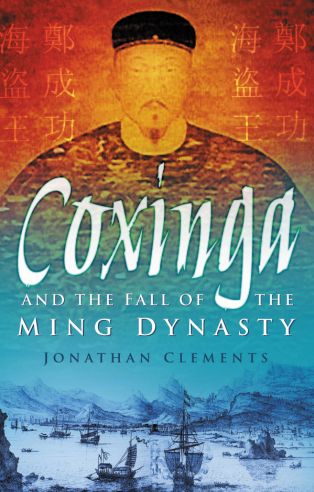
Throwing stuff in a suitcase for tomorrow’s trip. I’m off to Taiwan for a week’s work on a National Geographic documentary about Coxinga. We shot some footage in London a year ago, but this is the big one: much delayed, much rescheduled, but finally we’re off to the place he made his home.
There’s some historical consultant stuff to do for the re-enactment scenes, and then I am a talking head, discussing my long-standing interest in the man otherwise known as Zheng Chenggong, the leader of the resistance against the Manchu conquerors of China. His father was a former smuggler who became one of the richest men in the 17th century world, and an admiral in the dying days of the Ming dynasty. Coxinga was the half-Japanese son, raised as a Confucian scholar, groomed for a quiet existence as a minister, who was barely 20 years old when the Manchu invasion of China turned his world upside down.
Coxinga and the Fall of the Ming Dynasty was the first history book I wrote, back in 2003. When I first pitched it to my agent, she had to ask twice whether it was fact or fiction – the story is that fantastic. But his life has obsessed for even longer than that – I first wrote about him in 1992, as part of a course on “Pre-Modern Japanese Foreign Relations” that I took at university in Japan. So you could say it’s taken 18 years to get to this point. And there are still stories to tell about him, so many stories…
On 4th June, the Japanese will be releasing the DVD and Blu-Ray versions of the anime Yamato Resurrection, an announcement accompanied by excitable trilling about the on-disc extras. This was because the animators made two different endings, and left it to a focus group of 4000 viewers to vote for the one that was used. This is not a problem peculiar to Japan, but endemic in a medium that constantly tries to place a statistical value on creativity itself. I’m just saying, nobody needed a focus group to make Casablanca. Although if they had, Rick’s Café would be owned by a werewolf, and “As Time Goes By” would have been sung by Jay-Z and the cast of the Muppets.
The Writers Guild has a slogan that it likes to push at the public: “Somebody Wrote That.” Their point is that writing isn’t just what people say on screen. It’s the things you see. When Asuka Langley’s Eva unit picks up an entire battleship in End of Evangelion, somebody wrote that. When Ponyo’s mother rises out of the sea like a sentient tsunami, somebody wrote that. When the lead character in Dante’s Inferno crawls up a devil dog’s bum… er… I guess somebody wrote that, too.
But somebody made a decision. Who lives, who dies, who falls in love, these are questions in the hands of the author. I’m sick of recuts and reworkings and resprays, as if everything I pay money for is only a work in progress. Modern television tries to sell me rehearsals and auditions in place of performance. Modern movies increasingly ask me to fill in plot holes or write my own ending. I do that for a living. And I can do it at home without buying a cinema ticket.
Here we are again, back in the world of fan-pandering. Decisions like the dual ending of Yamato Resurrection play to modern youth’s love of interactivity and gaming, and the notion that decisions are made by the people who show up. Even if the people who show up are a bunch of giggling morons who will love anything as long as there’s a pretty vampire boy in it with a talking ocelot. Will it turn out soon that “nobody wrote that”?
I don’t want democracy at the movies. I want to see a writer’s creative vision, not mob rule by whoever showed up at a particular cinema several months ago. If I’m not paying the creators to use their expertise, why am I paying them at all? Democracy is me voting with my wallet, not discovering that the creatives named on the poster actually left it to 4000 strangers to decide how their film should end. It’s an abrogation of authorial responsibility – a sneaky, pre-emptive strike against bad reviews, as the answer is sure to be: “Well, that’s what you wanted.” If this film sucks, it’s the fans who will get the blame. And if it’s a success… well, write your own ending.
(This article first appeared in NEO #70, 2010)
Robotech producer Carl Macek, who died of a heart attack on Saturday, was a divisive figure in anime fandom. If it ever hurt him, it was because he rejected the premise that he was not part of it himself. To his own mind, he was as big an anime fan as anybody else, someone who had put his career on the line to bring Japanese cartoons to America. He was the anime business’s inconvenient truth, the man who shrugged with a smile and said that it was fine if you wanted to make your show that way, although you’d only sell 300 copies. But if you did it his way, you’d sell half a million, and then he could give you the money to do whatever you wanted. He was the man who looked at a crucial scene in My Neighbor Totoro, and noticed that a next-stop sign was in Japanese, and hence unreadable to the new target audience of American children…
Years of arguing at conventions had given him a facetious catch-all slogan: “All anime is dubbed”. He meant that all anime is put together as a compromise, between producers’ odd peccadilloes, and directors’ priorities, animators’ talents and accountants’ possibilities. To Carl, a finished cartoon was still raw creative material, ethnocentrically compromised, in need of refashioning and (his word) finessing to fit the available confines of domestic media. He worked with what he had, both in terms of the anime itself, and the needs of the market for which he repurposed it. On My Neighbor Totoro, he added a line to the script, because the Catbus needed to tell its passengers where it was going.
Art was never finished, only abandoned, and Carl’s conscience was clear about what he did with it afterward. In a recurring irony, his work would often turn people into anime fans, who would then decide they hated him. We spent a weekend in each other’s company when he came to London for an awful media event. He hung around on the Anime UK stand where we were shilling for Beast Warriors, and called me “a born salesman”, which, from him, was a high compliment indeed. The subject came up of a new anime company on the block, and he accurately predicted its demise to the nearest week, based not on the quality of releases, but on flaws in its relationships with distributors and licensors. He didn’t need to see the figures, he only needed to spend ten minutes with the company director. That’s what was so great about Carl, he was usually right. That’s what was so terrible about Carl, he was usually right.
It was impossible not to like Carl. Even if you didn’t like his work (and I was often scathing), you’d find he was just as critical about it himself. He had us in stitches with his account of the goings-on behind the scenes on Saber Rider and the Star Sheriffs, encouraging me to start writing about anime as an industry in constant crisis, where art was not so much completed as salvaged from a vortex of chaos. It was in the weeks after meeting Carl that I wrote the first irreverent columns that would become Schoolgirl Milky Crisis.
His was a science of the possible, and the decisions he took over translating (or not translating) anime made him notorious in the anime world. But it made him successful in the film world, where he was even more at home. If you didn’t meet Carl, the chance is gone. But only three months before he died, he recorded a long interview with Anime News Network that perfectly captured his energy, his humour, and his indelible position in anime history. There is no better tribute to him.
In the first American dub of My Neighbor Totoro, he was the voice of the Catbus.

From A Brief History of the Samurai, by Jonathan Clements — out now in the UK, and in the US in May. I love this passage because nobody knows what an ?yumi was. The historian in me says “crossbow”. The science fiction author says “giant robot.”
—
One casualty of Japanese warfare [in the 9th century AD] was the ?yumi or crossbow. Seemingly imported from China, the crossbow existed in several variant forms, and was in use as both an infantry weapon and as an artillery piece. In this latter form, installed on mountings on castle walls like the Roman ballista, crossbows appear to have been formidable weapons, highly prized by generals. The presence of an ?yumi at a Tsushima watchtower seems to have been such a grand prospect that the weapon’s name was eventually assigned to the town where it was based.
However, the ?yumi is also something of a mystery. When they were commonplace, nobody thought to draw them or describe their construction – ?yumi were simply used in battles and regularly reported to devastate enemy lines. If they came into Japanese hands during the Korean wars, their intricate manufacture and maintenance was only sustainable for a few generations. As the Korean and Chinese military advisers faded into the local population, the number of competent operators or mechanics dropped off. By the ninth century, ?yumi were still reported in district armouries, but rarely mentioned on the battlefield. Instead, district commanders griped about the cost of maintenance, or filed plaintive reports with the court, requesting instructors be sent to teach their men how to use the legendary weapons.
The weapons show up in Tsushima, close to the mainland, and also in border forts in the wilder frontier of the northeast – yet even there they appear to have swiftly degraded, their triggers jamming or sights left uncalibrated. Whatever an ?yumi was, its delicate mechanism, expensive springs and bowstrings became harder to replace. By 914, a general described the few remaining crossbows as ‘empty nostalgia’, gathering dust in local armouries, entirely beyond the comprehension of local troops. A few large-scale versions persevered in northern forts, but no extant examples survive for modern investigators to assess.
It probably did not help the crossbow’s fortune that it seemed primarily designed for defence rather than attack, in an age when relatively few battles on Japanese soil were fought under siege conditions. As decades passed with no sign of the much-awaited invaders, the crossbows fell into disrepair.
Nor should we discount the influence of a form of martial snobbery among the Japanese. The acceptable face of martial valour, throughout the history of the samurai, required great achievements in swordsmanship and archery – both skills that required long years of training. The crossbow, like the arquebus many centuries later, may have been seen as an unwelcome equalizer, operable by any conscript, but sufficient to turn such a man into the nemesis of any samurai standing in his line of sight. There is an intriguing class-based dilemma about the fate of the crossbow – it required a skilled artisan to manufacture, and the wealth of an aristocrat to maintain, but was liable to be crewed by lowly border guards. Despite its high-tech allure, it seems to have been shunned by the samurai, who saw no glamour or glory in its use.

It’s ten o’clock in the morning, on a rain-washed street in London’s Soho district. The clubs are dark and closed. The Thai Cottage restaurant won’t open until lunchtime. The coffee shop on the corner sells early morning caffeine shots. Yes, for the London media set, this is early morning. This isn’t the up-with-the-lark early birdism of sunny California. In media London, nobody’s at their desks before ten. They’re all out late at night partying, sorry, having meetings in popular local venues. And then the next day they sidle into the office after the rush hour is over.
I am the only one standing outside the screening rooms. This isn’t your afternoon or evening Event, with nibbles and wine and smiling marketing girls. An earnest, dapper Japanese man, still on Tokyo time, hands me a single glossy card about Schoolgirl Milky Crisis: The Movie. He has a stack of twenty. The cinema seats maybe fifty, in plush super-luxury.
Another five people arrive. They are young and bored. None of them really wants to be here. They are the newest workers in their respective offices, dumped with the worst of the pre-MIP tasks – watching a Japanese cartoon at ten in the morning.
All the real action will happen in France, at the Cannes MIPCOM fair. That’s where the buyers from the distributors are being wined and dined by the distributors. That’s where the goodie bags and perks are. That’s where people are splashing out on lunch. That’s where, in a week’s time, the higher-ups will be living it up. But before the movie world converges on France, there’s the pre-MIP screenings.
Nobody has time to watch movies in Cannes! They’re too busy being “entertained”. So the week before, they send out the expendable soldiers to catch film after film at special screenings, so they can turn up in France knowing what they want. Or rather, what they don’t want.
If a film is really huge, if it really has buzz and momentum and Tom Cruise, then you don’t need to revise for it on a wet April morning. These screenings are for the wallflowers – the ones that didn’t get invited to the ball. And yes, that usually means the Japanese cartoons.
Pro audiences are the worst in the world. Within 20 minutes, I am alone in the cinema. The others waited just long enough to make sure this wasn’t another Paprika, another Akira, another Howl. As soon as they confirm it isn’t, there’s no need for them to stay. They don’t want it. They walk straight out without a backward glance. They will write a single line email to their boss, and that’s another meeting he won’t be taking in France.
I stay to the end. I’m only here because I was genuinely interested in seeing the film. The Japanese exhibitor grabs me outside.
“You’re Jonathan Clements,” he says.
I ask him how he knows.
“You stayed to the end,” he says with a sad smile. “And you laughed at the Kurosawa joke.”
He stacks his remaining cards and looks at his watch. He knows who I am. Which means he knows I don’t actually have anyone to report to. Nobody’s buying Schoolgirl Milky Crisis, not today.
(This article first appeared in Newtype USA, November 2007 and was reprinted in the collection Schoolgirl Milky Crisis).
 A little namecheck for Empress Wu in today’s Guardian: “Wu Zetian makes Lady Macbeth look like a pussycat, filled from crown to toe, chock-full of direst cruelty, and then some.”
Rather odd that the article would appear in a series called “Great Dynasties of the World”, though, since Wu‘s Zhou dynasty began and ended with her, and was arguably little more than an elaborate filibuster to keep out *real* usurpers. Surely the Tang dynasty that both preceded and followed it would be a better candidate for true greatness?
Because the song translations I did for Pioneer were for the music division, not the anime division, they covered theme songs from other companies, too. That is the only possible explanation for Pioneer’s decision to hire me to work in 1997 on lyrics for the mad hair-metal theme to Fist of the North Star “Ai o Torimodose”. I did the best I could… and you thought Schoolgirl Milky Crisis was weird.
—
Shock of love! When heaven sent you it was just the start
Shock of love! Stopped me in my tracks, now you’ve got my heart
Burning fever binds me waiting for my love to find me
But now I’m giving it my all
None can stop my anger, I just point my little finger and down
They all fall
Shock of love! Just one look at you, heartbeat’s getting fast
Shock of love! Me and you as one, and it’s gonna last
Now my heart is burning with the madness they call yearning
To find the place where you’re hiding
I can’t live without you, fight the cruel thoughts that doubt you, I’ll do
Anything
Now you’re far away, a quest to save our love, and I’m here waiting for you
Tomorrow’s gone, until you bring the key
Never can forget your pretty smiling face, for I know your heart is true
Bring my love right back to me*
Shock of love! Shining light upon the shadows in my mind
Shock of love! Just the thought of you, and my thoughts unwind
When we’re back together, promise it will be forever and then
Take me in your arms
I will hold you to me and nobody’s gonna free me again
From your charms
repeat *
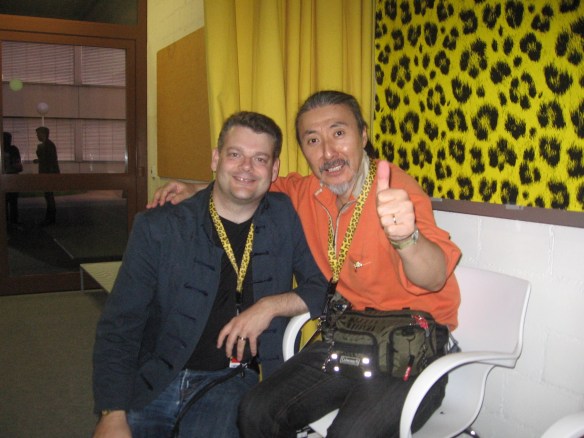
With his ponytail and khaki vest, Ichiro Itano looks like a rock star. The man who once strapped fifty fireworks to his motorbike to “see what would happen”, who once had a part-time job playing the Masked Rider in a department store theatre, is also one of the best animation action directors in the business. He taught for four years at the Yoyogi Animation College, and now he’s facing down a class of eager students in Switzerland, demonstrating how to use wide angle lenses, how to shoot moving vehicles, and how to block a cavalry charge against Chinese soldiers. All things that come in handy for the director of Angel Cop, Blassreiter and Gantz.
Someone asks about authenticity in animation, and his eyes light up mischievously.
“Let me put it like this,” he says. “There’s this flight school in America run by retired air force pilots. They’ll give you one lesson in really fast English, and one safety demonstration, and then they’ll take you up to 10,000 metres. You have a co-pilot, but he leaves it to you once you’re up. So it was me and Shoji Kawamori, in jets, ready for a dogfight. All as part of the research for Macross Plus. I wanted to know what it was like to fly a plane, to be in aerial combat, and I was curious about G-force.
“Each plane had a laser pointer, and if you could keep the enemy in your sights for three seconds, you scored a hit. So we started the dogfight, chasing our tails. I scored six hits on Kawamori. He was all over the place, but I was really good!
“So after all that, I decided: ‘I’ve done the dogfight. Let’s faint.’ So I grabbed the joystick and pulled right back on it. I heard the pilot shouting ‘Itano! Itano-san! Mr Itano! NO! Stop!’ and the G-force pushed me back in the seat. I felt my head lolling and then there was black. I’d blacked out, and it was like someone had pulled the plug on a computer.
“After that, it was just like I was rebooting. There was like static, and images, and the realisation that I was… wait… in a plane? Why am I in a plane? Why is there an American slapping my face…? Where am I… wha-? And then BANG, I’m back, after a minute unconscious, my head spinning as the co-pilot brought the plane down to land.
“I stumbled out of the cockpit and down the ladder, and then I threw up.
“Afterwards, everybody went to lunch. But the producer from Bandai took me off into a corner and just gave me a coffee, some paper and a pencil.
“He said: ‘No lunch for you. You might drop dead at any moment. First, you must draw the storyboards of a blackout.’
“So I sat there and drew the storyboards for the sequence in Macross Plus where a pilot blacks out. And that’s what we call authenticity.”
(This article first appeared in NEO magazine #69, 2010)

