Nothing describes the Chinese transition into capitalism quite as well as the Beijing Olympic mascots. Five little critters swarm all over the Beijing merchandise, in a move that guarantees a Pokémon style supermarket sweep for any parents at the games. Oh yes, you’ll have to catch ’em all, and since there are five of them, that’s five times the foreign currency for Beijing. Behind the scenes, the multiple mascots might have been intended to prevent any single Chinese region from speaking for the whole. You can’t have just a panda, as that only means Sichuan to the Chinese. Can’t have just a swallow, as that’s the symbolic bird of the Beijing region. A fish is too Shanghainese. What about a big red personification of the Olympic flame? What about a politically-sensitive Tibetan antelope? What about all of the above, darting across the merchandise like a squad of colour-coded Power Rangers.
Continue reading
Kung Fu Schoolgirls
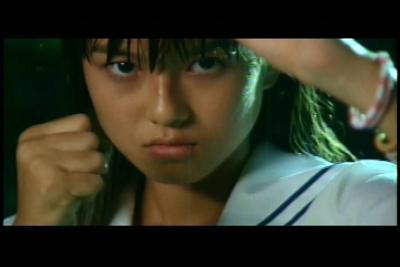
Anime schoolgirls are a distinctive breed. Lithe and long-limbed, these sailor-suited sirens are prone to demonic possession, often found with magical powers, and quite likely to be martial artists. Any resemblance to real-Japanese teenagers is purely coincidental. But then again, once in a while someone in the live-action world will wonder – just how difficult would it be to try this kind of story with real girls…?
Ever since she was bullied as a child, Mann (Jun Matsuda) has nurtured her own natural abilities in the martial arts. A few years of living abroad in Hong Kong and Thailand have allowed her to hone her skills in kickboxing, which come in handy on the tough streets of Shinjuku. Well, there’s tough and there’s tough. The bars and accessory shops are hardly mean streets, but it’s still the home turf of gangs of sailor-suited schoolgirls, and they’re fighting over their territory.
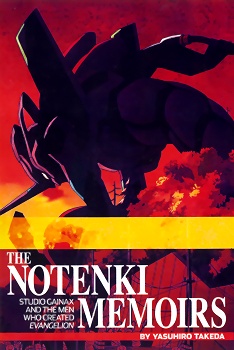
The Notenki Memoirs
It’s hard not to like Yasuhiro Takeda, the hapless nuclear physics student who repeated his second year at university five times before giving up. His reason, the passion for sci-fi that led him to run conventions, sell model kits, and eventually become General Manager and Producer for the Gainax company. This textual autobiography takes him from his failed student days, through his time as fanboy and amateur actor, right through the tax evasion calamity that dogged Gainax in the wake of Evangelion.
Meet the Parents
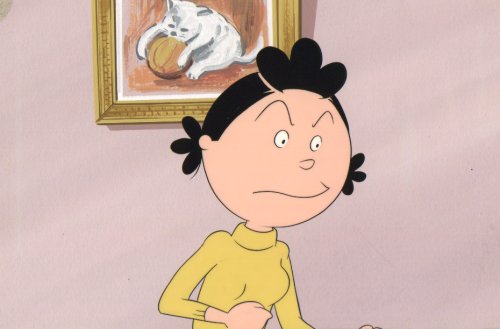
In the movies, life is planned out for you. You meet someone special, you fall in love, and then you live happily ever after. But while you might be able to choose the love of your life, you don’t have so much luck with their family. And in Japan, there’s less likelihood that you’ll be sharing a love-nest for two than moving in with your new in-laws. In manga and live-action drama, the Cinderella story often does not begin until after the wedding, when our pretty young heroine gets the man of her dreams, only to find herself an unpaid slave to a vindictive mother-in-law. This is the ever-growing dramatic genre of “in-law appeasement,” likely to expand further as Japan’s population grows and house prices soar ever higher – and The Curse is one of its more famous examples.
Continue reading
Lost in Translation
The top ten reasons why anime are “lost in translation”…
10: Lip Sync and Line Length
Lip Synchronisation, known in America as “fitting the flaps”, is a means of ensuring that the sound of the words being spoken matched the lip movements of the onscreen speaker. This can often lead to the addition of words on the spur of the moment in the dubbing studio – in erotic horror like Return of the Overfiend, this usually means the use of the F-word as a bonus adverb, adjective and noun! Subtitles normally suffer from the opposite problem – the deletion of parts of a script in order to make the lines fit a pre-determined length. Subtitlers must take into account not only the meaning of the line, but the reading speed of the average viewer…
Nebulous Achievements
It’s sweet of the Science Fiction and Fantasy Writers of America (SFWA) to award a Best Script Nebula to Howl’s Moving Castle, but hopefully the anime community will take it for what it is – a very belated recognition of a supreme talent. In my opinion, Howl is nowhere near Miyazaki at his best; it often plays like a committee’s attempt to reverse-engineer his greatest achievements. It’s more likely that Howl gets its award for being cosily familiar to the voters – one of those weird Japanese cartoons, but based on a book by an English-speaking author, and directed by that nice old man who made all those great movies in the 1990s that the voters mainly ignored. It is notable that the only anime to previously get a nomination from the SFWA were Princess Mononoke, which had Neil Gaiman credited for the script adaptation, and the subsequent Spirited Away, whose Oscar victory was inescapable. It is also notable that a large number of the SFWA voters are in Japan this month at the Yokohama Worldcon – perhaps they were booking their flights at the same time as they filled their ballots, and figured it couldn’t hurt.
Continue reading
Remastering
The idea behind a remake is based on the cold calculations of accountants. It’s known that half of the audience for Story X will come back to check out a sequel. That means, if Story X did big enough business, it’s worth knocking out a follow-up, just to grab the money. Hollywood is the most notorious offender of course, cranking out unnecessary sequels in which we get Another This, Son of That and Revenge of the Other. Manga do it, too. Sports stories take their heroes to the next championship level, martial arts stories bring on new opponents, and girls’ romances find a handy way to split up the lovers once more. In the case of Ironfist Chinmi, creator Takeshi Maekawa simply started renumbering the books – he declared that volume 36 of the old Chinmi was actually volume one of the “New Chinmi”, thereby hoping to attract new readers, even thought the story simply went on as before.
Continue reading
The Phantom Menace
We lived together for two years, I’ve known him for ten, he’s in his forties, and he’s never been interested in Japanese cartoons. Which was why I fell off my chair when a friend confessed to buying some anime last month.
Continue reading
Trading in Insults
A call came in from the editor of the script book of Serenity, the movie spin-off from Joss Whedon’s Firefly. In which, you may recall, people swear in Chinese.
“We’re just doing the back cover,” he said, “and we wondered if you could write us a Chinese slogan: ‘If you do not buy this book, your associates will consider you to be a stupid inbred sack of meat.’”
Taxing Time

Another tax-year gone, and I’m stuck with a bucket of receipts. The usual deduction issues ensue – are contract killers a reliable contract-enforcement expense? If I had fun watching an anime, can I still call it work? When I buy a copy of Golgo 13, it’s for work purposes only. It’s not like I enjoy it.
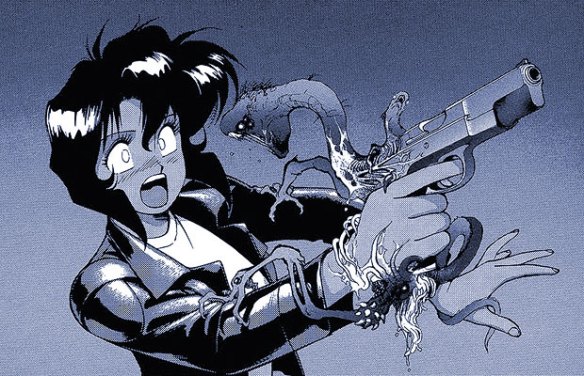
Anime companies have the same problems with media accounting. If a director has a packet of peanuts, is that ‘entertainment’ or ‘subsistence’? But there are perks, largely tied up in the sector of anime shows that take place outside Japan. There’s nothing an anime crew likes more than a roké-han, a ‘location hunt’, otherwise known as the thinly disguised staff holiday. No works outing to Grimsby for Japanese animators – imagine the misery of the Gunsmith Cats crew when they were all carted off to Chicago to drive fast cars and play with guns. They even filmed it as part of the Making of documentary. You see, they told the tax man, it was research.
Once you get your head around the accounting complexities of office perks, some of anime’s weirder moments make more sense. In Detonator Orgun, the invading alien robot action grinds to a halt for a whole minute while the female lead explains that she’s driving a replica of a 1963 E-type Jaguar. Pause for loving pans across the car’s flanks, zooms on its upholstery, and general auto porn. Well, someone had to get hold of a Jaguar for research purposes, didn’t they? And after that, they’d damn well better use it or face a tribunal. Does this mean that if I write about a date with a voice actress, I can claim for it on expenses? I asked my accountant if a dirty weekend could ever be tax deductible.
“Only if it’s with me,” he said, somewhat creepily.
Jonathan Clements is the author of Schoolgirl Milky Crisis: Adventures in the Anime and Manga Trade. this article previously appeared in NEO #6, 2005.