
 Mika Kaurismäki’s latest film, Tyttökuningas uses a deliberately counter-intuitive coinage in Finnish, directly translatable as “The Girl King.” Like Empress Wu and Queen Hatshepsut, the titular monarch was a woman who sought the recognition and power of a man in a man’s world. In the case of Queen Christina of Sweden (1626-89) the terminology is truly apt – she was the sole heir of a doomed king desperate for a son, inheriting her father’s throne as a child, and, it seems, never quite growing up.
The movie is an earnest Europudding from multiple funding bodies – based on a French-Canadian play about a Swedish queen, but shot in Finland with Turku Castle and environs standing in for Stockholm. The Finnish connection eludes many international viewers, but is entirely apt; at the time that Christina took the throne, Finland formed the eastern marches of the Swedish empire. Christina was, indeed, also the Queen of Finland, and the Finnish republic remains peculiarly obsessed with Swedish royals.
 Michel Marc Bouchard’s script, based on his own 2012 stage play Christine: la reine garçon, makes much of Christina’s intellectual aspirations, depicting her as a crazy bibliomaniac, authorising the invasion of Czechoslovakia to get her hands on the king’s library (many books from which turn out to be in languages nobody can read), and frotting her girlfriend on the open pages of the stolen Codex Gigas or Devil’s Bible. In her own eyes she is a proud iconoclast, defying the old order represented by her chief minister, and scattering Enlightenment like fairy dust. In this mode, she pompously bestows china plates and wine glasses on the hidebound Swedish court, which she thinks is enough to qualify as a “revolution”, and pouts when she is not allowed to read books by Catholics.
Malin Buska smoulders persuasively in the title role, playing the clueless virgin queen as an occasionally saucy but usually baffled teenager with a winning lopsided smile. But if the film belongs to anyone, it’s the impotent menfolk who tut and wring their hands at the side lines. There is, to be sure, an argument that Christina’s mad life is best presented as a tragi-comedy, and the only moment that drew universal laughter in the Finnish cinema where I saw the film was the scene where Count Axel Oxenstierna (Michael Nyqvist) hems and haws and gamely tries to mansplain that “women’s friendships are different.” It’s Oxenstierna who shoulders the burden of running the country through his queen’s minority, and who begs her to do her duty, marry and get pregnant… and when she’s not up for that, to just try to be sane and not do anything daft like switch religious faiths at a time of political crisis.
True to any good historical movie, Kaurismäki and Bouchard do not rewrite the facts, although they do try and present them as best they can. A protagonist who does not change is a villain, not a hero, and the film struggles, as do historians and previous scenarists, to present Christina in any light other than that of a spoiled brat, impossibly deluded, drunk on power but shirking any sense of responsibility. She dresses in a tight, swashbuckling get-up, the first indicator of her androgynous personality, but then trips lightly around the castle balustrade pretending to be a pony: a far more evocative depiction of her infantile nature.
 Initially, the story of Queen Christina must look like a dream come true for the queer film lobby: a European princess, raised as a boy, who falls in love with her lady in waiting and rails against the stuffy patriarchy! What a trailblazer she must have been… what a modern dash she must have cut among the dour Swedes. Except, no. The more one knows about the historical Christina, the more one cringes in embarrassment for any interest group that might dare to claim her. She has been depicted before in multiple media, including several operas, as well as the 1901 August Strindberg play Kristina, itself a source for the 1933 Greta Garbo costume drama Queen Christina. Garbo’s version pushed for an unlikely heterosexual resolution to her story, as did The Abdication (1974), in which Liv Ullman plays an older Christina, living in the Vatican and lusting after a cardinal.
There is, admittedly, some pleading of mitigation. Zachris Topelius, that great Finnish chronicler of the country’s Swedish past, wrote in his Stjärnornas Kungabarn of the similarities between Christina and her famous father King Gustav II Adolf, suggesting that her true misfortune was to inherit the hot temper and violent mood-swings that served him well on the battlefield, but which were deemed unwelcome in a regal daughter. Similar arguments are obliquely referenced in the film, particularly in an opening sequence which whisks through Christina’s awful childhood in thrall to a bonkers mother, who demands that she kiss her father’s putrefying corpse every evening, and who is later accused of having attempted to murder her. As the troubled dowager Maria Eleonora, Martina Gedeck periodically returns to chew the scenery, increasingly resembling a swivel-eyed Vivian Westwood, attended by an orbiting cloud of fops and dandies like a periodic pitch invasion by the cast of a Fellini film.
The script also pleads for the incipient intelligence of the young Christina. By the time she takes the throne in her teens, however, the bright, questioning girl of the early scenes has become a mercurial despot, unheeding of the advice of her ministers and generals, and promulgating a bipolar foreign policy that swings between hand-holding kumbayah internationalism and devious double-crosses. As her loyal subject Johan (Lucas Bryant) angrily berates her at one point, there is a human cost to every one of her decisions, and it is paid in the deaths and misery of others.
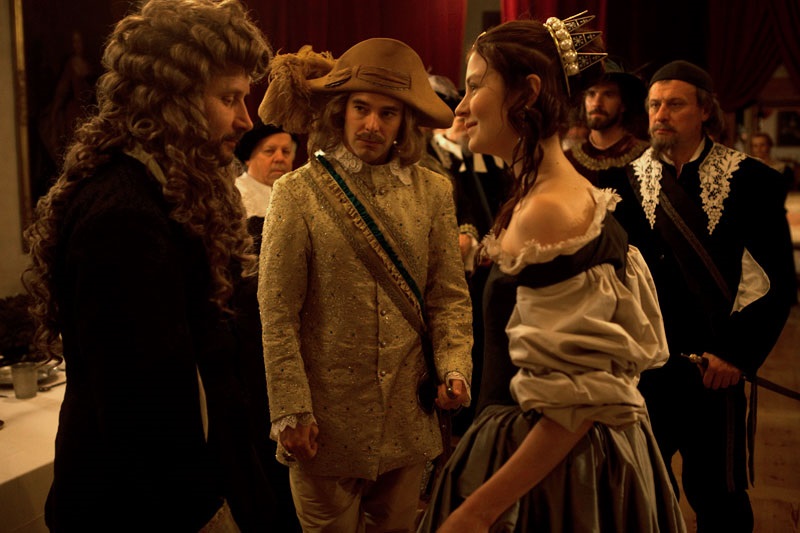 There is an attempt in the closing scenes to present her abdication as a great self-empowerment, or the realisation of her True Self as some sort of wandering swordswoman. But there is also some sense remaining that this capricious termagant has skipped away from the burning wreckage of an entire kingdom, leaving broken treaties in her wake and a vast, costly expansion of the nobility, which someone else has to pay for. Queen Christina clung desperately to the trappings of royal power, even as she spurned any of the duties that it brought.
Christina is a privileged, predatory idiot when seducing her handmaiden Ebba (Sara Gadon), commanding her into bed and forcing herself upon her, only to realise that she has no idea what she should do next – a fitting metaphor for her entire life. And in the grand finale, as in the historical record, she marches smugly from the throne room, having dumped the crown on her cousin, riding not quite into the sunset, but into the Alps. A closing title reveals that she died in Italy as the centre of a great salon of intellectual debate, and understandably neglects to mention her pathetic return to Sweden in 1660, when she demanded the return of her crown and was sent packing by an establishment that was glad to be rid of her.
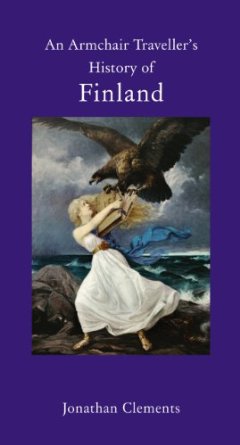
Jonathan Clements is the author of An Armchair Traveller’s History of Finland, available now in print and on the Kindle (UK/US).





 Finnish online magazine
  At long last, my biography of Mannerheim is out
