Category Archives: News
The Shadow Staff
In the new issue of Animation: An Interdisciplinary Journal:
Despite the attention paid by Japanese animation historians to cartoon propaganda films made during the Second World War, twice as much animation may have been produced in the period for military instructional films. These films, now lost, were made by a group of animators seconded to the Tōhō Aviation Education Materials Production Office (Tōhō Kōkū Kyōiku Shiryō Seisaku-sho). Occasionally running for five or six reels (c. 48 minutes), and in one case consisting of a feature-length eight reels, they form the missing link between the one- and two-reel shorts of the 1930s and Japanese animation’s first feature, Momotarō Umi no Shinpei (1945, Momotarō’s Divine Sea Warriors). The films included tactical tips for the pilots who would bomb Pearl Harbor, short courses in identifying enemy ships, and an introduction to combat protocols for aircraft carrier personnel. This article reconstructs the content and achievement of the Shadow Staff from available materials, and considers its exclusion from (and restoration to) narratives of the Japanese animation industry.
Booth Usher
“Hello, tech support.”
“Hello, this is the Ibaraki Film House here. We’re having trouble getting the film to play.”
“Have you tried turning it off and on again?”
“It’s not a digital film. It’s a film film.”
“Oh, right. Don’t you have a projectionist there?”
“What’s a projectionist?”
“A projectionist is the person who receives the cans of film, counts them, splices them if necessary, loads them on the plate, unspools back into 2000 foot reels…”
“What’s a reel?”
“…replaces the bulbs if they go out. Checks for dust.”
“How do you get dust on a film?”
“Well, in the case of Macross Plus, someone actually used one of the canisters as an ash tray for a few weeks. That didn’t help. So have you got a projectionist?”
“You must mean Ken the Booth Usher?”
“What’s a Booth Usher.”
“Well, he’s the guy who makes the film start, you know.”
“Aha! So he must be your projectionist.”
“Well, he serves popcorn and hotdogs… and then when it’s time for the film to start he…”
“Goes into the back room and presses Play?”
“Er… Yes.”
“Okay, I think I see the problem. You see, you have what’s called a state-of-the-art cinema.”
“Yes we blimmin’ do.”
“And the trouble is, that a state-of-the-art cinema, in the eyes of many corporations, is simply a giant DVD player with a hotdog seller outside.”
“You say that like it’s a bad thing.”
“Well, it is if you are having a… are you having a film festival?”
“Yes, we are!”
“So you’re showing some old movies?”
“Some of them date back to the late nineties!”
“The 1890s?”
“No! The 1990s!”
“And let me guess, they’ve arrived in big round cans full of black plasticky stuff in long strips.”
“Yes! So can you tell us what we need to do. We can play DVD, Blu-ray, Digibeta, HDCAM, full-on digital…”
“Do you have a pen and paper? Okay, good. Write this down: ‘Invent time machine. Go back ten years. Remember to keep training projectionists.’”
Jonathan Clements is the author of Schoolgirl Milky Crisis: Adventures in the Anime and Manga Trade. This article first appeared in NEO #99, 2012.
"Master Sun says…"
In approaching a text in Classical Chinese, we must consider the immense differences between books and reading in our time and in that of the Art of War. There was, in ancient China, no such thing as our “book”. Classical Chinese was usually carved onto bamboo strips bound together with leather or string. Their physical appearance was closer to that of a modern rolling window blind than a “book”. One of the problems faced by modern archaeologists is the reconstruction of books from scattered fragments of bamboo – when the leather straps or connecting string decays, ancient Chinese books collapse into hundreds of scattered strips of unpaginated bamboo.
Many translators have overlooked the performance required from Classical Chinese texts. Classical Chinese is a literary language that often summarises the vernacular rather than directly quoting it. The meaning of Classical Chinese has to be unpacked and interpreted. We might consider the written Art of War less as Sun Tzu’s “book” than as his notes for a speech or for further discussion.
The first words of the text, repeated at the head of each chapter, are “Master Sun says.” Everything that follows is implied speech, delivered to an implied listener: a local king perhaps, or a group of officer cadets. This is surely the origin of many of the text’s apparent repetitions: not the meanderings of a forgetful author, but moments of call and response by a commanding orator. “This is how war is waged,” says Sun Tzu at various points, an antiphon to wake up the students at the back, just as he makes an important point. The reader is encouraged to read it out loud; it is often a text better heard than read.
While handmade copies certainly might circulate of the better known texts, the best way for a ruler to “read” Sun Tzu was to have Sun Tzu’s words spoken, in person, by Sun Tzu himself. It is such interactive performances, in which a monarch might question a philosopher during and after a reading of the philosopher’s work, that have generated the many conversations and interrogations that can often be found interpolating classical Chinese texts. There is the original, and then there are the conversations and responses inspired by the original, and then sometimes there is the revised manuscript incorporating such conversations, followed in later centuries by the annotations of others. In such a way, ancient Chinese books often bear a closer resemblance to academic working papers, and are less “published” than they are placed on a continuum of revisions and facsimiles.
From The Art of War: A New Translation by Jonathan Clements. Out now in the UK and the US.
Our New Frontier is a Nice Place
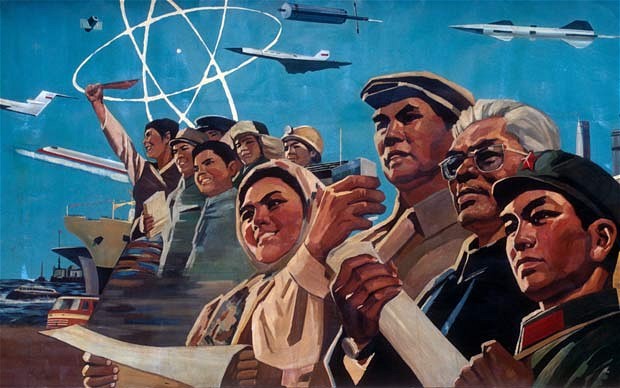
“Xinjiang Hao” is one of my favourite songs. It’s a propaganda ditty from the Mao era, which charmingly recites all the reasons that China’s “new” frontier is a wonderful place. There are run-downs of natural resources, and lists of local fruit and veg. There’s a chorus that always brings a tear to my eye: “Our beautiful fields and gardens, our beloved Home”, and an oddly plaintive, clingy refrain that seems to be actually begging the listener to visit. Here is a rather eurotastic version, featuring some sultry bimbling and a prancing idiot who appears to be trying to play his own leg as a musical instrument.
This is, largely, how Xinjiang looks whenever it’s mentioned on Chinese telly – joyful dances and graceful dark-haired beauties. Back in the time of Empress Wu, her adviser Judge Dee suggested that she steer clear of Asia’s arid heart, thereby leaving it to her enemies to waste their energies crossing its forbidding deserts before they reached her borders. But Wu, and subsequent Chinese rulers, expanded the realm far to the west along the Silk Road, exposing China’s flank to a long, modern, festering border with all those Central Asian republics we tend to lump together as “The Stans”.
The Tree That Bleeds: A Uighur Town on the Edge is a fast read. Despite its 350 pages, some of the chapters are only a paragraph long, although author Nick Holdstock has artfully imposed a seasonal and narrative structure over what clearly began as scattered diary entries from his time in the remote town of Yining. The result is a welcome addition to the English-speaking world’s small supply of books about Xinjiang, China’s landlocked new frontier and place of exile.
Holdstock’s book is unlikely to lead to a flood of tourist trips. Like Mannerheim before him (who was underwhelmed with the place), and Eric Tamm in Mannerheim’s footsteps, he describes a drab, dusty dump you’d have to be mad to visit, with nosy, snotty children, world-weary cab-drivers, and wheeler-dealers selling condemned blackcurrant juice. As for Things to Do, there’s always the cockfights, clamorous karaoke bars and pink-lit brothels. “Anyone wishing to launch a cultural pogrom in Yining,” Holdstock observes, “would be hampered by the shortage of targets.” There are none of Youtube’s pretty Uighur dancers here, nor much in the way of homespun shepherd wisdom. Instead, Holdstock finds squalid slums of crumbling concrete, apples that almost break his teeth, and a drunken, drugged-out population of no-hopers and spivs.
Arguably, one finds what one is looking for. Holdstock’s book is boldly formalist, discussing only what he sees and stumbles across. He doesn’t go out of his way to find natural beauty or local colour; instead he lets Xinjiang dig its own hole. Apologists and propagandists for Xinjiang describe lush green hills populated by gambolling sheep, glittering mosques, happily dancing natives (a recurring stereotype that clearly winds the locals up), and quaint folk traditions. But many foreign observers (well, so far in my reading, all of them) instead outline a tense, jumpy borderland in a permanent stand-off between restless native Uighurs and unwelcome Han colonists.
Holdstock is uncompromisingly even-handed in his treatment not only of the region, but of its contending interest groups of clueless bigots, smug religious fanatics and downtrodden peasantry. Irritated in equal parts by squabbling Muslim factions, undercover Christian missionaries and listless Chinese bureaucrats, Holdstock is a Canute-like figure, teaching English to students with little hope of escape, and railing against the jobsworths who won’t sell him a bus ticket.
He has an ear for the long silences and dispiriting platitudes of stilted intercultural conversations, but also for sudden, unsettling outpourings of emotion, when his Chinese colleagues feel they can open up, and he often wishes they hadn’t. The stir-crazy Holdstock grows so bored with frontier life that he actually looks forward to seeing a horse get butchered, and is frustrated even in this simple ‘pleasure’ by the interfering authorities.With comedic haplessness, he also embarks upon a grand enterprise to expose a kind of international espionage (I won’t spoil it), only to repeatedly shoot himself in the foot regarding contacts, evidence and subterfuge. That’s not to say a whole lot happens – this is not a plot-driven narrative – but it amply, and damningly conveys the loneliness and tedium that is surely a hazard of the job for many teachers, missionaries and diplomats in all the inhospitable corners of the world. If anyone had a romantic idea about Xinjiang (or China, or Cambodia, for that matter, where Holdstock winters for an interlude among stoners and paedos), The Tree That Bleeds tramples it in the dust.
Far too many books about China are tiresome travelogues by chinless Torquils on a gap year, or earnest, uncomprehending Lucindas who think that readers will find their baffled musings endearing. I grew weary long ago of reading about how Daddy’s money and Uncle Jeff’s friend in Hong Kong pulled this string or wangled that boondoggle, all so little Rupert could chortle in a Clapham gastropub about the larks he had in Kunming. I am, to put it bluntly, sick of books about China that brag of the author’s ignorance. But there is none of that with Holdstock, who comes to Xinjiang in the noble, monastic penury of a Voluntary Service Overseas contract, and crucially has served time already in Hunan, thus inoculating him against any large-scale culture shock. Ignorance for Holdstock is not a badge to wear in place of content, but an alluring, whispering shadow over his whole stay, as he attempts to find out exactly what happened in a series of riots (or demonstrations) that were suppressed before his arrival.
Residing in Yining at the time of the Twin Towers attacks, he is drily cynical about the Chinese government’s attitude towards local unrest. There apparently “wasn’t any” until 9/11, when the Bush administration made it fashionable to rebrand reprobates as terrorists. Suddenly, everyone is jumpy about al-Qaeda and the Taliban, whereas previously the Chinese have been diligently saying that all Xinjiang is good for is a sing-song. Holdstock never really finds the answers he is looking for, but The Tree That Bleeds is all about the questions anyway.
I would like to believe that The Tree That Bleeds is subjective and one-sided, despite overwhelming evidence to the contrary. Never having been to Xinjiang myself, I rely for my picture of it on the writings of others, who unanimously depict it as a miserable, god-forsaken place, ever since Marco Polo wrote of its howling winds and haunted sands. There are so few books about Xinjiang (go on, name five. I’ll wait…) that every new addition is welcome and Luath Press, a small Edinburgh outfit I’d never heard of before, is to be commended for taking a risk with Holdstock’s anti-travel book.
But Xinjiang can’t be as awful as he makes it sound… can it? Can it…? One day I shall find out for myself. Until then, I consider myself forewarned and forearmed.
The Tree That Bleeds: A Uighur Town on the Edge is out now from Luath Press.
China Syndrome
Uproar in Heaven, the “new” 3D film from the Shanghai Animation Studio, has a long pedigree. Based on the same Chinese legends that brought us Monkey, Dragon Ball and One Piece, it recycles Wan Laiming’s famous cartoon adaptation from the 1960s. And as a 3D cartoon, it’s a shot across the bows of the Japanese.
The statistics tell their own story. In 2000, there were only two animation courses being taught in Chinese higher education. By 2003, ninety-three, with 4,000 students. By 2007, 447 courses with 466,000 students. Meanwhile, Ryosuke Takahashi estimates that the entire Japanese staff of the Japanese animation business amounts to no more than 7,000 people.
So, maybe, the Chinese system is generating several anime industries’ worth of talent every year. Except if it is, where are they all? Clearly, not every graduate of the Chinese animation courses is working in animation, as otherwise we’d be up to our necks in Chinese cartoons already, not just a tentpole title like Uproar in Heaven. A good 12,000 of them are working in the ‘Japanese’ business, below-the-line on anime. A few dozen thousand more are working on American, French and other foreign cartoons. But that still leaves tens of thousands of animators, or people with animation ability.
However, what the figures don’t describe is the nature of the training. If it’s pushing a mouse around for a bit, that’s no guarantee that the next Miyazaki is sitting at a computer terminal somewhere in Shanghai. It’s noteworthy that the blockbuster Uproar in Heaven is an upscale of Wan Laiming’s original cartoon, made in 1961 and used here as reference footage for the 3D version. In other words, the artistry in the cartoon is 50 years old. I’m sure that in China this isn’t seen that way – far from it, leaning so heavily on a respected original is seen in a Confucian culture as a mark of great respect, and a marker of traditional values. Su Da’s Uproar in Heaven is a meticulous, superb restoration job that rejuvenates a classic, but elsewhere in the world, Uproar in Heaven risks being regarded as a prolonged exercise in glorified colouring-in. But it shows that those animation graduates are going somewhere… where are they going next and should Japan be worried?
Jonathan Clements is the author of Schoolgirl Milky Crisis: Adventures in the Anime and Manga Trade. This article first appeared in NEO #98, 2012.
Economies of Knowledge

Ten years ago, I was a presenter on a short-lived TV show called Saiko Exciting. It was a two-hour umbrella under which huddled pop videos, games reviews, and two anime tentpoles – Evangelion and Nadesico. Like many organisations, the Sci Fi channel had believed the hype about anime taking the world by storm, and was hence rather surprised when its anime-themed prime-time show failed to attract significantly high ratings.
So they called in a consultant.
He crunched the numbers and evaluated the footage, and delivered his report, which, as far as I could tell, amounted to a suggestion that life would be a lot easier if the channel threw out all that irritating anime crap… from their anime-themed prime-time show.
I am sure that he made other recommendations, too. One of which may well have been that the two young ladies were very easy on the eye, but perhaps that unsmiling nerd spouting anime statistics was best moved to a late-night slot where only anime fans would see him – certainly, that’s where I soon ended up. But the Unhelpful Consultant has always been something of a running gag ever since, particularly after similar encounters in my Manga Max days, with another boffin who recommended to Titan Magazines that the thing that was really holding the title back was all the stuff in it about manga.
I have had to think managerially a lot more these days. Since starting my own company in 2003, I have had to think more commercially about culture and the arts, and parse ideas in terms of monetisation, amortisation and other words I may have just made up. I have long been fascinated by the early 20th century management theorists – Taylor suggesting that workmen be given bigger shovels in order to move more stuff with each heft; the Gilbreths noting that it would really help if the employees were happy; and Mayo realising that he was getting particular answers because he was there asking questions. The Gantt organisational chart, pioneered during the First World War, was soon adopted in the 1920s by numerous industries, not the least animation, where it formed the basis of the ‘dope sheet’ used to plan productions to this day. If you work in a company of any significant size, someone has sat in a room with a Power Point presentation where someone lectures them about ‘hierarchies of needs’ or ‘aristocracies of the capable’, and it has knock-on effects on all sorts of things from where the coffee machine is to what time you start work in the morning.
After reading The World’s Newest Profession, I have come to regard consultants in a new light. Christopher McKenna’s book goes a long way towards explaining what management consultants actually do, beginning with the shop-floor ‘scientific management’ of the early 20th century, right through the corporate trouble-shooting of modern times. He chronicles the strange admixture of accountancy and engineering that distinguished the early consultants and shows them at work fixing companies all around the world by trumpeting new buzzwords and shaking things up a bit.
As readers of Schoolgirl Milky Crisis know, I often work as a consultant myself these days, as institutional memory or advising on storylines for media companies. And I like to think that people get their money’s worth. I remember once being sat in a room with a producer for a Thursday and Friday, hammering out the outline of a computer game. He went off home, and I spent the weekend typing it up. On the Monday, he had a 13,000-word story breakdown, with characters and assets. I mention this because it had been assessed at the company as a job that would have probably been possible to do in-house, but would have taken up nine man-months. Thanks to my freelancer’s blindness to weekends, he had it in two working days. This is what Christopher McKenna calls an ‘economy of knowledge’, wherein a company realises that despite the high cost (and I was not cheap), it will still work out cheaper to bring in outside expertise. It’s easy to see how that might work with writers and artists. It’s easy to see how it works in everyday life – after all, what is a hairdresser if not someone who can do it better than you, for the hour that you need her? The real trick with the management consultants of the 20th century is that they applied to managing itself – whatever your company does, however it works, they can come in and make it work better. Some companies were so sure of this that they even offered to work for nothing if their fee was not justified by the saving.
The World’s Newest Profession talks through numerous incidences of corporate intrigue and subterfuge over the last century, including the rise of NASA, which McKenna provocatively parses as a committee that sub-contracts almost everything to outsiders. He paints a picture of grim-faced men in grey flannel suits, deliberately designed to mark them out as serious players in any corporate face-off, whispering suggestions in the chairman’s ear for loopholes, tax havens and legal wriggles that can help a company shave the bottom line. Although is the profession really that ‘new’? – elements of McKenna’s narrative are uncannily similar to tales of Confucius and Sun Tzu.
Sometimes, management consultants are necessary in a corporate environment for speaking unwelcome truths. Nobody at Sci Fi was going to say that a prime-time anime show would never get a million viewers in a country of only 60 million people, with 100 other channels to choose from. Irritating though the consultant’s comments were, they seem in hindsight to be rather honest. Sci Fi didn’t ask him to fix their anime show; they asked him how to make more people watch their channel. And he pointed out, with unwelcome precision, that the ratings went down every time the anime came on.
That doesn’t tell you that anime is toxic. It tells you that the people who watched Sci Fi were not keen on anime. Someone producing an anime show was never going to like hearing that, but they got the answer they needed to hear. Of course, he would have been more useful to me if he’d offered advice on how to sell what we already had, rather than giving what was, to a certain extent, the easy answer, that we should be selling something else.
I am not sure who advised them to change their name to SyFy, though. Sometimes management consultancy really is just bollocks.
Jonathan Clements is the author of Anime: A History. The World’s Newest Profession: Management Consulting in the Twentieth Century is published by Cambridge University Press.
[Time travel footnote: eight years after writing this article, I know exactly why they changed the name to SyFy. Just as Sony deliberately mis-spelled Blu-ray, the switch to a term not already in common use meant it was possible to trademark and guarantee optimal tagging in social media.]
Kickstarted
Pity the poor anime pundit, busily making predictions about stuff that’s in the distant… I mean near… I mean tomorrow… I mean just happened. Only last month I was merrily giving an interview to Variety magazine, predicting crowd-sourced anime within the next two years. I was inspired by the sight of the Kickstarter funding for the manga of Osamu Tezuka’s Barbara, which swiftly rustled up the required ten grand. You could probably squeeze out a crappy anime video one-shot for $20,000, I mused, so what were the chances that someone decided to hit up forty wealthy fans for $500 each? It’s already what the Japanese charge for some DVD box sets, so why not?
Within a couple of weeks, San Francisco developer Double Fine announced that it had managed to scrape $480,000 to go into production on a new game, a “Double Fine Adventure”. That’s enough to make a 12-episode anime television series! If you really want to make an animated tentacle-invasion version of the Iron Lady, now all you need is to rustle up 10,000 like-minded friends.
Except! You don’t need to be a genius mathematician here to see that some of the Double Fine investors were putting in a lot more than the minimum $15. In fact, if there were 10,000 of them, their average investment was the price of a posh car, each! So this isn’t quite the grass roots investment funded solely by potential end-users that some are pretending it to be. There are still some big investors behind the scenes, but not many! Just think, what if you could write off the cost of a convention weekend and put it towards actually making an anime? And since there are stepped levels of involvement, you’d also be likely to score some exclusive, personalised merchandise, too, and your name on the credits. Beats standing around a car park dressed as an elf!
So, for now, my prediction still stands. I still see a crowd-funded anime production happening within the next two years [Time Travel Footnote: there was a wait of only eight months or so before this happened]. Probably a crowd-funded anime translation substantially sooner than that. But if you had a personal say in which new anime actually got made, which would you choose?
Jonathan Clements is the author of Schoolgirl Milky Crisis: Adventures in the Anime and Manga Trade. This article first appeared in NEO #97, 2012.
Eurovision Shouty I-Spy 2012
Hello, Woki Mit Deim Popo, and welcome to the Eurovision Shouty I-Spy Game, back for the first-ever final to be held in the immensely gay-friendly town of Baku.
Step One: you will probably need to be quite drunk. Step Two: The following sights will be seen during this Saturday’s Eurovision Song Contest. Can you see them first? Remember to shout it out. Party hosts will need to keep score of who gets what first, or otherwise dish out the forfeits to those that aren’t quick enough. As ever, there is more than one key change, and plenty of orbital cleavage. Keep your eyes (or ears) open for any of the following. And when you notice it, SHOUT IT OUT!
With great disappointment we have had to say farewell in the semi-finals to Montenegro’s fat rapper and his onstage Trojan horse, as well as the fantastically named Trackshittaz from Austria, with their neon knickers and pole dancing. We shall also miss the chance to shout “SPLITTER!” every time the Finnish entry opens her mouth and sings in Swedish. But that still leaves us with the best/worst Eurovision in years, with a bunch of certified mentalists bringing you the trancey, oddly cyberpunky fun. Occasionally dressed as refugees from Assassin’s Creed.
In no particular order, in Saturday’s final you should look out for:
Winking
Is it snowing?
Sergeant Pepper’s Epaulettes
One glove (doesn’t make you cool)
Hammer Time (sideways footy shuffle)
ACCORDION!
Cloaks!
Na-na-na-na-na-na-na-na
Onstage fountain
“SING WITH ME, MY CHILDREN!”
Rotating oven
La la la la la la la la la la la la la la la la
Instant boat!
KEY CHANGE! (every time you hear one)
Backflips
Blindfold
Oh no! An Oboe!
Very very small xylophone
Dancing onscreen rubber gimps
Bimbling*
Onstage baking
ORBITAL CLEAVAGE**
Men in skirts playing trumpets!
Muffins for everybody!
Assassin’s Creed on Keyboards
Blacksmith’s Apron
Bagpipes
Synchronised Swimming (without water)
Bronze tights
Breakdancing on plinths
Fingers make a heart
Hair stuck to her chest
Moonwalk (have to be fast to catch this one)
DRUM-SITTER (she’s sitting on a drum!)
FLAME ON! (every time there’s pyrotechnics)
We include our traditional category of COSTUME CHANGE, just in case someone actually changes costumes, although nobody did in rehearsals.
(*swaying one’s head from side to side in a snakey fashion. This is particularly difficult to spot this year, so I’ll give you an extra clue: SHIPBOARD BIMBLING).
(**ostentatious cleavage sufficient to see from a satellite in orbit, which, according to Eurovision bra consultant Tom Clancy, requires a minimum of C-cup).
Bonus item: A LITTLE BIT OF POLITICS
A point every time the presenters claim that Azerbaijan is in Europe.
Special bonus points all round if one of the acts decides to self-destruct on the night and inject some sort of live protest. Look out for rainbow flags or badges at the very least.
Are Armenia voting…? If they are, you can be sure someone says something cutting…
Apologies to American readers, who will have to just imagine what the world’s biggest, gayest song contest is like. Just imagine, for one day every year, Europe gets to behave the way that Japan does all the time!
For hard-core players, Shouty I-Spy is now available in Finnish.
Digital Disruption
My review of Iordanova and Cunningham’s Digital Disruption: Cinema Moves On-Line is up now on the Manga UK blog. It’s a very interesting walk through some of the issues facing “cinema” and “broadcasting”, in a globalised economy where nobody wants to pay for anything.
I particularly like the authors’ decision to eschew content, access and production, and to talk about matters of exhibition and distribution, which are all too often overlooked in film studies.