
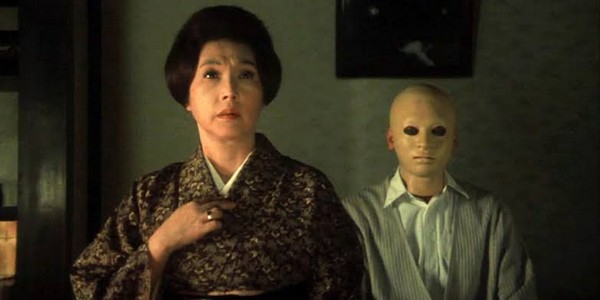
Producer Haruki Kadokawa also sneaked on-screen in his own film, playing a detective. In his memoir, My Struggle (2005) the flamboyant media mogul describes how as a twenty-something nepo-baby, handed the reins of his father’s publishing company, he decided to revive the fortunes of an obscure novelist whose works were falling out of print. Seishi Yokomizo, for it was he, had supposedly become so obscure that Kadokawa himself wrongly believed him to be dead, and was surprised when the novelist, very much alive, answered his own doorbell.
At the turn of the 1970s, Kadokawa began to create a Seishi Yokomizo brand, repackaging his novels for teenage readers. In Japanese, this involved stripping out some of the more complex characters, and adding furigana pronunciation guides, transforming them from 1950s throwbacks to what today might be more akin to “light novels.” This careful redaction took the Yokomizo detective novels out of the dusty stacks in libraries, and back in bookshops all over Japan, targeting a new generation.
Kadokawa was a firm proponent of what is now called the “media mix” – a synergy of multiple media in which each format became an advertisement for the other. His first Yokomizo reprint was The Village of Eight Graves (originally serialised 1949-51), not because it was the best, but because Shonen Magazine was running a manga adaptation by Go Nagai.
“Comics,” wrote Kadokawa sagely, “tend to be ahead of their time.” If the teens were devouring Yokomizo-based manga, he reasoned, then the time was right for a revival of the books. Kadokawa makes no mention of what was surely another huge influence on his decision – the high ratings for an American show about a similarly scruffy sleuth, Columbo (1968), which began running on Japanese television in 1972.
From my sleeve notes to the new Blu-ray box set of Kon Ichikawa’s Inugami films, coming soon in Australia from Umbrella Entertainment.

