Scumbag FTW

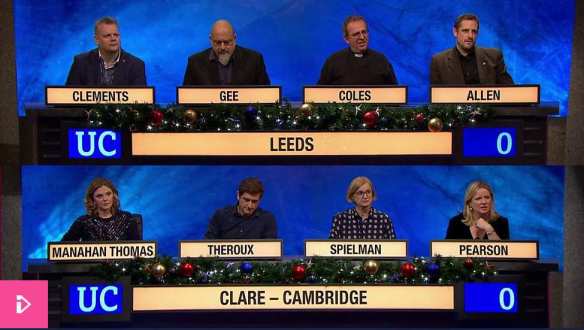
In case you can’t hear the fireworks (or possibly gunshots) in Beeston and the dancing in the fountains (or possibly a burst water main) in Headingley, the Leeds team just won the Christmas University Challenge final tonight, the first non-Oxbridge team to do so.

The people at ITV Studios (which as the former Granada, still packages University Challenge for the BBC) were incredibly grateful and solicitous for our participation, and kept restating that we “didn’t have to do this” and “were good sports.” I didn’t really understand such feather-stroking until I saw the opprobrium heaped upon our opponents in the first round. I don’t really have a reputation to lose, but some others risked ridicule if they weren’t on top academic form in what was only supposed to be a bit of seasonal fun.

I’ve heard some comments out there in the twittersphere both kvetching about certain gaps in knowledge, but also moaning that so many contestants were media types. But keeping your cool with six cameras and Jeremy Paxman in your face, in front of a live studio audience and remembering the nationality of a famous serial killer is no mean feat, and I suspect several of the contest’s less media-savvy contestants might have been too over-awed to press their buzzers. It takes a ridiculous degree of concentration to focus on an intricate question, and to weigh up the risk factors of buzzing too soon and getting it wrong, or waiting a fateful extra second in the hope that an opponent won’t jump in. You take to keeping one eye on Paxman and another on the rival team, so see if anyone’s shoulder looks about to twitch.

To be honest, Leeds were too dim to realise what was at stake. We only met each other on the day of recording, and unlike one rival team (who shall remain nameless), we had neither spent four weeks practising, nor presumptively bought a bottle of celebratory champagne on the way to the studio. It was only after winning the first round that we made any effort at planning, and even then that amounted to Tim Allen lying in the bath for an hour, listening to YouTube celebrity obits, just in case Andre Previn came up.

One lady, who shall also remain nameless, was so traumatised by her team’s defeat by Wadham College, Oxford, that she marched into the green room proclaiming: “Whoever wins the next round, I WANT YOU TO DESTROY THEM!” But Wadham turned out to be the friendliest of all the teams we went up against, particularly the affable Roger Mosey, who shook my hand and announced that the “best team had won”, and Tom Solomon, who even came along to our victory knees-up (and, I believe, took the photo at the top of this page).

And what do we get for our achievement…? Well, the eternal love and gratitude of the University of Leeds, I would hope. If 2% of the people who watch University Challenge bought just one of my books, I could pay off my mortgage, but looking at the sales figures this week, it looks like that only person who has been inspired to do so is TV’s Henry Gee, who is off to Japan this week with a copy of my Brief History under his arm. I guess that’s why they don’t bother to advertise books on the telly.

I’m sure I speak, too, for both Henry and Tim when I say that our thoughts tonight are with our captain Richard Coles, the night of whose triumph cruelly coincides with the funeral of his husband David, who died a few days after the final was recorded. Richard brought great joy to the studio, particularly when his frustrated “BOLLOCKS!” had to be redacted to avoid offending middle England, but also when he suggested that Vita Sackville-West should be played by Janette Krankie. I hope he finds the time to enjoy his victory, even as he mourns his loss.

Jeremy “Widow Twankie” Paxman didn’t like my Uranus joke.

“Isn’t ‘Uranus’ a little tired?” he grumbled.

The Mighty Leeds

The friendly waitresses at the Manchester Media City Holiday Inn all have tattoos peeking out of their clothes, like they are an undercover roller-derby team. This is strangely comforting to me at breakfast, as I round up two of my team-mates, the third still being en route on a train.

Sun Tzu says that the best battles are won without fighting, I say, so this is how we prepare. The questions in Christmas University Challenge are often seasonal or commemorative. So if Jeremy Paxman shows you a map of Israel and wants you to identify a town on it, it’s probably going to be Bethlehem. If he wants to know something about an odd bird, it’s probably going to be a turkey. Not all the time, but just enough to make a difference if you’re stumped.

As for commemoration, more often than not there are going to be questions about someone who has died this year. We’ve already made tits of ourselves by not knowing anything about Toni Morrison (doubly embarrassing to the vicar, who not only owns her books, but owns copies personally signed to him); let’s not get caught out on Ginger Baker or Chewbacca the Wookiee.

As for our specialties, Henry Gee will handle dinosaurs, sciency things and old people’s music, the Reverend Richard Coles will handle the Bible (we hope) and the Ibiza rave scene (for some reason), and Timothy Allen will handle photography in a cold climate and things to do with a dead yak. And I will absolutely be your go-to guy on Japanese cartoons, which come to think of it, are really unlikely to show up. In fact, if they arise at all, it will be in the form of: “Numerically the worst mass-murder in post-war Japanese history, an arson attack killed 36 workers at which studio this year?”

In commemoration terms, there was an outside chance that Paxman might offer a bonus round on adaptations of works by Kazuo Koike, or possibly: “With a pseudonym combining a common type of simian with a common boxing move, which Japanese comics artist created Lupin III?” But those have to be the only occasions this year when anime and manga news has stood a chance of being an identifiable part of the mainstream. Unless, of course, you count your own correspondent showing up on Christmas University Challenge, representing Leeds, where as an undergraduate he was infamously late for his Japanese language finals because he’d been in a studio playing V-Daan, the most powerful sorcerer on the battleship Uranus.

Leeds has never won University Challenge in any form, so making it through to the final is our chance to redress fifty-six years of hurt. Although we had watched the other semi-final from the green room, and so got to see Wadham College, Oxford, completely demolish Trinity Hall, Cambridge. So it’s us versus Wadham in the Christmas University Challenge final, a final which has never been won by a non-Oxbridge institution. So wish us luck.

Get Your Fight On

Daredevil photographer Timothy Allen snapped this candid picture of the chaotic, cramped elevator down to the studio in Manchester for the semi-final of Christmas University Challenge, containing the Leeds team (Tim, TV’s Henry Gee, who has decided to tell a joke in binary during his introduction, the Reverend Richard Coles, and Art of War translator Jonathan Clements), anointed by Twitter as “the Forces of Good”, as well as three visible members of the team from University College London (Arctic explorer Pen Hadow, former China correspondent Poppy Sebag-Montefiore, and BBC news reporter Maryam Moshiri).

And below is a Tim’s-eye view of our panel at the semi-final, which goes out on BBC2 on 2nd January. We’ve been swotting up on who died this year in the hope of getting some of the usual commemorative questions. As an Essex boy, I am hoping for a music round on the tunes of the Prodigy, in memory of Keith Flint. [Time Travel Footnote: I don’t get one.] #leedsleedsleeds

The Art of War

The top FAQ about my new translation of the Art of War, is why the world needs another one. Apparently, Sun Tzu’s Art of War is the second most-translated Chinese book in history, after the Dao De Jing.

Well, there’s translations and there’s translations. Let me give you a passage of Chinese. Here is chapter one, verse two:

故經之以五事校之以計而索其情

一曰道二曰天三曰地四曰將五曰法

And here is the same piece of text, by several different translators:

Lionel Giles (1910)

The art of war, then, is governed by five constant factors, to be taken into account in one’s deliberations, when seeking to determine the conditions obtaining in the field. These are: (1) The Moral Law; (2) Heaven; (3) Earth; (4) The Commander; (5) Method and discipline

Samuel Griffith (1963)

Therefore appraise it in terms of the five fundamental factors and make comparison of the seven elements later named. So you may assess its essentials. The first of these factors is moral influence; the second, weather; the third terrain; the fourth, command; and the fifth, doctrine.

Thomas Cleary (1988)

Therefore measure in terms of five things, use these assessments to make comparisons, and thus find out what the conditions are. The five things are the way, the weather, the terrain, leadership and discipline.

And finally, this is my version:

Jonathan Clements (2012)

War is governed by five crucial factors, which you must consider and implement:

· Politics

· Weather

· Terrain

· Leadership

· Training

And that is why I think the world can wear a new translation of the Art of War. In bookshops now, and also on Kindle.

For the Money (1938)

The title of this comedy from Suomi-Filmi is a pun – “For the Marks”, i.e. something along the lines of “One for the Money”, but also “For (Mr) Markka”, the stuffy old bachelor (Uuno Lakso) whose mansion is just about to be invaded by a cast of rude mechanicals. Released in October 1938, and clearly filmed at the height of the Finnish summer, it makes much of the sunshine and sporting opportunities of the Finnish riviera – the opening sequence bathes in the heady life of the Hanko peninsula, all beach balls, water slides, and games of leapfrog. In strangely timeless encounters that would not look out of place 80 years later, the menfolk conspire over how to chat up girls, not that the impossibly handsome Kullervo Kalske, last seen here in The Jaeger’s Bride (1938) needs to do anything more than snap his fingers. While there are several male leads, however, the film belongs almost entirely to the two ladies who variously pursue them or are pursued by them.

Gym teacher Ritva (Irma Seikkula) is looking for her sister Irmeli (Birgit Kronström) in Hanko, because she needs her for a fashion show… no, I don’t know why, either. But Ritva can’t find anywhere to stay, until she is offered a crash-space by Tilda (Aino Lohikoski), the maid at a rich man’s house. In an echo of the confusions of All Kinds of Guests (1936), she is ordered not to let anyone but the owner in, only to find the house besieged by a bunch of unexpected visitors, including the two lounge lizards that her sister Irmeli has met out on the town. If the plot device of random visitors descending on a house seems tired already, I would argue that it is emblematic of the limitations not of Finnish film, but of the Finnish theatre repertoire from which so many Finnish films then derived.

Although Markan Tähden was based on a play script, Hilja Valtonen’s Day of the Heiress (Päivä perijättärenä, 1932), it seems that the play version was never staged. Instead, it forms the latter acts of a movie that begins with vivacious outdoor location scenes, luxuriating in the opportunities presented for comedy business and Finns in swimsuits. It is, in fact, something of a let-down when the film grudgingly gets around to its actual story, tramping off to the real-world location of a Kulosaari mansion (supposedly just off the beach, but actually a hundred miles away in Helsinki, in what is now the embassy district), in order for a bunch of would-be couples to get bogged down in a series of misunderstandings, accidents with soda canisters, mistaken identities and pratfalls.

Comedy, such as it is, is expected to derive from wide-boys trying to scam a posh restaurant, and social climbers attempting to marry into money. Irmeli inveigles a stranger into pretending to be her Dad in order to throw off an unwelcome suitor, only to find that she has inadvertently charmed a man with loads of money. Seikkula, most memorable for her turn as the titular Juurakon Hulda (1937), wanders through each scene in a slight daze, as if the whole thing is beneath her, while Kronström, a multi-talented Swedish-Finn blessed with comic timing and musical skills, shines here in what would become the first of several flapper roles that would make her a wartime star. She certainly lights up every scene she’s in, and that’s before she sits down at the piano and starts belting out songs live.

The Finnish press criticised the film for some “somewhat unnecessary scenes”, although one wonders what that was supposed to mean. Frankly, the entire plot is unnecessary, and regardless of the critical reception at the time, the film’s value in 2020 comes from the wonderful glimpses it offers of Finland in the summer of 1938, before giving way to another dreary farce. As the two wayward sisters, Kronström and Seikkula are also hypnotically watchable when in individual scenes (including Seikkula in a bare-backed bubble-bath moment that was surely testing the bounds of 1930s respectability), but clunkily lacking in rapport when they are together. As the Finnish papers noted at the time, it created an odd situation whereby they were only believable as siblings went they weren’t in the same room.

Jonathan Clements is the author of An Armchair Traveller’s History of Finland

Your Starter for Ten

Your starter for ten: where are you likely to find the biographer of Confucius, the senior editor of Nature magazine, the vicar of Finedon, and an award-winning photographer?

Yes, that’s me on the Leeds team in this year’s Christmas University Challenge, alongside TV’s Henry Gee, former Communard Richard Coles, and Mongol-herding filmmaker Timothy Allen. I just hope there’s a question about Eurovision, or I’m in trouble. [Time Travel Footnote: There wasn’t]. 23rd December, 19:30, BBC2.

uc 05

Shunted to Saturday

As noted by the Asahi Shinbun, anime passed a grim milestone in September when its last two representative serials faded from primetime. Doraemon and Crayon Shin-chan, once heavy-hitters of the early evening schedule, are now pulling audience shares that struggle to hit 7%, which has caused them to be shunted aside this October. They will now air on Saturdays, leaving the primetime weekday slot for, I don’t know, inane panel shows and something about a cat that drives trains.

The news sits at the nexus of a whole bunch of metadata and statistics, tied up in part with technological shifts and the changing demographics of Japan. Time was, when the average Japanese nuclear family had two school-age kids who needed to be distracted on the single television in the lounge. Now, they are more likely to have just one child, halving the number of hours a TV is liable to be turned to children’s entertainment. And that notional Japanese child, certainly by his or her teenage years, is liable to have a TV and/or a computer screen, and a video-compatible phone.

And while this is probably a tad academic and nerdy, even for NEO, I feel obliged to point out that primetime is still keeping animation companies busy – there are logos and idents, eye-catches and adverts, a vast number of which not only require animation, but pay substantially better second-per-second than a 22-minute cartoon. We should also remember that the anime that you enjoy – your Death Note and your Ghost in the Shell and the like, have never been part of primetime. Most of the shows that score high with a foreign audience tend to air in Japan late at night, in the graveyard slot, when nobody is watching. The otaku audience has not been served by primetime since the last century.

So don’t cry for the “loss” of anime from primetime. This is an accountant’s decision, to do with who is liable to be watching at those hours, and what advertising space is most lucratively sold for them. I was sitting in the departure lounge at Narita airport last month, and the primetime adverts that assailed me were for writing a will, retirement homes, and a commercial for Tokyo Gas. Then again, the latter featured pop star Kyoko Fukada, dressed as devil-girl Lum and singing a pastiche of the Urusei Yatsura theme song. Anime isn’t gone just yet.

Jonathan Clements is the author of Anime: A History. This article first appeared in NEO #194, 2019.

Turning Japanese?

“… it’s all totally worth it as long as the end result is Kirsten Dunst, dressed as a schoolgirl witch, singing ‘Turning Japanese’ (a song about wanking), while dancing down a Tokyo street. ‘No sex,’ as she points out, ‘no drugs, no wine, no women, no fun, no sin, no you, no wonder it’s dark.'”

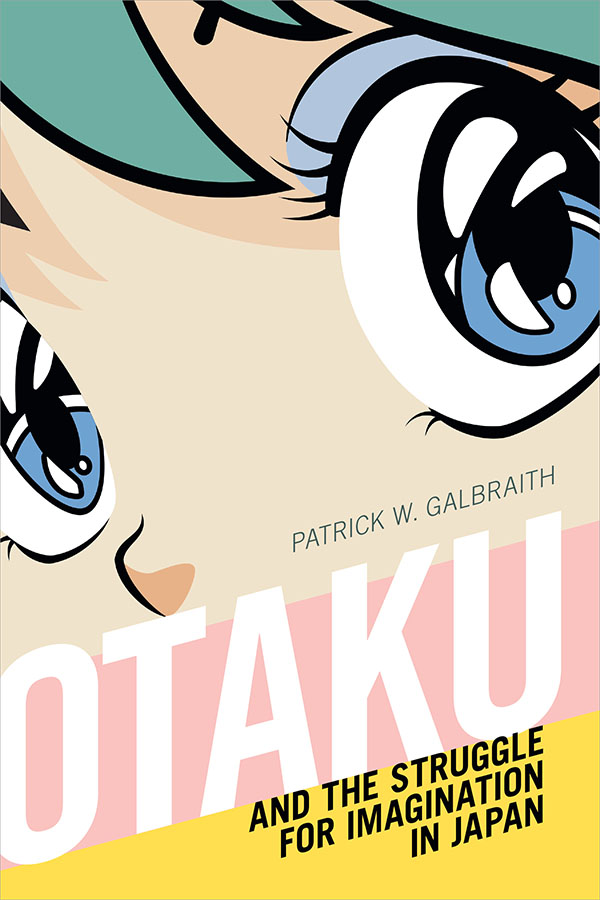
Over at All the Anime, I review the new book by Patrick W. Galbraith.

100% Perfect Sunshine Girl

Up on the All the Anime blog, my take on Makoto Shinkai’s Weathering with You.

“Shinkai was plainly unequipped for the fame that Your Name brought to him. He has spoken in interviews of being recognised in the street by enthusiastic fans, but also of overhearing people bad-mouthing his film in public. The reaction of some celebrity critics was particularly tough. Hirokazu Kore-eda, director of the Oscar-winning Shoplifters, diplomatically commented that the film was packed with elements of a hit, ‘…perhaps too packed.’ Yoshiyuki Tomino, the notoriously prickly creator of Gundam, declared that he doubted anyone would be watching Your Name in five years’ time.”

“I asked myself,” a wounded Shinkai told Matt Schley of the Japan Times, “should I make a film my critics will like, or should I make one they’ll hate even more?”

Archiving Anime

Over at All the Anime, I review Niigata University’s free publication on archiving Japanese animation materials, with special reference to their test case, The Wings of Honneamise.

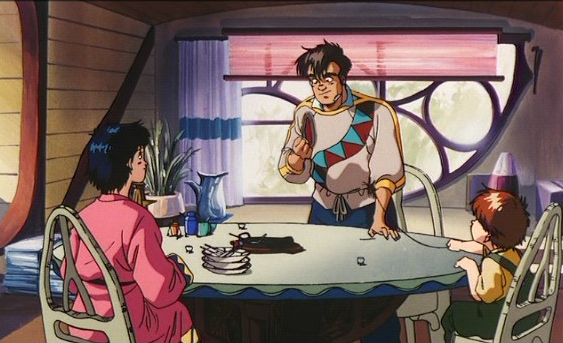
“Other elements of the book include Dario Lolli on history and technology in Honneamise, Jaqueline Berndt on the history of overseas anime/manga exhibitions (written before the British Museum’s recent triumph), a revealing interview with Hiroyuki Yamaga about the financial underpinnings of Gainax and his own struggles with creating the characters, and Kim Joon Yang asking what archived materials can tell us about anime. He delves deep into some of the directions on storyboards, noting that, say, a Star Wars inspiration is far more arguable in an analysis if we have the director’s own scrawl in the margins, reading ‘Make this like that scene in Star Wars!'”