The Girl King (2015)

kuningatar kristiina elokuva kuvauksetMika Kaurismäki’s latest film, Tyttökuningas uses a deliberately counter-intuitive coinage in Finnish, directly translatable as “The Girl King.” Like Empress Wu and Queen Hatshepsut, the titular monarch was a woman who sought the recognition and power of a man in a man’s world. In the case of Queen Christina of Sweden (1626-89) the terminology is truly apt – she was the sole heir of a doomed king desperate for a son, inheriting her father’s throne as a child, and, it seems, never quite growing up.

The movie is an earnest Europudding from multiple funding bodies – based on a French-Canadian play about a Swedish queen, but shot in Finland with Turku Castle and environs standing in for Stockholm. The Finnish connection eludes many international viewers, but is entirely apt; at the time that Christina took the throne, Finland formed the eastern marches of the Swedish empire. Christina was, indeed, also the Queen of Finland, and the Finnish republic remains peculiarly obsessed with Swedish royals.

tyttokuningasNETTIMichel Marc Bouchard’s script, based on his own 2012 stage play Christine: la reine garçon, makes much of Christina’s intellectual aspirations, depicting her as a crazy bibliomaniac, authorising the invasion of Czechoslovakia to get her hands on the king’s library (many books from which turn out to be in languages nobody can read), and frotting her girlfriend on the open pages of the stolen Codex Gigas or Devil’s Bible. In her own eyes she is a proud iconoclast, defying the old order represented by her chief minister, and scattering Enlightenment like fairy dust. In this mode, she pompously bestows china plates and wine glasses on the hidebound Swedish court, which she thinks is enough to qualify as a “revolution”, and pouts when she is not allowed to read books by Catholics.

Malin Buska smoulders persuasively in the title role, playing the clueless virgin queen as an occasionally saucy but usually baffled teenager with a winning lopsided smile. But if the film belongs to anyone, it’s the impotent menfolk who tut and wring their hands at the side lines. There is, to be sure, an argument that Christina’s mad life is best presented as a tragi-comedy, and the only moment that drew universal laughter in the Finnish cinema where I saw the film was the scene where Count Axel Oxenstierna (Michael Nyqvist) hems and haws and gamely tries to mansplain that “women’s friendships are different.” It’s Oxenstierna who shoulders the burden of running the country through his queen’s minority, and who begs her to do her duty, marry and get pregnant… and when she’s not up for that, to just try to be sane and not do anything daft like switch religious faiths at a time of political crisis.

True to any good historical movie, Kaurismäki and Bouchard do not rewrite the facts, although they do try and present them as best they can. A protagonist who does not change is a villain, not a hero, and the film struggles, as do historians and previous scenarists, to present Christina in any light other than that of a spoiled brat, impossibly deluded, drunk on power but shirking any sense of responsibility. She dresses in a tight, swashbuckling get-up, the first indicator of her androgynous personality, but then trips lightly around the castle balustrade pretending to be a pony: a far more evocative depiction of her infantile nature.

17-41592566ae4c65ab0dInitially, the story of Queen Christina must look like a dream come true for the queer film lobby: a European princess, raised as a boy, who falls in love with her lady in waiting and rails against the stuffy patriarchy! What a trailblazer she must have been… what a modern dash she must have cut among the dour Swedes. Except, no. The more one knows about the historical Christina, the more one cringes in embarrassment for any interest group that might dare to claim her. She has been depicted before in multiple media, including several operas, as well as the 1901 August Strindberg play Kristina, itself a source for the 1933 Greta Garbo costume drama Queen Christina. Garbo’s version pushed for an unlikely heterosexual resolution to her story, as did The Abdication (1974), in which Liv Ullman plays an older Christina, living in the Vatican and lusting after a cardinal.

There is, admittedly, some pleading of mitigation. Zachris Topelius, that great Finnish chronicler of the country’s Swedish past, wrote in his Stjärnornas Kungabarn of the similarities between Christina and her famous father King Gustav II Adolf, suggesting that her true misfortune was to inherit the hot temper and violent mood-swings that served him well on the battlefield, but which were deemed unwelcome in a regal daughter. Similar arguments are obliquely referenced in the film, particularly in an opening sequence which whisks through Christina’s awful childhood in thrall to a bonkers mother, who demands that she kiss her father’s putrefying corpse every evening, and who is later accused of having attempted to murder her. As the troubled dowager Maria Eleonora, Martina Gedeck periodically returns to chew the scenery, increasingly resembling a swivel-eyed Vivian Westwood, attended by an orbiting cloud of fops and dandies like a periodic pitch invasion by the cast of a Fellini film.

The script also pleads for the incipient intelligence of the young Christina. By the time she takes the throne in her teens, however, the bright, questioning girl of the early scenes has become a mercurial despot, unheeding of the advice of her ministers and generals, and promulgating a bipolar foreign policy that swings between hand-holding kumbayah internationalism and devious double-crosses. As her loyal subject Johan (Lucas Bryant) angrily berates her at one point, there is a human cost to every one of her decisions, and it is paid in the deaths and misery of others.
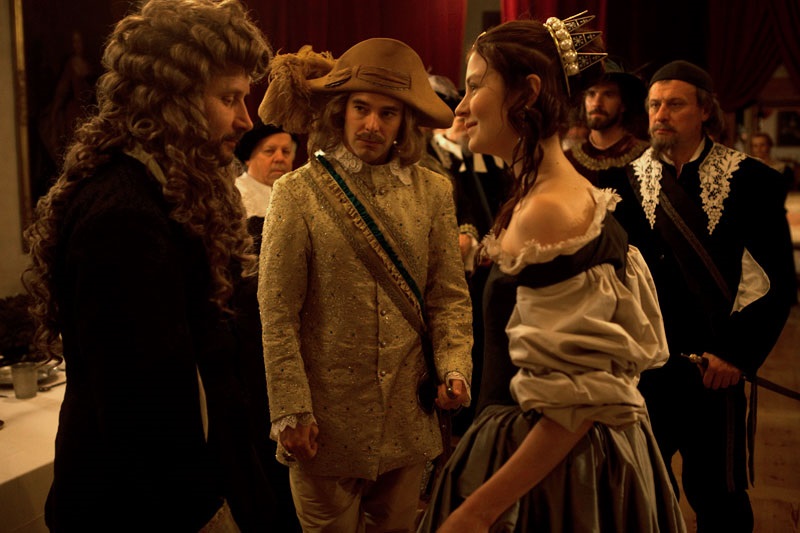
TheGirlKing_800aThere is an attempt in the closing scenes to present her abdication as a great self-empowerment, or the realisation of her True Self as some sort of wandering swordswoman. But there is also some sense remaining that this capricious termagant has skipped away from the burning wreckage of an entire kingdom, leaving broken treaties in her wake and a vast, costly expansion of the nobility, which someone else has to pay for. Queen Christina clung desperately to the trappings of royal power, even as she spurned any of the duties that it brought.

Christina is a privileged, predatory idiot when seducing her handmaiden Ebba (Sara Gadon), commanding her into bed and forcing herself upon her, only to realise that she has no idea what she should do next – a fitting metaphor for her entire life. And in the grand finale, as in the historical record, she marches smugly from the throne room, having dumped the crown on her cousin, riding not quite into the sunset, but into the Alps. A closing title reveals that she died in Italy as the centre of a great salon of intellectual debate, and understandably neglects to mention her pathetic return to Sweden in 1660, when she demanded the return of her crown and was sent packing by an establishment that was glad to be rid of her.

Jonathan Clements is the author of An Armchair Traveller’s History of Finland, available now in print and on the Kindle (UK/US).

Your Country Needs Geeks Like You

ob2Just when life looks grim for slacker Shinichi Kano, he discovers that his love of anime, manga and games is a fast-track to a new career. Earth has opened a magic portal to a parallel universe, and now it needs cultural ambassadors to jump into a fantasy world and sell the locals… stuff! Walkmans and iPads, Nintendo consoles and cartoon serials about demon warriors, anything they will buy.

Shinichi is packed off to the magical Eldant Empire. Imagine some hipster salesman wandering around the set of Game of Thrones, trying to interest Queen Cersei in Viagra, and offering Tywin Lannister a better lock for his toilet door. But it’s a dream come true for the average sci-fi nerd, dropping in on a world of slave-girls and stirring swordplay, but still being able to pop home.

The anime series Outbreak Company beautifully captures a very modern sensibility. Look around any classroom of bleary-eyed teenagers, and you will see a bunch of kids who, only the night before, were leading armies of orcs, rescuing kidnapped princesses, and slaughtering legions of zombies… in their bedrooms. Fantasy worlds have made increasing demands on our time, sneaking out of books and films and into our daily lives, our games consoles, conversations and even our phones. And there is, indeed, money to be made. As the spoof advert that begins Outbreak Company makes clear, there is a chance, however slim, that geekish interests can actually turn into a geekish career.

This is only partly true. Take anime itself, for example, where the creation of such shows is a notorious grind, underpaid and unappreciated, and where hard-core fans are given short shrift by producers whose eyes are always on the bottom line.

But Outbreak Company is also a playful retelling of Japan’s own desperate desire to sell its culture to other countries. In the middle of a recession in 2005, the prime minister Taro Aso began a long-term effort to push “Cool Japan” abroad, and to recognise Japanese films, books and games as major exports. You’ve got it; you sell it; you’ve still got it! Some of these initiatives have spearheaded Japanese culture into foreign territories, and, presumably, inspired Ichiro Sakaki to write the seven-volume book series on which this anime is based.

So although your average Japanese salaryman hasn’t quite met a half-elf maid like the anime’s Myucel, or introduced someone like child-queen Petralka III to Japanese comics, they’ve probably done something very similar when trying to push sushi in Sao Paulo, and noodles in Neasden. There is a sense that when Shinichi arrives in this fantasy realm of dragons and accordions, he is like a Japanese tourist staring goggle-eyed at the weirdness of the mysterious West. Nor does Outbreak Company shy away from the fact that much of Shinichi’s sales pitch is offloading a load of junk – the anime equivalent of selling mirrors and beads to clueless natives.

The people of Earth are also busily interfering in the politics of Eldant, from do-gooders trying to bring an end to slavery to military personnel with secret agendas. What starts out as a celebration of fan culture and good-natured bridge-building soon takes a darker turn, as Shinichi is confronted with the economic side-effects of colonialism, and the prospect that cultures can exchange the bad along with the good. His trips to Eldant broaden his mind as he encounters a different way of life, but also leads him to appreciate the world he has left behind.

Commendably, Outbreak Company is not one long allegory for gap-year tourism. Instead, it starts off funny and satirical, and becomes increasingly wary of motivations for such initiatives. As well it might – only last year, the Chinese press in the real world accused the Japanese of trying to win them over by getting them to love the fluffy blue robot cat Doraemon. With ever louder sabre rattling in the South China Seas, some Chinese pundits began complaining that Japanese “soft power” – manga, anime, and games – was functioning as a form of insidious propaganda, and concealing their plans for world domination. Now, there’s an idea for an anime series.

Jonathan Clements is the author of Modern Japan: All That Matters. This article first appeared in Geeky Monkey #2, 2015.

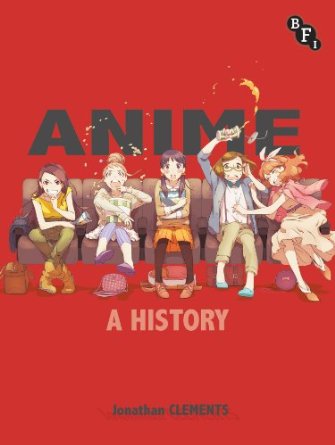
Anime: A History (eBook)

41bkTuP9TdL._SY445_Out of nowhere, my book Anime: A History is suddenly available as an eBook including here from Amazon UK, and here from Amazon US on the Kindle. I’ve been waiting for this for literally years, and I know I am not the only one.
—-

Japanese animation is at the nexus of an international multimedia industry worth over $6.5 billion a year, linked to everything from manga to computer games, Pokémon and plushies. In this comprehensive guide, Jonathan Clements chronicles the production and reception history of the entire medium, from a handful of hobbyists in the 1910s to the Oscar-winning Spirited Away and beyond.

Exploring the cultural and technological developments of the past century, Clements addresses issues of historiography within Japanese academic discourse and covers previously neglected topics such as wartime instructional animation and work-for-hire for American clients.

Founded on the testimonies of industry professionals, and drawing on a myriad of Japanese-language documents, memoirs and books, Anime: A History illuminates the anime business from the inside – investigating its innovators, its unsung heroes and its controversies.

The Price of War

“Thus, while soldiers have heard that it is stupid to move too fast, it is also unwise to take too long. There has never been a long war that worked to the benefit of a kingdom […]

“Sending forces far away is a heavy expense to the homeland. Meanwhile, a military force nearby will raise prices, and high prices exhaust the wealth of the common people.

“Once impoverished, they are soon forced into service. Their strength drained and livelihood gone, homes are left deserted on the central plains. The cost to the common people will be three-tenths of their worth. For the treasury, the cost for broken wheels and worn-out horses; armour, helmets, arrows and crossbows; lances, shields, spears and tents; oxen and wagons will amount to four-tenths of their worth.”

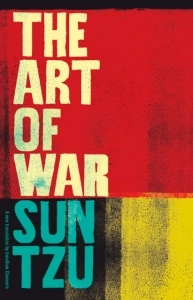
From Sun Tzu’s Art of War, a new translation by Jonathan Clements.

How Tokyo Changed The World

82

I am interviewed in the Emirates in-flight magazine, talking about Japanese inventions that are actually useful:

“For demographic and geographic reasons – a high population and very little flat land for building – the Japanese were generations ahead of the rest of the world in terms of having to cope with living piled on top of one another,” says Dr Jonathan Clements, author of Modern Japan: All That Matters.

“This has led to a greater interest, in terms of design and technology, in being able to isolate oneself from the people around you. The Walkman was originally designed so that the boss of Sony, Akio Morita, could listen to music on a plane. Can you imagine air travel today without it? The Walkman then kicked off a revolution in fitness, but miniaturisation and falling costs have also been instrumental in the migration of TV sets from lounges to bedrooms, and the diversification of media into narrowcasting, whereby different people can watch the TV programmes or videos that they want, even in the same house.”

What Next?

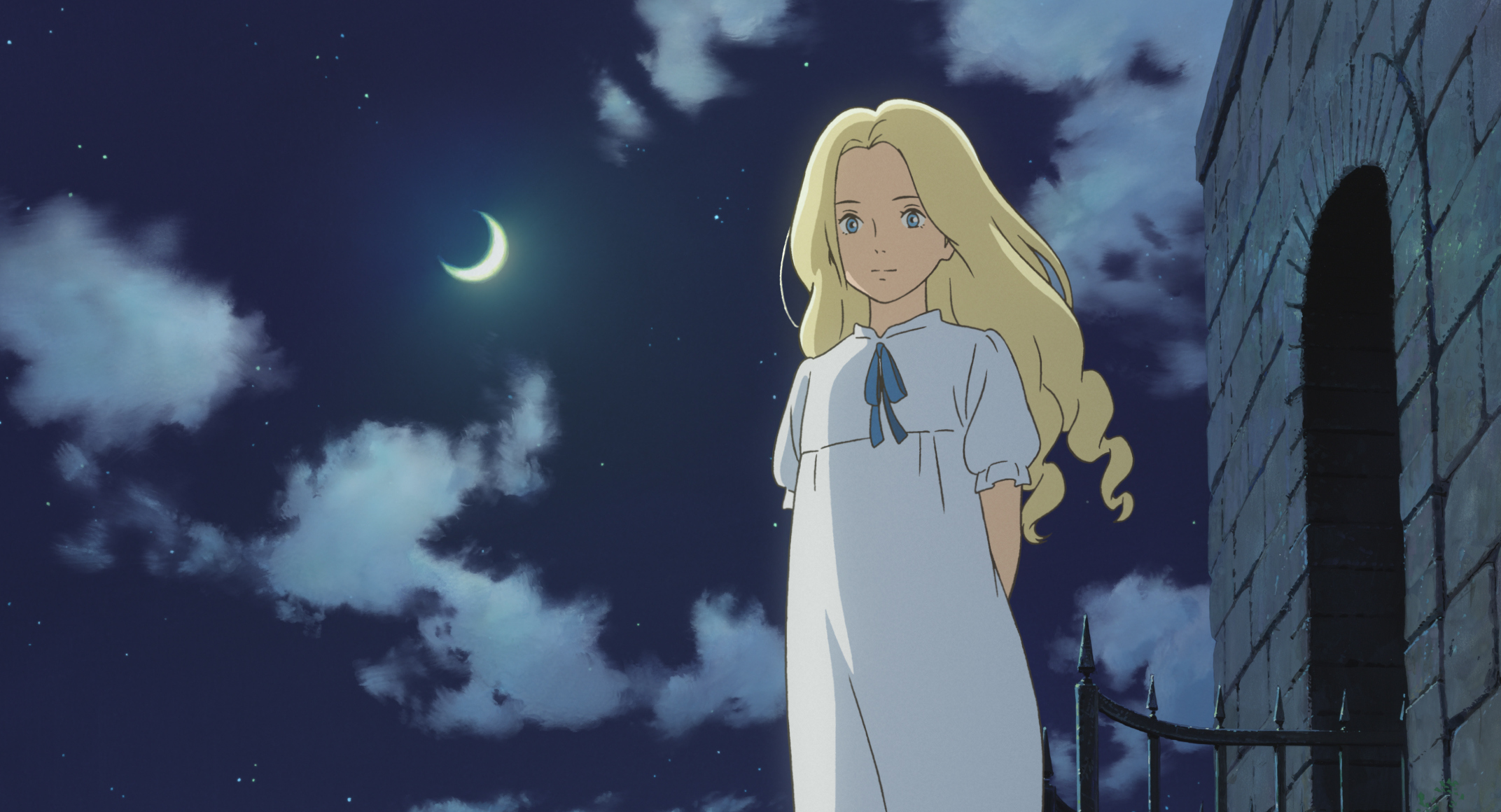
marnie_hires_6There were two notable absences from the screenings at this year’s Scotland Love Anime – or rather, two notable presences at the London Film Festival. Hiromasa Yonebayashi’s When Marnie was There, the last feature film from Studio Ghibli, and The Boy and the Beast, the latest feature from Mamoru Hosoda, both made it onto the LFF roster instead. You might call this a victory all round – Hosoda’s films are often snatched by the LFF ahead of SLA, thereby leaving a slot in Scotland for less mainstream fare, as well as guaranteeing that Hosoda doesn’t sweep the Scottish Judges Award every year. But London’s programmers, as they are wont to do, are also snatching the most commercial and audience-friendly Japanese animated features. What are they going to programme next year?

Almost everybody in the anime business is tired of the “next Miyazaki” argument, in part because there can be no such thing. Hayao Miyazaki was a one-off, as was the synergy formed by his partnership with Isao Takahata and Toshio Suzuki. Moreover, the conditions that made their Studio Ghibli such a world-beater were also, in themselves, unique. The putative successors to Miyazaki are competing in an environment that is worlds away from the situation that saw Princess Mononoke rise to fame.

But concerns about who might be anime’s new poster-child aren’t just about the search for a new creative force. They are also all about money. For a Japanese movie to break even at the domestic box office, it has to be in the top twenty films released that year – a benchmark that only Studio Ghibli and a couple of long-running franchises (your Pokémon, your One Piece) could ever manage. A Studio Ghibli film (let’s be honest, a Miyazaki film), was a blue-chip investment, guaranteed to put bums on seats in Japan, and to monetise in foreign sales. Nobody else in Japan currently comes close, and that doesn’t just affect the likely enjoyment of family audiences. It affects festival programmers looking for something Japanese for their slates; it affects retailers planning how many feet of shelves to give to anime; and it affects distributors allotting budgets to those weird Japanese cartoons we keep hearing about. With Ghibli removed from the equation, the investment value of the entire anime medium drops by a significant factor, forcing everybody – distributors, retailers, and cinema owners, to work a lot harder to keep it in the public eye. So do your bit: go and see a Japanese animated film in a cinema this year… It’ll show up on someone’s balance sheet, and might make all the difference.

Jonathan Clements is the author of Anime: A History. This article first appeared in NEO #143, 2015.

Harem Scare ‘Em

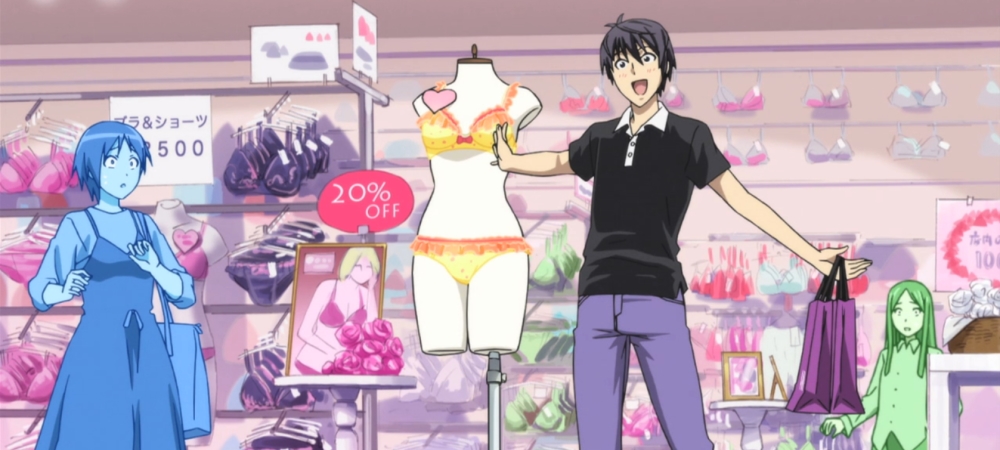
32243-ComicArtAsst_3Yuki Aito is living the dream… in a way. His comic Haji Café has become a hit, dragging his art career from a hobby into a full-on profession. Like many a manga artist before him, he’s discovering the hard way that a weekly schedule never lets up, taking on a bunch of assistants to help him grind out the pages. But because he’s a self-acknowledged pervert, obsessed with knickers, he has only hired pretty teenage girls.

Even if you’re not an anime or manga fan, you’re probably familiar with the look of the “harem show” – a romantic comedy that places a single hapless boy in the company of a whole gang of pretty women, every one of them girlfriend material. The genre has been visible in Japan for the last 20 years, serving the anyone-will-do desperation of horny teenage boys, with just a dash of wish fulfilment. These fantasy women aren’t just beautiful and theoretically available for Yuki, they are also comics fans like him.

Should he plump for Sahoto, the hard-working artist who cherishes a dream of being a comics creator all on her own? Or should he go for Rinna, the talentless assistant hired only for her looks, and the fact that she is a fan of his work? Maybe he should chance his arm with Sena, the pathologically childish teenager who nurses a hidden sadistic streak? Or perhaps he should return to his past with his old schoolmate Mihari, once a childhood crush, now a hard-nosed editor at his manga publisher?

The Comic Artist and His Assistants is based on a manga about creating manga, one of a burgeoning sub-genre of self-referential titles that have also seen tales of wacky sci-fi shop-owners, convention costumers as the heroes of their own show, and a chronicle of behind-the-scenes shenanigans at an animation studio. For everyone who keeps hearing that anime and manga are taking the world by storm, it’s a gentle reminder that some of anime’s appeal actually stems from its ability to go small: narrow-casting to niche audiences such as, in this case, boys who like drawing comics and ogling girls, and who don’t see anything creepy in the very obvious exploitation of workplace power. Original creator “Hiroyuki” first found fame with a manga about creating amateur manga, and now he’s gone pro in every sense.

As you may have noticed, it’s all about Yuki’s choice, his options and his desires. The women in The Comic Artist and His Assistants are less characters than they are gaming objects, clusters of attributes and quirks – this one’s got small tits, that one’s got blonde hair, that one’s too weak to open an ink pot. There are plenty of anime and manga for a female audience (and this column will get to them soon enough), but this month’s offering is resolutely chauvinist, deriving much of its humour from putting the girls in embarrassing situations and subjecting them to sexual harassment (boob-grabbing now counts as “research”).

Takeshi Furuta’s animated adaptation seems to instinctively know that its one-note perving is going to be difficult to sustain. Consequently, its episodes clock in at a quick 15 minutes each, just long enough to set up a pantomime situation of ooer-missus innuendo, and to slap our priapic protagonist with some sort of half-hearted retribution. One typical episode focuses creepily on Yuki stuck in an elevator with the childlike Sena, as she reveals that she is desperate to go to the toilet. The show takes evident pleasure, like Yuki himself, in the prospect of her humiliation, turning their dilemma into a comedy of manners when he offers her an empty bottle to piss in.

This isn’t a show with morals as such, although every now and then it pays lip service to the idea that Yuki needs to grow up before he can achieve his true potential, and, it is implied, bag himself a girlfriend for real. But personal growth was not the message of Hiroyuki’s original, nor should we expect it to be. This is an anime show about wobbly bits and cat-calls, pulling girls’ pigtails and peering down their dresses. You will also learn the Japanese for knickers, which is pantsu.

Jonathan Clements is the author of Modern Japan: All That Matters.This article first appeared in Geeky Monkey #1, 2015.

Podcastery

3518686_1399254412953.75res_400_300I appear in my role as the Scotland Loves Anime jury chairman in this month’s All the Anime Podcast, in which we discuss the four features in competition: Miss Hokusai, The Case of Hana & Alice, Expelled from Paradise and Empire of Corpses. For anyone interested in the kind of dialogue that goes on behind the scenes at a film festival, it should be quite illuminating.

Since Anime News Network’s Justin Sevakis was one of this year’s judges, talk then turns to his career behind the scenes in US anime distribution, most notably the hellish life of a hentai trailer maker, with reference to the notorious Night Shift Nurses (pictured). As a result, this podcast is most definitely Not Suitable For Work, unless you work at at anime company — trigger warnings for necrophilia, scatology and incest, and that’s just the guests, everything from the Golden Partridge to the Golden Shower.