Public Lending Right

My results are in for the last year’s library loans, and as predicted last year, the Brief History of the Samurai has raced up the chart. The top ten JC British library loans are:

  1. A Brief History of the Samurai
  2. Confucius: A Biography (hardback and paperback combined)
  3. A Brief History of the Vikings
  4. Wu: The Chinese Empress Who Schemed, Seduced and Murdered Her Way to Become a Living God
  5. Beijing: Biography of a City
  6. The First Emperor of China (hardback and paperback combined)
  7. Chinese Life
  8. Marco Polo
  9. A Brief History of Khubilai Khan
  10. Admiral Togo: Nelson of the East

This year, for the first time in living memory, I made no money at all from my 1996 translation of Streetfighter II: the Manga, although Ironfist Chinmi is still bringing in enough revenue after 17 years to buy me a Chinese takeaway.

Curse of the Blue Duck

Last month I met an animation director from a well-known company, who let me in on a little trick of the trade. He had grown tired of endless meetings with licensors and advertisers, wherein stuffed shirts would look up from their Blackberries for just long enough to say something, anything, that made it look like they were paying attention.

There are politics at such companies. People want the boss to remember that they were in a meeting and that they made a contribution, and that invariably means pointing at something in the rushes or the storyboards, and saying that they don’t like it. Job done!

Except if someone is picking holes in your cartoon just to impress the boss, you don’t want to get it absolutely right first try. Instead, you want to come up with something that really, obviously, needs fixing, so the drones can point it out, and you can get on with your job without having to change the scenery, replace your lead, or anything similarly pointless.

And so, in new work for corporate clients, the animation company now includes an incongruous blue duck in every piece of work. Doesn’t matter if it’s an advert for funeral homes or a party political broadcast by the Independence Party, they’ll shove a blue duck in it. It’ll be there, waving nerdily at the camera, or tripping on a banana skin in the background. And it’ll look calculatedly stupid.

“I love the storyboards,” the suits will say. “But can we lose the blue duck?”

That, at least is the plan.

But looking at certain anime works, one wonders if the joke hasn’t backfired awfully. How many anime mascot characters started out as a blue duck gambit, only to unexpectedly meet with management approval. Did anyone seriously ask for Ulysses 31 to have an irritating robot in it? Does Tekken: Blood Vengeance really need a comic-relief panda?

But maybe a few films could be improved by a blue duck. A little quack levity in Legend of the Overfiend, perhaps. Or a bit of comedy business in Grave of the Fireflies? It might work…

Jonathan Clements is the author of Schoolgirl Milky Crisis: Adventures in the Anime and Manga Trade. This article first appeared in NEO 93, 2011.

Indian Giving

Mark Schilling’s latest article in Variety discusses some of the issues facing modern anime, including the ever-growing rush to outsource, plummeting demographics and hybrid contents. Yours truly is briefly quoted with a very conservative estimate of the size of the foreign labour pool — Ryosuke Takahashi puts it a lot higher. Schilling suggests that declining numbers of children are responsible for declining numbers of anime, but I do not entirely agree with this, or at least, not with the way that the data is presented here. The peak of production in 2006 was generated by an insanely high investment interest from abroad, which is still playing out today as all the investors sue each other over what went wrong.

Pen Names

When I handed in my manuscript of Spartacus: Swords & Ashes, I decided to call myself J.M. Clements. I thought it would be a smart move to stop Amazon spamming everybody who’d bought one of my non-fiction books and expecting them to like my fiction, too. I mean, they might. But I figured Spartacus is for Spartacus fans, and my name on the cover shouldn’t influence them one way or the other.

“It’s pretty obvious who you are,” sniffed the Editrix. “It’s about as likely to fool the public as Iain ‘M’ Banks.”

“I know,” I said. “And I’m proud of the book. I’m just trying to keep fact and fiction in separate areas. I hate it when some douche on Library Thing decides I shouldn’t be allowed to write about one subject because he thinks I can only write about something else.”

“That’s stupid,” said the Editrix. “That never happens.”

“It always happens!” I protested. “And they’ve got a particular hard-on for people who switch between fact and fiction, which people often do if they write for a living. I dread to imagine what these one-track people are like in real life, as if they don’t think it’s possible to be a father and an insurance salesman, or a Saturday footballer and a chef. They probably have conniptions if they have to do two things at once. Then they review themselves and say: ‘I cannot possibly walk and chew gum, for those activities are mutually exclusive. Worst gum-chewing walk evarrr.’”

“You are over-reacting,” said the Editrix.

“If they ran the world,” I ranted, “they’d say Neil Gaiman could only write about Duran Duran. Lynda la Plante would be good for nothing but Rentaghost. Robert Silverberg could only write popular history. And Tolkien can piss right off and stick to Anglo-Saxon etymology.”

“All right,” sighed the Editrix. “Have it your way.”

The next day, the Editrix was back.

“The distributors want to know about the other things you’ve written,” she said. “It’s so they can tell booksellers how brilliant you are.”

“But won’t that make it really obvious who I am?” I said.

“Yes, probably,” she said, without pause or apology.

So I told her about The Destroyer of Delights, which was a Doctor Who audio I was very pleased with, which had a recurring subtext about the nature of slavery. And since there were lots of fights in it, I thought that my Highlander story Secret of the Sword, was probably worth a mention. I decided it probably wasn’t worth bringing up the biography I once wrote of the president of Finland. He doesn’t crop up much in Spartacus.

A day later, the Editrix was back again.

“The distributors want to know where you live,” she said.

“Jupiter’s cock! Why!?”

“They like it. Their sales people like being able to say, ‘he’s a local boy’, to a bookseller near you.”

“But isn’t it more productive if everybody thinks I am a local boy?”

“Do not question the House of Random!”

“All right, all right.” So I told her where I lived. It felt a little bit like I was handing over my bank details to a Nigerian prince.

All of which meant was that by the time Spartacus: Swords & Ashes was up on Amazon, some bright spark had already worked out precisely who I was, and it was listed with all my other books. My attempt to carefully separate my fact and fiction had failed again.

“I’ve got a translation of The Art of War coming out in the summer,” I protested. “But shelvers at book-stores are going to look me up online and order their copies on the basis of the sales of this novel, which is full of sword-fights, swearing, rape and adverbs. It will be the most heavily over-ordered classical text in living memory.”

“You say that,” said the Editrix, “like it’s a bad thing.”

J.M. Clements is the author of Spartacus: Swords & Ashes, available now in paperback and on Kindle. He has written a few other things, too.

Fill Them All

I’m a guest blogger this week over at Starburst, discussing Roman law, the history of slavery and allegories of zombie outbreak in the Roman Republic. There’s also a chance to win a copy of my Spartacus novel.

And that’s not all, for there’s another guest blog from me over at A Temporary Distraction, this time analysing my love of the earthy language of Spartacus — probably the only time you’ll see someone discussing Derek Jarman, gladiators’ groupies and the use of the indefinite article all in on the same page. If you’ve ever wanted to know about how to insult someone’s mother in Latin, now’s your chance.

ARE YOU NOT ENTERTAINED? If that’s not enough, I appear yet again over at Blogomatic 3000, this time discussing the pitfalls of writing something that has to displease all readers equally. How obscene is too obscene, in a world where people get their faces hacked off? I hasten to clarify, when I say in this piece “crushed and broken by empire”, I’m using “empire” in its post-colonial studies sense as a “decentred and deterritorialising apparatus”. Spartacus lived at the time of the Roman Republic, of course, but the empire was already on its way.

And yet another, over at What Culture, where I talk about the nature of time in television. Probably the only time that EastEnders, Downton Abbey and Spartacus get mentioned in the same piece.

One more for luck: here’s me over at SF Review, discussing the sort of picture you see when you walk into the National Museum of the Philippines. Now, what on Earth does that have to do with Spartacus and “empire”…?

The Votoms Line

There’s a short piece on director Ryosuke Takahashi up now on the Manga UK blog, drawn from our many conversations at last year’s Scotland Loves Anime. Takahashi was the unquestionable star of the festival, and a great raconteur, with stories about scrubbing gold paint off naked actresses, robots on rollerskates, and his early days as a dogsbody at Osamu Tezuka’s Mushi Production.

His quote of the week was delivered to the audience as they took their seats for the Armoured Trooper Votoms: Pailsen Files movie.

Pailsen Files and golf have a lot in common,” he said, with a mischievous twinkle in his eye. “Both are the inheritors of long traditions. And both are quite boring to watch!”

The Verrine Orations

Gaius Verres was an asshole. He persecuted the Roman citizens that he was supposed to be ruling. He exploited a disaster on the mainland in order to line his own coffers, by accusing locals of harbouring escaped slaves. A man who stood up to him was so badly beaten that he died from his injuries. Another was crucified in sight of the mainland, taunting him with the knowledge that he died almost, but not quite out of the jurisdiction of the man who’d had him killed.

The people of Sicily got their revenge in the end, when they hired the young, up-and-coming litigator Cicero to plead their corruption case against their former governor. Cicero went for Verres like a man possessed. We know this because we still have the transcripts of his court-room arguments: a scathing, sarcastic series of personal attacks published as the Verrine Orations. Cicero never got to deliver them all because Verres, realising that bribes wouldn’t save him, fled the country, but Cicero was so keen on taking him down that he published the rest of his notes anyway.

The accusations from the Verrine Orations read like a…. well, like a proposal for a tie-in novel for Spartacus: Vengeance. As Spartacus terrorises the mainland, Verres uses his own position as governor of Sicily to exploit the disaster. He accuses locals of harbouring escaped slaves, and confiscates their property on trumped-up charges. He puts an incompetent crony in charge of his anti-pirate fleet, so that he can steal the man’s wife. The newly appointed admiral is so useless that the pirates actually attack Syracuse harbour.

My novel Spartacus: Swords & Ashes had to take place during the first season of the TV series, just before Verres took office in Sicily. But the temptation was irresistible to treat it as a prelude to the Verrine Orations. Why would Cicero be so keen to take Verres down after the Spartacus War? Could it be that they had met before, in a story unmentioned in the history books?

One of the stand-out characters in the Verrine Orations is Timarchides, a freed slave who works as Verres’ hatchet-man, intimidating witnesses, beating up rivals, and purloining government property for parties and orgies. For a story like that of Spartacus, obsessed with the state of slavery and what it means for human beings, what kind of man would Timarchides have been? How would he feel about having won his freedom, and what sort of attitude would he have to those who were still slaves?

So I put all three of them into Swords & Ashes. Gaius Verres, the newly-appointed governor of Sicily, ready to frisk the province for all it’s got. Timarchides his right-hand man, a former gladiator who despises slaves. And Cicero, the good-hearted young investigator, who comes to Neapolis on senatorial business. All are thrown into new intrigues at the funeral games of a noted local lanista, whose Capuan colleague Batiatus is providing the gladiators… including his celebrity warrior, Spartacus.

What could possibly go wrong…?

J.M. Clements is the author of Spartacus: Swords & Ashes, out now in the US in paperback and on the Kindle. It is released in the UK on 27th January.

The Final Encyclopaedia

David Langford has kindly sorted out a list of all the entries I have written so far for the Encyclopedia of Science Fiction. Which is nice. I think I still have a good 100 or so to do before the Japan section starts to look ship-shape, and the same again for China.

2011: The Year in Anime Books

For the last few years, it has been my mission to read through as many Japanese books about anime as possible, with special concentration on personal testimonies from the animators themselves. And I have been annotating as I go. For some reason, many of the people who write books about anime are allergic to indices, so I have been writing my own, of dozens upon dozens of memoirs and biographies, in order to build up a picture of the way the anime business looks to the people who actually work in it. The concordance is currently at 230 typed pages, although I think it will hit 300 before I am done. The work has functioned as a sort of audit of what people think they know about the business they work in, and has allowed me to chart several memes and misconceptions from their birth through to their establishment as industry lore.

And so my neck-deep wade through Japanese-language books on anime has continued, most recently with the NTT collection of scholarly essays Anime in Transition (or Anime Across Borders? or Anime Transnational?). The book is something of a landmark, forming an entire volume of the eight-part Japanese Film is Alive series from Iwanami Shoten, and hence perhaps redeeming anime as just as reasonable a field of study as, say, documentary, performance or audience. Notably, however, five of the eleven chapters in the book are written by foreign authors, with the likes of Marc Steinberg, Thomas Lamarre and Hu Tze-yue providing commentary and perspectives that the Japanese seem unwilling or unable to provide themselves. Is Japanese academia on animation really that lacking in local heroes, or is this a form of auto-orientalism, with the Japanese lapping up foreign attention as a means of validating their own interests in such an unlikely, unloved field as animation studies?

I’d believe it if NTT Shuppan had not answered within the year with an all-Japanese collection. There is no question about the anime book of the year 2011 — that award surely goes to Anime Studies, edited by Mitsuteru Takahashi and the omnipresent Nobuyuki Tsugata. Anime Studies contains ten chapters of detailed commentary on many interesting areas in the anime field, including education, intellectual property and national animation policy. The authors include academics, but also producers and directors, most notably with a chunky section from Ryosuke Takahashi about Tezuka’s anime “revolution”. Anime Studies is the book to which I wish every Western scholar had access, laden with charts and diagrams explaining the way that modern anime works, but also with informed references to peripheral areas, and, that greatest rarity in books on anime, a functional index.

Anime directors continued to be feted with studies and analysis, notably in books about Kenji Kamiyama and the journeyman director Keiichi Hara, now enjoying a new-found fame thanks to his breakout feature Colorful. This has also been a good year for books that analyse anime from the perspective of a producer or manager. Six years after he penned a guide to the anime business, Hiromichi Masuda writes an all-new account of the same subject, incorporating the wild ride of changes since the 2006 production peak. Meanwhile, Kinema Junpo jumps on the bandwagon with books on the below-the-line squabbles that get anime made in the first place including How to Make a Hit “Mundane” Anime and On the Job of the Anime Producer. Meanwhile, Yuichiro Oguro publishes the long-awaited second volume of his Anime Creator Interviews, collating material originally run in Animage at the beginning of the last decade.

You’ll notice, perhaps, that many of the books have dully typographical covers. In a country where Japanese studios will often charge magazines even for illustrations used to accompany rave reviews, the studios are often their own worst enemies when it comes to picture sourcing. I am pleased to note that the current crop of Japanese academics and scholars have simply given up playing the studios’ game, and instead published the texts that they want to publish, without bending over for outrageous fees or assenting to textual tampering — here’s a hello to the idiot who tried to get us to lie about the production details of his company’s movie in the Anime Encyclopedia, and who tried to use image access as the lure to make us cooperate. Anime is, assuredly, a visual medium, but I would much rather have good books published without pictures than see compromised picture-books, defanged of all their interesting content.
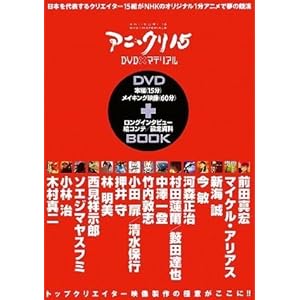
There is still a good deal of pretension awash in the anime field. Ani Kuri 15 DVD x Material is an infuriatingly packaged book of interviews and storyboards from the short series of NHK commercials made to order by creatives including the late Satoshi Kon, as well as Yasufumi Soejima and Shinji Kimura. Which is all very well, but it comes with a tight yet flimsy paper wraparound that is sure to tear after a single use, and includes an origami robot by way of apology.

Other books I’ve read this year have included Yuka Minakawa’s two-volume account of the “rise and fall” of Tezuka’s Mushi Production, although the fall is bundled into the final few pages. Like Eiichi Yamamoto’s much-cited 1989 Rise & Fall of Mushi Pro, the book is presented in fictionalised form, although Minakawa presents detailed references, usually to DVD sleeve-note interviews and other ephemera that might elude the more traditional scholar. I also found much of interest in Makoto Misono’s 1999 Complete Book of TV Animation, a forerunner of the Anime Studies collection that diligently attempted to create an institutional memory for television cartoons more than a decade ago. I think I bought it when working on the first edition of the Anime Encyclopedia, but I haven’t properly gone through it till now. I also stumbled across Masaki Tsuji’s long out-of-print The Youth of TV Anime, a memoir of the 1960s and 1970s by the scriptwriter of, among other things, Astro Boy, Star of the Giants and Sazae-san. It’s the last that interests me in particular, since the studio that made Sazae-san has never really had to try since. Go on: see if you can name it without opening a book or another window. It’s not all that famous, despite making Japan’s highest-rated and longest-running cartoon. Whereas other studios have to push and flash and bluster to get attention, the studio that makes Sazae-san just motors along on a job that is essentially below-the-line… certainly below the notice of many foreign fans.

In this periodic round-up, which I have previously run in 2010 and 2009, it’s usually my habit to talk about the English-language books on anime that come my way. In many cases this year, I have already reviewed them elsewhere, such as this piece on the excellent Ladd and Deneroff memoir of early anime in America. I’ve also written a glowing review of Iwao Takamoto’s autobiography, but that won’t appear until later in 2012. In others, I simply haven’t got round to them, since the Japanese-language books are prioritised ahead of them. In a couple of others, I have read them, although they were so awful that I cannot bring myself to even name them. One was an academic account so up itself as to be entirely impenetrable, including an interview with a Japanese creator who actually tells the author to piss off and talk to someone else. The other was a seemingly self-published witter about divinity in anime, by a man who couldn’t even spell Wikipedia, even as he cited it.