A little namecheck for Empress Wu in today’s Guardian: “Wu Zetian makes Lady Macbeth look like a pussycat, filled from crown to toe, chock-full of direst cruelty, and then some.”
Rather odd that the article would appear in a series called “Great Dynasties of the World”, though, since Wu‘s Zhou dynasty began and ended with her, and was arguably little more than an elaborate filibuster to keep out *real* usurpers. Surely the Tang dynasty that both preceded and followed it would be a better candidate for true greatness?
Because the song translations I did for Pioneer were for the music division, not the anime division, they covered theme songs from other companies, too. That is the only possible explanation for Pioneer’s decision to hire me to work in 1997 on lyrics for the mad hair-metal theme to Fist of the North Star “Ai o Torimodose”. I did the best I could… and you thought Schoolgirl Milky Crisis was weird.
—
Shock of love! When heaven sent you it was just the start
Shock of love! Stopped me in my tracks, now you’ve got my heart
Burning fever binds me waiting for my love to find me
But now I’m giving it my all
None can stop my anger, I just point my little finger and down
They all fall
Shock of love! Just one look at you,heartbeat’s getting fast
Shock of love! Me and you as one, and it’s gonna last
Now my heart is burning with the madness they call yearning
To find the place where you’re hiding
I can’t live without you, fight the cruel thoughts that doubt you, I’ll do
Anything
Now you’re far away, a quest to save our love, and I’m here waiting for you
Tomorrow’s gone, until you bring the key
Never can forget your pretty smiling face, for I know your heart is true
Bring my love right back to me*
Shock of love! Shining light upon the shadows in my mind
Shock of love! Just the thought of you, and my thoughts unwind
When we’re back together, promise it will be forever and then
Take me in your arms
I will hold you to me and nobody’s gonna free me again
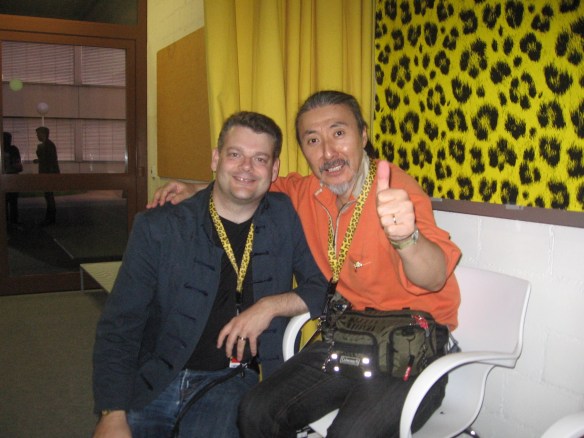
With his ponytail and khaki vest, Ichiro Itano looks like a rock star. The man who once strapped fifty fireworks to his motorbike to “see what would happen”, who once had a part-time job playing the Masked Rider in a department store theatre, is also one of the best animation action directors in the business. He taught for four years at the Yoyogi Animation College, and now he’s facing down a class of eager students in Switzerland, demonstrating how to use wide angle lenses, how to shoot moving vehicles, and how to block a cavalry charge against Chinese soldiers. All things that come in handy for the director of Angel Cop, Blassreiter and Gantz.
Someone asks about authenticity in animation, and his eyes light up mischievously.
“Let me put it like this,” he says. “There’s this flight school in America run by retired air force pilots. They’ll give you one lesson in really fast English, and one safety demonstration, and then they’ll take you up to 10,000 metres. You have a co-pilot, but he leaves it to you once you’re up. So it was me and Shoji Kawamori, in jets, ready for a dogfight. All as part of the research for Macross Plus. I wanted to know what it was like to fly a plane, to be in aerial combat, and I was curious about G-force.
“Each plane had a laser pointer, and if you could keep the enemy in your sights for three seconds, you scored a hit. So we started the dogfight, chasing our tails. I scored six hits on Kawamori. He was all over the place, but I was really good!
“So after all that, I decided: ‘I’ve done the dogfight. Let’s faint.’ So I grabbed the joystick and pulled right back on it. I heard the pilot shouting ‘Itano! Itano-san! Mr Itano! NO! Stop!’ and the G-force pushed me back in the seat. I felt my head lolling and then there was black. I’d blacked out, and it was like someone had pulled the plug on a computer.
“After that, it was just like I was rebooting. There was like static, and images, and the realisation that I was… wait… in a plane? Why am I in a plane? Why is there an American slapping my face…? Where am I… wha-? And then BANG, I’m back, after a minute unconscious, my head spinning as the co-pilot brought the plane down to land.
“I stumbled out of the cockpit and down the ladder, and then I threw up.
“Afterwards, everybody went to lunch. But the producer from Bandai took me off into a corner and just gave me a coffee, some paper and a pencil.
“He said: ‘No lunch for you. You might drop dead at any moment. First, you must draw the storyboards of a blackout.’
“So I sat there and drew the storyboards for the sequence in Macross Plus where a pilot blacks out. And that’s what we call authenticity.”
(This article first appeared in NEO magazine #69, 2010)
Just when you thought it was safe, I dig up another of my song translations from the Pioneer anime CDs. This one is the theme from the second series of Fist of the North Star, for which i set myself the intellectual exercise of keeping all the Engrish lyrics in exactly the same place in my translation as they occurred in the original. “Tough Boy”, for so this song is called, is an interesting exercise. Even to the Japanese, it must have seemed impossibly dated — I was hired to translate it in 1997, with a chorus that lionised the fact that its singer was “living in the eighties.” Good luck with that!
From the looks of this, it seems that I couldn’t be bothered to make the lyrics to this one actually rhyme. Perhaps I knew I was on a hiding to nothing.
Welcome to this crazy time
On the run and deep in trouble, your life’s on the line
You’re such a tough boy…
She never met a boy that made her feel so bad
I got a feeling that a man like you could drive her crazy
You, tough boy…
Here we are, at the end of the century
Our time is now, out on the streets, our generation’s taking over
Keep you burning, till the race is run
Got to be more to your life than all this scum and crime and dirty fighting
No boy no cry, cast your fears aside
There’s a bright tomorrow waiting, wait until you see the rising sun
We are living, living in the eighties
We still fight, fighting in the eighties
Looks as if you’ve had your share of battle scars
It’s gonna take more than a few hard knocks to break your spirit
Such a tough boy…
Everywhere she turns she gotta feel so sad
I gotfeeling that’s there more to you than causing trouble
Tough boy…
Here we are, in the eternal rockland
Our fists are raised, it’s time for us to make a stand and take it over
Keep you burning, till the race is run
Gotta fight the madness of illusion, till our hopes and dreams are all our own
No boy no cry, keep on keeping on
Turn and face the wind and take its strength so you can be a hurricane
We are living, living in the eighties
We still fight, fighting in the eighties
We are living, living in the eighties
We still fight, fighting in the eighties
You’ll notice, perhaps, that my pronouns are all over the place here — a sign of my indecision over whether the singer was male or female, and hence whether the titular tough boy was first- or third-person. Such switches in addressee are a bad idea. I’m pretty sure, for example, that such vagueness in the lyrics of “How Does She Know” in Enchanted cost the song its Oscar. But there won’t be any Oscars for “Tough Boy”, either, not till hell freezes over. These days, I would be able to YouTube the original song and get a look at the band… or Wiki them to work it out, but those options weren’t available 13 years ago. At least, they weren’t to me.
A manga is a Japanese comic. Anyone who says otherwise is selling something.
Inconvenient for the artist Joe Bloggs, who wants to sell you his How to Draw Manga book. Inconvenient for Large Corporation, that wants to sell you a book of non-Japanese comics with the word “manga” on the front. But that’s what happens when you try try to sell apples and call them oranges. Gravett admits that you can’t boil down a definition of manga to specific elements of style, or attitude or content. An argument that some of you may find familiar, and may even have expected.
In which case, there is no point in using the word manga at all unless we are talking about Japanese comics. In fact, it’s insulting to the broad church of Japanese comics if one tries to strip down such a rich medium to such simple (and, as six years of my Manga Snapshot column should have demonstrated by now, not necessarily universal) aspects as big eyes or spiky hair.
We got there in the end. Only took, what, five years? Ten? What are the odds that this will put an end to the tedious “debate”* on definitions?
No, the odds are not good, for all the reasons I cited in 2008, and on innumerable occasions preceding.
—
* (I put it in quotes because it’s hardly a debate if the other side consistently turns up empty-handed and wearing ear plugs)
Back from Cardiff, where Skillset Screen Academy Wales invited me to teach my infamous workshop on Storylining in a Corporate Environment, pronounced on previous occasions as “life-changing”, “instructive”, “terrifying”, and “better than the guy we had last week.”
The venue was the swish multimedia Atrium building of the University of Glamorgan; the task, distilling a series of contradictory directives into an idea that would displease everybody equally. After initial instruction in the way that Japanese animation is put together, the students, largely postgraduates studying Film or Scriptwriting (but also Animation and Business Management), were forced to come up with their own ideas for a story bible mixing criteria from Japan, America and Europe. And within half an hour, we were arguing the merits of High School Knights versus Hattie Bast, a British schoolgirl who is also a reincarnated Egyptian cat goddess, as well as debates on tokenism, individuation, transforming robots, the merchandising value of magic amulets, and why it’s never a good idea to name your toy line after a natural disaster. There was even time out for a brief lesson in forensic pathology, as we discussed the alleged Death Note Murders. Also, there was free coffee.
My favourite idea of recent classes remains Decontaminators, the series pitch worked up by students at the Irish Film Institute last week, which was concocted as a sci-fi franchise designed to sell soap to anime fans, but there’s no telling where the wild tangents and industry related rants will take any given group of participants. It’s a calculatedly hit-and-miss affair, and we’re obliged to compress debates that take weeks in the professional world into just a single morning.
The recurring theme is “monoculture” – that deadly affliction of cliche to which so many TV serials and toy lines are dragged by the demands of their corporate sponsors and management teams. But surviving such pressures and getting the job done is really what the workshop is all about. I always have a lot of fun doing it and the students seemed to enjoy themselves, too. One of them called it a “wake-up call”… that’s a good thing, right…?
One day, I really must just give them a title like, I don’t know, Schoolgirl Milky Crisis, and see what ideas they come up with to fit it.
My latest book, out now in the UK, and coming in May in the US — everything you always wanted to know about the samurai, but were too afraid of ritual disembowelment to ask.
—
The samurai were the embodiment of the Japanese martial tradition. From humble beginnings as frontiersmen and border guards, they rose in power to become the true rulers of Japan, with an ideology based on military strategy and chilling battlefield aesthetics.
This new study includes their greatest battles and worst defeats, their wars and weaponry, tradition and etiquette, and their transformation from hired swords to kingmakers, from Buddhist warlords to Christian soldiers.
Jonathan Clements examines samurai facts and fictions, as a warrior society retells great battles, dramatises heroic deeds, and aspires to a code of ethics rooted in tall tales and romanticised conflict. Looking beyond the end of Japan’s civil wars in the 17th century, this Brief History depicts the rise and fall of a samurai society in which the victorious Shogun had nobody left to fight. A closing chapter examines the shadow of the samurai in modern times, as heroes, villains, and mirrors to the Japanese soul.
Back now from Dublin, where I’ve been at the Irish Film Institute Anime Weekend. Festivities kicked off for me before I was even off the plane, when my neighbour turned out to be a man from Ghana who wanted to know about intellectual property rights. On Saturday morning, I taught a workshop on the way that anime are constructed, with special reference to the Introduction to Anime Screenwriting by Jinzo Toriumi. This is just one of several books by old-school anime writers that are used to teach the next generation in Japan how it all works — they make for very illuminating discussions with an audience of marketers, curators and students curious about what makes anime tick.
The rest of the weekend was taken up with screenings, including the European premiere of Gundam Unicorn, and the Irish premieres of Summer Wars and Evangelion 2.0. I found myself on panels talking about, among other things, the career of Yusaku Matsuda, the uses of a naginata, the corporate structure of the Yomiuri Group, and the history of “breast dynamics” at Studio Gainax. And I found myself signing copies of the Anime Encyclopedia, Schoolgirl Milky Crisis, and even Beijing: The Biography of a City. In a very 21st century touch, I also got to sit in the bar and watch the Manga UK Twitter feed as Jerome Mazandarani explored Tokyo for the first time. Me in an Irish bar, reading live about the adventures of an Australian man on a Japanese toilet.
Meanwhile, Dublin was full of people who had come to watch rugby, which is apparently one of those mainstream situations where cosplay is considered acceptable, so although a number of anime fans had dressed up as cartoon characters, if I walked out of the cinema, I would find a street full of men in kilts and/or painted blue, to the extent that Temple Bar often looked like a low-budget sequel to Avatar.
While statistics show that the size of the manga market has steadily decreased in Japan over the last decade, that doesn’t necessarily mean that the Japanese are reading less manga. The figures only refer to new manga – serialised in magazines and bought in shops as graphic novel compilations. In the past, the vast size of the Japanese publishing industry was often over-estimated by pundits who counted the same title twice, once on its magazine publication, and once when it was reprinted in book-form. This only matters if you are an accountant, not a fan.
But it’s these book forms that are weighing heavily on the industry now. Anthology magazines the size of phone directories have built-in obsolescence. The ink comes off in your hands, the paper is often coloured to hide the fact it has been recycled several times already. You’re supposed to read it on a train and then dump it at the next station, thereby allowing creators to sell the same thing back to you later on in book form.
But books are much more enduring. In Japan, you can shell out for new editions of the complete works of Masamune Shirow or Osamu Tezuka, or you can just pick them up second-hand for a fraction of the price. Ex-bachelor fanboys are forced to sell off their collections by irate spouses. Old-time fans die off, leaving their collections to go back on the market. Second-hand manga are great news for impecunious fans, but they can cause the entire market to depreciate in value. It’s going to be an interesting question, over the next few years, if UK manga sales also develop a second-hand afterlife. Then again, there are some companies whose products are so shoddily assembled that they won’t last long enough to make it to the second-hand stores. Poor print quality, weak glue… was this a cunning plan to build in obsolescence, or just low quality from the start?
(This article first appeared in NEO magazine #24, 2006, and was reprinted in the collection Schoolgirl Milky Crisis. I choose to reprint it today because of the recent news that the manga market dropped 6.6% last year, something of a collapse after the steady 2%/year decline since 1995).
Time for another visit to the translation archives. I’ve decided to put up more of my pre-Schoolgirl Milky Crisis works up online. Back in 1997, Pioneer hired me to translate the lyrics of some of the CDs they were selling in the UK market. The company already had a reputation for bilingual releases, although often English and Japanese versions of the same song were quite different in meaning. They asked me if I could come up with English versions of songs for the CD liner notes, so that fans could sing along if they wanted.
The ones I was proudest of were songs with lyrics by Natsuko Karedo, including Tenchi Muyo spin-offs like “Ueno Love Story” and “Discovery Blues”. But I can’t find versions of them on You Tube, and without the sound of the song to hang the translation off, it loses a lot of its effect. However, I did stumble across “Megami wa Utau” from one of the Oh! My Goddess albums. I’ll put the Japanese into the comments if any linguists want to scrutinise it for themselves. I wrestled for a while over the term “nice”, which is horribly twee, but then again, some might say…

 A little namecheck for Empress Wu in today’s Guardian: “Wu Zetian makes Lady Macbeth look like a pussycat, filled from crown to toe, chock-full of direst cruelty, and then some.”