A Brief History of Japan

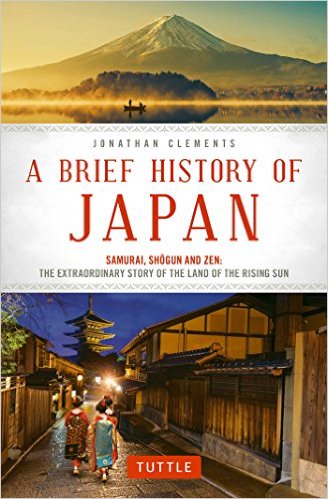
51zwcdv1xl-_sx326_bo1204203200_My new book is out on 1st August on Amazon UK and Amazon US.

Stretching for 3000 kilometres and encompassing almost 7000 islands, Japan has the fourth largest GDP and the tenth largest population in the world. Japan is a country of paradoxes, a modern nation steeped in ancient traditions; a democracy with an emperor as head of state; a famously safe society built on 108 volcanoes and an active earthquake zone. Despite a reputation for sprawling cities and cutting-edge technology, 73% of its land comprises uninhabited mountains and forests.

First revealed to the West in the Travels of Marco Polo, Japan was the legendary faraway land defended by the fearsome Kamikaze storm, and ruled by a divine sovereign. It was the terminus of the Silk Road and the edge of the known world, a fictional construct for European arts and crafts, and an enduring symbol of the mysterious east. In recent times, it became the powerhouse of global industry, a nexus of pop culture and a harbinger of post-industrial decline. This fascinating book tells the story of the people of Japan, from ancient teenage priest-queens to teeming hordes of salarymen, a nation that once sought to conquer China, yet also shut itself away for two centuries in self-imposed seclusion.

Advance praise for A Brief History of Japan:

“Writing a brief history of a land as ancient and complicated as Japan is no easy task. It requires not only superb language and research skills, but the ability to synthesize and organize vast amounts of information, and to make cross-cultural comparisons from a truly global perspective. It also requires a certain intellectual fearlessness. Luckily, with Jonathan Clements, readers are in the hands of a master. His crackling prose, sharp wit, and learned insights make Japan’s history truly come alive.” –  Frederik L. Schodt, author of America and the Four Japans: Friend, Foe, Model, Mirror

“Perfect for travelers or students new to Japan. A wonderfully fun, interesting, and informative introduction to Japanese history. Clements blends culture, politics, military, economics… all with wit and humor that both carry you forward and make the topic real.” – Mark Zachary Taylor, author of The Politics of Innovation

“With a lightness of touch but seriousness of purpose, Clements negotiates the complexities of Japanese history in this compact book. The result is an accessible, persuasive and reliable introduction.” – Ellis Tinios, Honorary Lecturer in East Asian History, University of Leeds


Projection Booth: Akira

“Jonathan Clements, author of Anime: A History, provides Mike with some much-needed background on Japanese animation while co-hosts El Goro and Chris Cummins describe their love of Otomo’s groundbreaking film.” I feature on the acclaimed Projection Booth podcast, as the team tackle anime.

The Hawking Index

We live in an age with unparalleled potential for big data. I nearly wrote “access to big data”, but in fact, a lot of that information is proprietary and only shared within the corporations that own it. Most notoriously, Amazon was able to use Kindle data to work out not only who was buying what, but who was actually reading it. The company was able to announce that Donna Tartt’s The Goldfinch was the least-finished book of recent times, abandoned partway by 55% of the people who paid to read it.

The mathematician Jordan Ellenberg proposed a “Hawking Index”, named for the author of the much-bought, little-read Brief History of Time, listing all the books that failed to get any reader love. It was one of those jokey news items that closed out the day, and little has been heard of it since.

But that big data is still churning. When the online streaming giants started up, there was a veritable scramble for content. Companies sitting on a reasonable backlist of anime found themselves offloading digital rights by volume, because what mattered to the early-bird marketers wasn’t quality, it was quantity. Join our service, they would proclaim, because we have five hundred anime titles! Of course, most of those titles would be stuff like King of Bandits Jing, which nobody really watched, and which had previously only monetised when the warehouse storing the DVDs was burned down during the London riots and the owners got to claim on the insurance.

But that didn’t matter. Never mind the quality, feel the width… until you fast forward a couple of years, and companies like Netflix know exactly what people watch and what they don’t. They know now that nobody is actually impressed by King of Bandits Jing, and see no reason to hang onto it. They’ll just keep Attack on Titan, thank you.

But now Netflix is even dropping their blue-chip titles. Remember: Netflix is a channel, not an archive. Quite controversially, last month it even dropped Buffy the Vampire Slayer, because Netflix is no longer in the old-show game. It wants to make new shows. Good news for new anime that Netflix is prepared to commission, but bad news for anime companies that evaded due diligence for a few years. And bad news for you, if you wanted to watch a less-loved show and didn’t bother to buy the DVD.

Jonathan Clements is the author of Anime: A History. This article first appeared in NEO #164, 2017.

Trolled by the Finns

It was only a matter of time before the Finnish embassy in Tokyo came up with a mascot character. And what did they choose? An Angry Bird? A heavy-metal corpse? An open-source penguin? No, they came up with Fintan, a somewhat simple seven-year-old boy, dressed in a lion costume, whose gormless presence somehow helped propel the embassy Twitter feed to 130,000 followers, making it the “tenth most followed diplomatic mission Twitter account.” You hear that? Better than eleventh. In your face, Burkina Faso! Fintan has been infesting the embassy social media for five years, but this year, as the Finnish republic celebrates its centennial, he branches out into animation.

“Our aim through these short anime is to increase the interest of the Japanese public towards Finland, and convey the message that Finns are innovative but also easy-going and easy-to-approach people, who don’t take themselves too seriously”, said Markus Kokko, Counsellor, Press and Culture of the Embassy of Finland in Tokyo.

In Kenji Itoso’s first short episode, Fintan goes to an air-guitar competition and a cellphone-throwing competition, before sitting in a sauna for a while. The “plot” for this and episodes yet to come were the result of an open competition by the embassy in Tokyo, so I guess we should be glad that the public didn’t demand it be called The Adventures of Finny McFinnface. Coming soon from the British embassy, perhaps: the wacky animated adventures of Brekshit the incontinent, immigrant-hating bulldog?

And yet, Finland already has a good showing in Japanese animation. Lucy Heartfilia from Fairy Tail, sometimes seen wearing a Finnish flag made out of boobs, could easily be an ambassador for the country. The Moomins already are, to such an extent that there’s always summer work for Japanese-speakers if they want to dress up as troll-things in the Moominland Theme Park. Meanwhile, in Hetalia, the character of Finland is depicted as being in an oddly creepy relationship with Sweden… also true to life.

Hopefully Fintan’s later adventures will be more adventurous. Things that the Japanese would lap up like crazy about Finland: liquorice-flavour vodka, tar-flavoured ice cream, 58 words for frozen precipitation, the Winter War, the world’s 16th highest rate of gun-ownership, the Northern Lights, Topless Thursdays, and the time a Japanese secret agent sent a bunch of drunken sailors with a ship full of guns and ammo to start a Finnish revolution and distract the Russians from the Far East. Now there’s an anime…

I’m sorry: I made Topless Thursdays up, but there’s still time, Finland.

Jonathan Clements is the author of An Armchair Traveller’s History of Finland. This article first appeared in NEO #163, 2017.

The Road to Beijing’s History

IMG_1411

In An Armchair Traveller’s History of Beijing British author and historian Jonathan Clements conveys a brief account of the history of Beijing from prehistory to our contemporary age – through its fluctuating fortunes under a dozen dynasties. From Mongolian chiefs and the glorious Ming emperors, whose tombs can still be found on Beijing’s outskirts, the book gives us the opportunity to experience Chinese history itself. The book also emphasises the city’s precarious heritage in the 21st century as modern construction wiped out vast chunks of the old city to pave way for residential areas for twenty million people.

Whether you are a Sinophile, or you simply want to find out more about this city that has been presented in Western media more for its soaring levels of pollution than its rich culture and complex history, come and join us at London’s Asia House on Tuesday, 18th July when Jonathan Clements will be sharing his insights about the past and present of Beijing through the pages of his book published by Haus Publishing.

Tickets on sale here.

Animation Plus

Animation Plus: Research on Transformation and Upgrading of China’s Animation Industry was published a year ago by the Social Science Academic Press, and has received a telling ZERO reviews on Amazon China. That, I would suggest, is palpably part of the problem – despite its immense leaps in recent years, people find it hard to get invested, emotionally or otherwise, in Chinese animation, including the Chinese themselves. Author Zhang Huiling has a background in both journalism and broadcast media, and has approached China’s underperforming industry armed with charts, facts and figures. But despite her diligent and extremely useful compilation of data, is anyone paying attention?

Her study is packed with admirably hard information, detailing the recent history of Chinese animation, as well as some intriguing elements of its statistical composition, including episode counts, genre percentages and studio locations. She deals with China largely as a sealed system, large enough to create winning franchises without recourse to foreign sales, although this is precisely why Chinese animation so rarely exports well.

To a certain extent, Zhang is both rediscovering the wheel and pretending she can’t see the cart. Much of her book is an extended argument about the crucial role of intellectual property – what the Japanese call contents – in forming a firm foundation for exploitation in multiple media, including animation. But in doing so, she runs right into the middle of a political minefield in which Chinese animation refuses to discuss the existence of Japanese competitors. Japanese animation, as noted on this blog on multiple occasions is not only a vital patron of the Chinese arts, but also a rival worth watching. Zhang acknowledges this with a final chapter devoted to the successes of Toei Animation in Tokyo, but one can’t help but wonder if the timidity with which she raises this topic undermines her own argument. It’s not her fault if “Japan” is a dirty word in modern Chinese academic discourse, but an understanding of Japan’s success is vital for seeing both where the Chinese animation industry may have gone wrong, and indeed where it has the potential to do right.

An intriguing section of her book breaks down animation around the world, suggesting that certain territories have fundamentally different production and finance trees for their cartoon production. I’m not sure I agree with her flowcharts all the time – the Japanese one, for example, contains a solecism that has not been true for fifty years – but it is fascinating to see how Zhang the external observer explains the functions of the “American”, the “British”, the “Canadian” or, say, the “German” system. Zhang delivers in spades her subtitle’s promise of “research on transformation” of China’s animation industry, but I am not persuaded that her conclusions say anything that hasn’t been said before regarding its “upgrade”. As suggested by Rolf Giesen, among many others, the fundamental issue facing Chinese animation is not something that can be solved with financial voodoo or marketing magic. It requires an overhaul at the very foundations, arguably nothing to do with Chinese animation at all, but lodged more squarely in the creation of the intellectual property itself. For as long as the Chinese animation industry is dominated by bean-counters, managers, and political meddling in content, it will never create the kind of intellectual property to support the sort of world-beating franchise that Zhang demands. Her book, however, is a treasure trove of useful information that other researchers will be sure to draw upon.

Jonathan Clements is the author of Anime: A History.

Route Awakening 3

Season three of Route Awakening is now airing in China, with some thirty or so other countries fast behind it. You can see the trailer here for glimpses of me getting attacked by Kam tribesmen in fancy dress in a muddy pond, witnessing the shamanic rituals of the Gorlos Mongols, and sundry other explorations among China’s ethnic minority groups. The picture above is my favourite from the shoot, taken by Mack Zhang, our fixer, of me and Daniel the director of photography, interviewing the village “Ghost Master” in Tang-an, Guizhou.

Things Unheard

I would very much like to be enjoying A Silent Voice, but I have a bunch of other things to worry about. Just before the lights go down in the cinema, I get the word that the promised 40-minute post-film Q&A had suddenly dropped to 20 minutes – shoving an extra half-hour onto a slot’s running time often disappears in the cracks between schedulers, projectionists, front-of-house and cleaners. The woman who tells me this also warns me that we are starting 15 minutes late, because someone who shall remain nameless went off to the bogs, and we couldn’t start the film without them.

Anime Limited want to film the Q&A event for a DVD extra. Kyoto Animation are in the house with their own camera. The director, Naoko Yamada, is sitting next to me and has no idea about the blind panic unfolding in my mind over the next two hours. She’s already sat through a 40-minute meeting where we talk over the likely questions, and her minders steer me towards the areas they most want to discuss. But now I am feverishly calculating and re-calculating the logistics.

How much time do I actually have? Assuming that I am not thrown out the moment I take the stage, is there enough time for audience questions at all? If I drop audience questions (and risk the wrath of fans), will there be still time to talk about the staff at Kyoto Animation, as I have been requested to do, or do we now have to make this all-Naoko, all the time? Maybe if I rush. Maybe if I just fire questions at her like an interrogator. Maybe if I drop all questions about the manga and pre-production and just get her talking about her work, I can salvage something.

The lights go up. I take to the stage and introduce the director of A Silent Voice, and catch myself glancing at my watch when the applause goes on too long. Too much applause will cost me another question.

The cameras are running, the audience are laughing. I even relax the interrogation a little and we seem to have time for audience questions. Later on, I find out why – the person tasked with signalling me that we are out of time has decided to simply lie about it. We run over, which means that cinema-goers two films behind us might find themselves hard-pressed to make it for the last bus. Someone is going to get into trouble over this, but it’s a judgement call that saves the event. For the half-hour that the event lasts, it all looks smooth. Nobody saw the negotiations beforehand, the fretting throughout the film, or the slap on the wrist that the distributor got from the Glasgow Film Festival authorities for playing havoc with their schedule. It’s our job to make this all look easy, but sometimes it really isn’t.

Jonathan Clements is the author of Anime: A History. This article first appeared in NEO #162, 2017.