Statue of Limitations

Just a couple more years, and Bandai accountants might have thrown away all the relevant documentation, allowing two former employees to get away with deceptively simple crime. But someone got a surprise when checking over old invoices, leading at least one man to get caught cooking the books at the Japanese company most famous for Gundam.

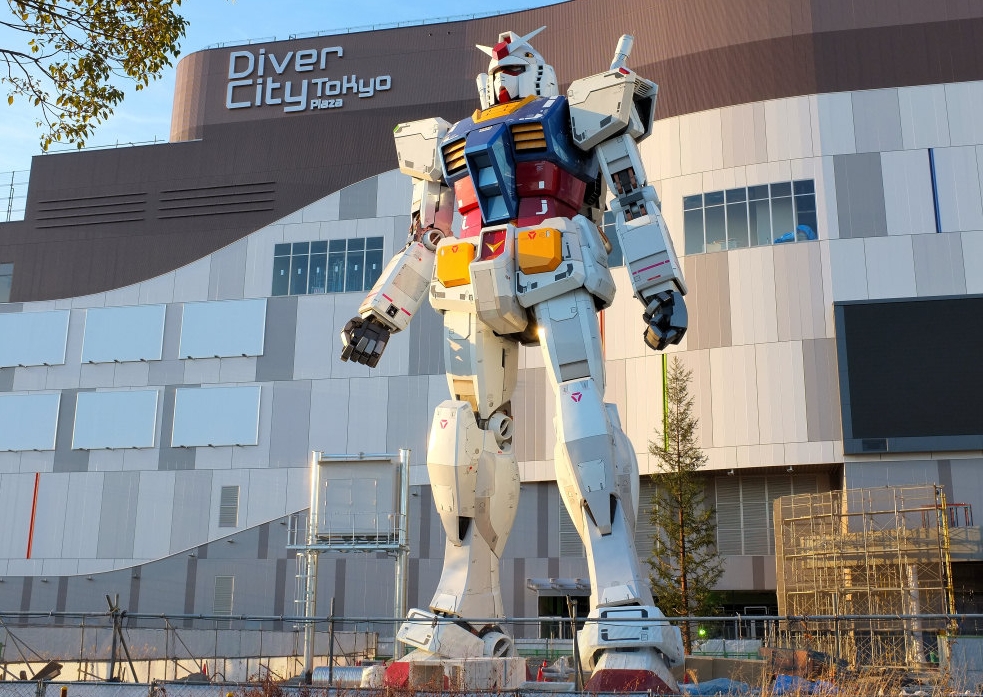
I say “at least one”, because so far among the accused, only Takashi Utazu (44) has pleaded guilty to the charges, which include talking up the costs of installing the giant Gundam statue in Odaiba in 2013, and pocketing the surplus. LED lighting, which should have cost 10 million yen, was billed to the company at 20 million, leaving Utazu and his alleged accomplice with almost £70,000 in pure profit. And that’s only one incident in a four-year scam, thought to have netted the embezzlers a total of 200 million yen (£1.4 million).

Because of the sheer size and volume of certain franchises, toy companies have to deal with sums an order of magnitude above what simple folk like you and I are used to. A few years ago, when the Japanese government was dickering about the expense of the much-mooted National Media Arts Centre, it was a Bandai staffer who put everybody in their place by pointing out that the sums under discussion cost no more than a single new theme-park ride. It’s very easy, said another, to spend a million dollars. He meant that when you’re dealing with numbers this big, the overheads of simply making enough toys for something to stand a chance of becoming a bestseller turn into phone-number sized entries on a spreadsheet. Bandai won’t miss a few thousand, right?

Well, wrong. Their bean-counters are super-powered, transforming maths robots, and the dating on these reports makes me think that someone flagged up something fishy, seemingly in projects connected to another employee – a man who is currently continuing to protest his innocence, even though he was fired in October 2017 over the audit findings. There’s a statute of limitations on financial reporting – in Japan as in the UK, companies aren’t obliged to hold on to records for longer than seven years. So the thieves might have got away with it, if it weren’t for those meddling accountants.

Jonathan Clements is the author of Anime: A History. This article first appeared in NEO #186, 2019.


Tabito’s Party

It was the party to end all parties. Otomo no Tabito, the governor-general of Dazaifu had invited thirty-one bigwigs from all over Kyushu to a fete in his garden, scheduled to be held a fortnight before reigetsu, the “auspicious moon” that marked the second month of the lunar calendar. The year was 730 AD. People came from as far away as Satsuma and Tsushima. The plum blossoms were just starting to open, there was mist on the mountains and the first signs of life were stirring – new butterflies had hatched from their cocoons, and old geese returning from their winter retreats.

Pleasantly sozzled, the vice-governor Lord Ki came up with a poem of welcome, suggesting that it was a nice night to welcome the plums – likely a reference not only to the flowers in the garden, but to the booze everyone was knocking back. His junior assistant, Mr Ono, answered with a poem of his own, pleading with the blossoms not to fall and scatter. Don’t forget the willows, said Mr Awata, another junior, again in verse form, creating a chain in which every guest threw in his own variation on a theme. It was a decidedly Chinese affair, redolent of the contemporary drunken poet Li Bai, conceived in apparent imitation of similar festivities in Chang-an, the distant capital of China’s Tang dynasty. There was a lot of talk of flowers, but also of the transience of life and the joys of booze. Later verses, fuelled by more wine, drifted a little towards the maudlin. The penultimate poem, from the secretary Mr Kadobe, spoke wistfully of the blossoms staying forever to delight the girl he loved… a rather tardy acknowledgement that only men’s voices were being heard, and that maybe they could all find something better to do than sitting around talking to other blokes. The women, presumably, were off somewhere having a party of their own, with limbo dancing and pillow-fights.

Tabito himself spoke in the middle, wondering if he could see scattering petals or flurries of late snow. But once the verse cycle was complete, he seems to have spoken up again, appending several other verses as closing remarks. The guests had tried to keep things light, but Tabito’s final words alluded to his advancing years, and his annoyance at a career that had seen him promoted away from life in Nara to a provincial posting. You could keep your wine, he said. You can keep your thoughts of Daoist immortality treatments. No booze or magic potion will make me feel young again. Only seeing the capital will do that for me. “To see [the capital] / That will cure this villainous old age / And give me my youth again.”

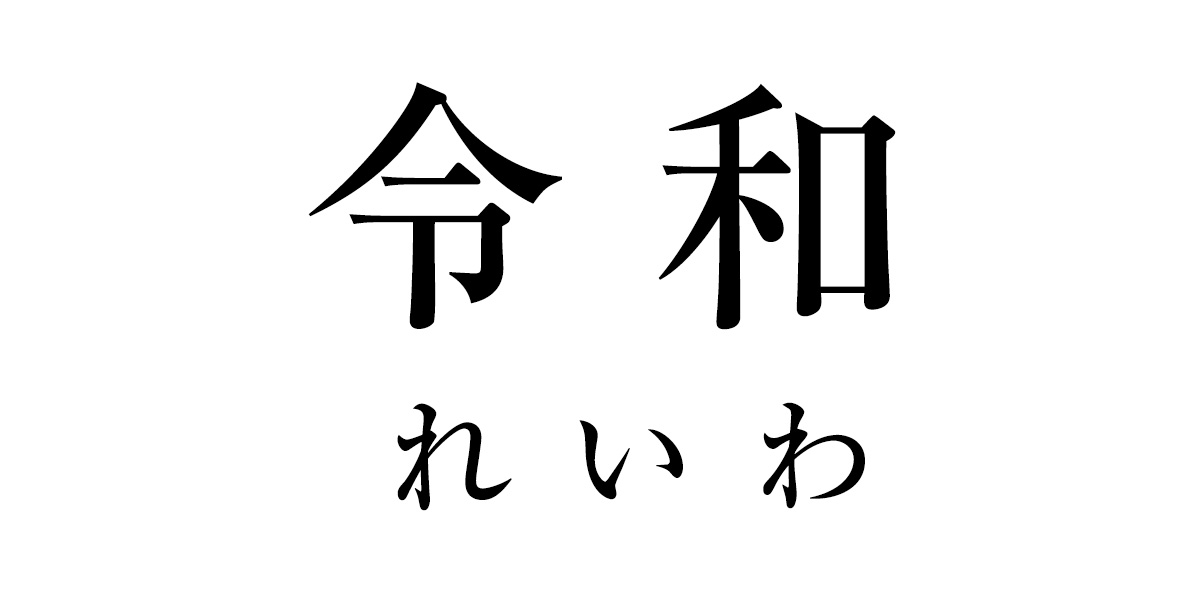
Otomo no Tabito died the following year, in his mid-sixties. The cycle of verse from his big party was preserved for long enough to end up a generation later in one of the poetry selections in the Manyoshu (Collection of Ten Thousand Leaves). It came accompanied by a preface written in literary Chinese, which set the scene with the fateful line (taken here from Edwin Cranston’s translation in A Waka Anthology: “It is now the choice month of early spring; the weather is fine, the wind is soft.” One thousand, two hundred and eighty-nine years later, the two characters rei and wa would be lifted from that phrase, and used to name the reign of the new Japanese emperor, Naruhito, in 2019.

Jonathan Clements is the author of A Brief History of Japan.

Animated Encounters

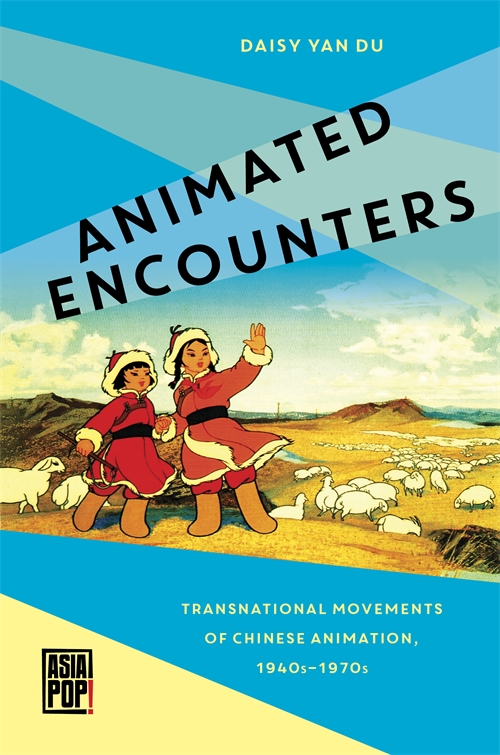
Over at the All the Anime blog, I review Daisy Yan Du’s new book about the inspiration and influences of Chinese animated films, which includes substantial detail on cross-pollination with Japan.

“Du’s concentration on Chinese animation in an international context is a rewarding account not only of films released, but of unexpected influences and projects that never happened. She regards the Wan brothers’ Princess Iron Fan (1943), for example, as’“far more influential in wartime Japan than in wartime China,’ but also reports that when Japanese animators came to Shanghai in 1988 looking for subcontractors on the Saiyuki TV anime, the Shanghai Animation Studio refused to work on it, because the Japanese version of the legend of the Monkey King deviated too far from acceptable norms.”

Money for Nothing

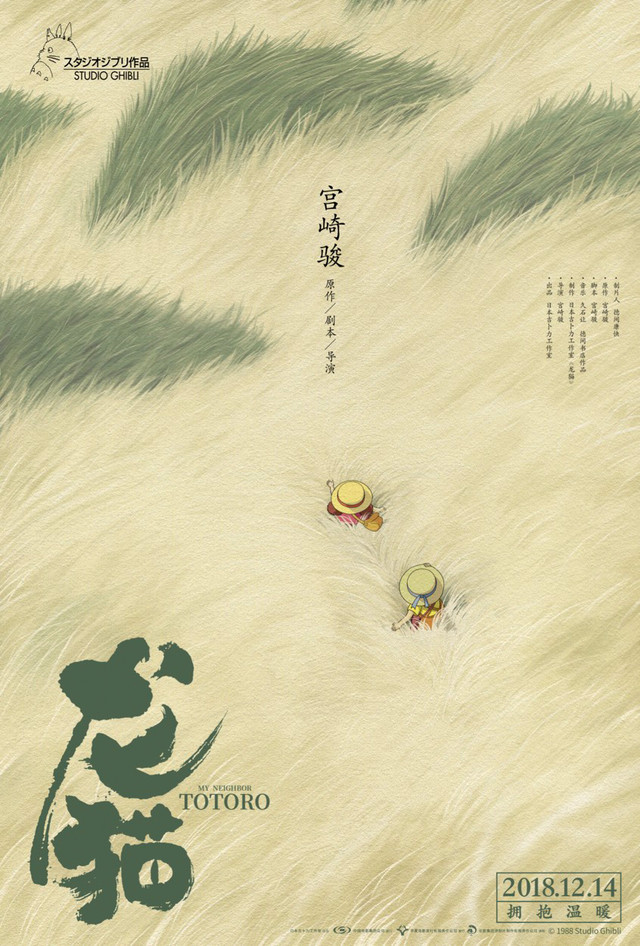
Hayao Miyazaki’s fluffy forest spirit Totoro has been around in China for thirty years, sneaking in through Taiwanese or Hong Kong DVDs, or stowing away in kids’ luggage on return trips from Japan. But his first official cinema outing in the People’s Republic did not come about until December 2018, when he suddenly burst out on 3,000 screens.

Interpreting the numbers, Totoro had a fantastic opening weekend, making $12.9 million and beaten only by Aquaman. But by the end of its second week in Chinese cinemas, its takings had slumped 75%. I’m writing this article on New Year’s Eve 2018, as Totoro’s total Chinese box office takings edge over the $20 million mark.

You might not think that $20 million is a lot of money, especially considering that half of that money stays with the Chinese distributors and exhibitors, and fair old chunk probably went on marketing. But Studio Ghibli certainly hasn’t lost any money by belatedly releasing its much-loved classic in China. In fact, it’s easy to forget that Totoro only made $5 million on its original Japanese release, and that was on a double bill with Grave of the Fireflies. Thirty years on, this is money for nothing. The Chinese box office last month counts for 80% of Totoro’s global lifetime theatrical takings!

But as long-time readers will know, movie accounting is often not about those numbers at all. It’s about a bunch of other issues, including the fact that the Japanese 2012 Blu-ray of Totoro created an all-new, cleaned-up pin-sharp copy of the film, ready for duplicating on 3,000 hard-drives to open on 3,000 Chinese screens. It’s about the fact that, unlike creaky old TV shows or low-budget video fare, movies have a much longer shelf-life, and a period piece like Totoro, with a rural setting and a feel-good tone, seems tailor-made for the Chinese provinces.

Meanwhile, with the suspension of the One-Child Policy, there are suddenly twice as many Chinese children to form a market. Children’s entertainment, along with clothing and toys, is a surging new growth area in modern China. Even considering the vast piracy of Ghibli products over the last few years – and I have never seen a Chinese video pirate who isn’t selling Totoro, usually a knock-off of the Taiwanese dub – there’s a whole new generation of Chinese kids who have never seen it, who now get to see it in cinemas, ahead of a roll-out of other Ghibli products. And is someone eyeing up the blueprints for Japan’s new Ghibli theme park, and wondering if they could transplant something similar to Shanghai Disneyland…?

[Since this article was published, the Chinese box office takings for Totoro climbed to $25.75 million]

Jonathan Clements is the author of Anime: A History. This article first appeared in NEO #185, 2019.

Top Men

At the end of Raiders of the Lost Ark, Indiana Jones was assured that his priceless, powerful archaeological find was being looked after by ‘Top Men’. But as the credits began to roll, we saw it nailed into a crate, dumped in a giant warehouse full of similar boxes, forgotten and abandoned. The image was Lucas and Spielberg’s homage to Orson Welles, a little piece of Citizen Kane recycled for a modern audience. But in Japan, Hiroshi Takashige asked himself: what was in all those other crates? And more importantly, who were these Top Men?

In collusion with artist Ryoji Minagawa, he decided that they were a secret, self-sustaining unit within the Pentagon, tasked with nabbing any weird and wonderful artefacts that come to light, many of which had been left behind by an ancient, highly-advanced civilisation. They began work on the comic project that would become Spriggan, only to find themselves influenced by real-world events.

They were writing at the time of the First Gulf War; a very difficult prospect for the Japanese. A nation, supposedly sworn to avoid violence and military aggression, was forced to sit on the sidelines and watch while the rest of the world got involved in a conflict about resources in the Middle East, the cradle of civilisation, resources that Japan itself needed as desperately as everyone else. It resulted in such tales as the desert robot combat anime Gasaraki, and in an interest, partly fuelled by The X Files, in presenting the Pentagon as the bad guy.

There is more than one agency searching for these artefacts. The Pentagon competes with the KGB, and both are in opposition to ARCAM, a global corporation that wants the artefacts for itself. Its crack, super-powered agents are spies-cum-archaeologists named after ancient Celtic temple guardians, the Spriggan.

Minagawa and Takashige initially wanted to feature an adult agent, but ended up selling their concept to an anthology magazine aimed at boys. Consequently, they moved their original lead into the background, and concentrated on his teenage nephew, Yu Ominae.

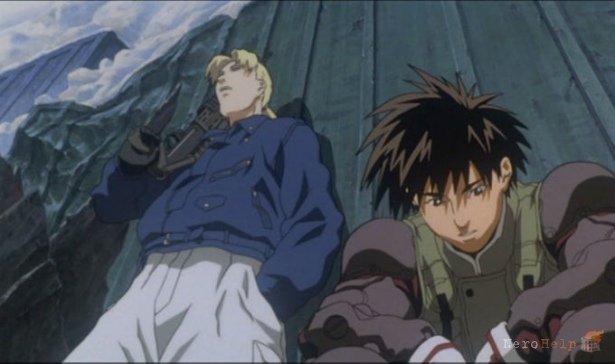
Rights for a movie adaptation were soon sold, and Spriggan went into production as an anime. The film-makers plumped for a script that emphasised the Indiana Jones parallels, chasing after a different Ark (Noah’s, in this case) at Mount Ararat, with cyborg Pentagon agents roughing it up with the ARCAM Spriggans in an action-packed thriller.

As Ominae, producers cast Shotaro Morikubo, better known in Japan as the movie-dub voice of Johnny Depp. Originally intended to go straight to video, the budget received a massive injection of cash, sufficient for a movie, when Katsuhiro Otomo announced he would be ‘involved.’ Akira creator Otomo was supposed to be working on his own project, the long-delayed Steam Boy, but fancied Spriggan as a kind of busman’s holiday. In fact, he is rumoured to have been the director in all but name; his fingerprints are all over Spriggan, in the design of the space-faring Noah’s Ark that the agents unearth, in the blue-skinned Pentagon child-telepath General MacDougall, and in the large amount of night-time shooting – an expensive luxury in animation that relies so heavily on light coming through the cels, but one that Otomo often enjoyed for the artistic hell of it. The credited director, Hirotsugu Kawasaki, has not had another movie to his name since, only emphasising the impression that Otomo’s more nebulous title of ‘General Superviser’ may have been adopted for contractual reasons. But for those in the know, there was no mistaking who the Top Man on the Spriggan production really was.

This article first appeared in the Judge Dredd Megazine #236, 2005, and was subsequently reprinted in Schoolgirl Milky Crisis: Adventures in the Anime and Manga Trade. A new adaptation of Spriggan has just been announced, forthcoming from Netflix.

Law & Justice

In case you missed it up on the All the Anime blog, my review of the academic collection Law and Justice in Japanese Popular Culture: From Crime-Fighting Robots to Duelling Pocket Monsters.

“Law and Justice in Japanese Popular Culture is packed with interesting concepts and articles. It will prove particularly useful as a wildcard for the savvy college tutor – something to throw into the reading list in order to engage with young students about the implications of Pokémon fights or the way that the best sci-fi anime can suggest new and prickly areas of legal dispute. It also offers valuable details on some of the peculiarities of the real-world Japanese legal system, as seen through the way they influence the plots of thrillers, and even the assumptions that fictional characters make about the nature of right and wrong.”

Disappearing Anime…

December’s issue of Wired magazine included an article that stumbled across something that NEO readers have known for years – that online repositories for your favourite movies cannot be trusted. Brian Raftery’s article “Streaming isn’t Everything and Blu-rays are Here to Prove it” informs Wired’s hipster readership that the really cool kids are hunting down bespoke DVDs of their favourite films, because there really is no guarantee that some whim of international licensing will suddenly cause titles in online libraries to wink out of existence.

If, like me, you are lucky enough to live in a town with a well-curated second-hand video store, you may still be able to snatch up one of the obscurities. Good curation, however, also comes at a price. The nearest store to me is scrambling desperately to offload its DVDs so it can concentrate solely on Blu-rays.

There are all sorts of reasons why a film is no longer available. Often it is a trivial matter like music rights, when it is too expensive to remove a song, but also simply not worth the distributors’ while to pay for the rights to use it. The number of likely sales is outweighed by the cost of ticking all the right legal boxes, and this is a particular danger to anime, when many titles struggle to sell more than a couple of thousand copies.

Films fall in and out of libraries. Their ownership is tangled by changes in committee compositions, or corporate take-overs. It’s important to remember that just because you own a DVD, you don’t actually “own” the film on it, only the right to play it in your recorder. If your DVD stops working after a thousand plays, you are not entitled to a replacement; you’ll have to buy it again.

I find it ironic that even as the likes of Netflix throw buckets of money at new anime shows and fund remakes of Death Note and Cowboy Bebop, their very ubiquity and disruptive influences are making other shows harder to find. But on balance, we still have an easier time of it in the modern world. Streaming sites still offer immediate access to hundreds of anime, and may well introduce you to something you would never find in the video shop. And if you really must look for a solid, online stores can tell you in moments whether that’s actually possible…. And if not, cheekily offer you a Dutch or Polish version that’s almost as good and will probably play in your player. Some anime might fall between the cracks in the pavement, but at least online searching saves you wasting shoe leather tramping around the shops.

Jonathan Clements is the author of Anime: A History. This article first appeared in NEO #184, 2019.

Vital Statistics

Continuing to make a mockery of the supposed four-panel format is I Love the Best Boobs in the World by Wakame Konbu. Yes, that’s a pseudonym, since it means Seaweed Seaweed, and you’d probably want to hide your real name if you were writing a comic about a kind-hearted teenager, Chiaki, who is best friends with classmate Hana, whose mammary glands are apparently the top of the tit tree. In this month’s instalment, our two heroines go shopping for bras, which allows the implied male reader a delicious, erotically-charged peek at what goes on in lingerie shop changing rooms. Chiaki, in fact, is a wolf in sheep’s clothing – as a girl, she gets a free pass into such inner sanctums, although she secretly has a fetish for large breasts, and loves to be around them.

Because NEO leaves no stone unturned in its investigation of Japanese culture, it’s time to talk boobs. The Triumph company has been logging Japanese bust-sizes since 1980, allowing statisticians to plot a curve of Japanese… curves. The story it tells is a compelling one born from changes in Japanese dietary habits (particularly dairy products containing bovine growth hormones) and trends, suggesting that A, B, and C cup sales have been dropping for a generation. Whereas A-cups in 1980 were worth 58.6% of all Japanese bra sales, now they’ve fallen to 4.1%. 2016 was the tipping point – the first year in which D, E and F cup sizes represented more sales in Japan than A, B, and C.

However, before you rush off to impress your friends with this news, some things to bear in mind. Firstly, Japanese bra sizes are not the same as other countries’. A Japanese E-cup, for example, is the same size as an American D-cup or a British DD.

Even allowing for these differences in definition, there is still a palpable change in bra-buying in Japan since 1980, but this does not necessarily mean that Japanese women are suddenly bustier. Triumph cautions that it may simply mean that women with bigger chests buy more bras, either as a feature of their struggle to find one that fits properly, or possibly because they are more likely to work in a sector that requires what we shall gingerly call performative lingerie exhibition.

University undergraduates who have suddenly decided on their final essay topic while reading this page are also advised to bear in mind that many Japanese bras are also aspirational – you might be a humble A-cup, wearing a padded C-cup because you think it will get you noticed. In that regard, the changing statistics may have less to do with changes in body type, and more to do with 21st century standards of beauty.

Jonathan Clements is the author of  A Brief History of Japan. This article first appeared as part of the Manga Snapshot column on Comic Cune in NEO #180, 2018.

The Curse of the Muramasa

Urban myths of the late eighteenth century suggested that Tokugawa Ieyasu had been troubled by the constant recurrence of the name of one particular swordsmith among his enemies. Late in life, he developed a superstition that blades made by the sixteenth-century school of Muramasa had been specifically cursed to do damage to the Tokugawa family. The reasoning for this, at least as far as the rumours went, was that Ieyasu’s grandfather had been killed by one, his father had been stabbed by one, and Ieyasu injured himself with one when he was a child. His worries only increased when he discovered that in the case of two executions, that of his adulterous wife and supposedly treacherous adopted son, the executioner’s blade had been a Muramasa, too. Over time, Ieyasu came to believe that every one of the generals who had opposed him had wielded a Muramasa blade, including Sanada Yukimura, who had supposedly dealt him a troublesome wound at the Battle of Tennōji in 1615. The attentive reader may note that sources from the time report that, if Ieyasu was wounded at all by Sanada, he was wounded with a spear, but no matter – the fiction was already more alluring than the already shaky facts.

Muramasa blades were highly prized, so it should have come as no surprise that they were in the possession of wealthy members of the aristocracy. Nor should it have been a mystery why aristocrats facing death would insist on their executioner using the sharpest, highest-performance blade available. But the stories about the ‘Curse of the Muramasa’ seem to have served another purpose in eighteenth-century Japan: delivering a chilling frisson to audiences with the reminder that there was a time when someone stood against the Shōgun, and that their legacy lived on, hidden within clans, buried in storehouses, and traded among sword-dealers.

Muramasa blades, it was said, were cursed. Their creator was half-mad, and the weapons he made could impel their wielders into murderous rages. One story tells of a young samurai, Gentaro, up in Edo as part of his obligatory domain service, who sees a Muramasa hanging among the other swords on a dealer’s rack:

Trembling, he withdrew it from its scabbard, and he forgot to breathe. The sword had hidden depths, like morning mist welling up within the metal. Light danced off the blade in the colours of the rainbow . . . Just by holding it in his hand, he could tell it was a masterpiece . . . an artefact suitable for a lord’s treasure house, fated never to come into the hands of a common samurai.

The samurai is even happier when the dealer offers to sell him the blade for a fraction of its true value, although he will not say why. Cheerfully, Gentaro brings the sword back with him to his home domain, where he shows it off to his fellow officers at the monthly sword club. Despite everyone’s gasps of awe, the club chairman tells him the sword is worthless. Suspecting that the chairman merely wants to buy it from him cheaply, Gentaro seeks a second opinion, and is told the whole sorry story of the cursed blades. In a spate of demises that prefigure the calamities of a modern horror film, most people involved in the story are dead within a week, as is the family servant told to throw the sword in a river, who unwisely plans to keep it for himself.
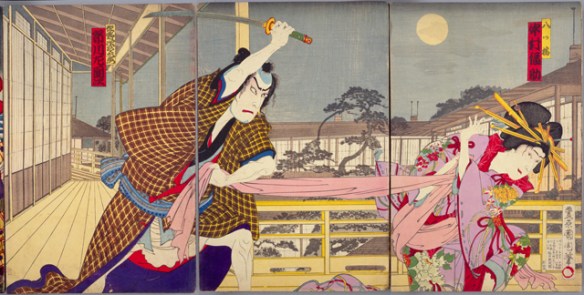
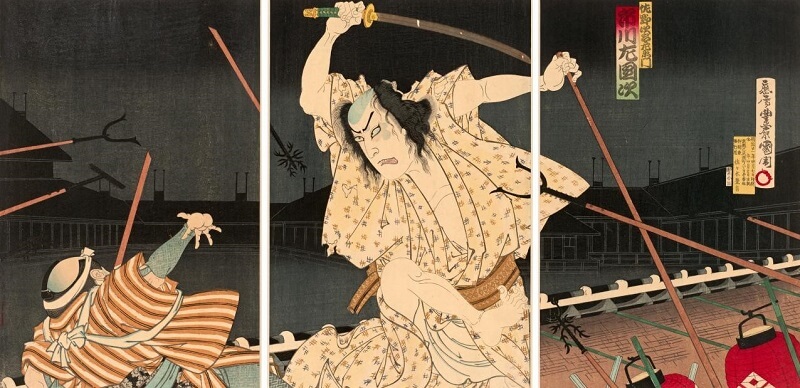
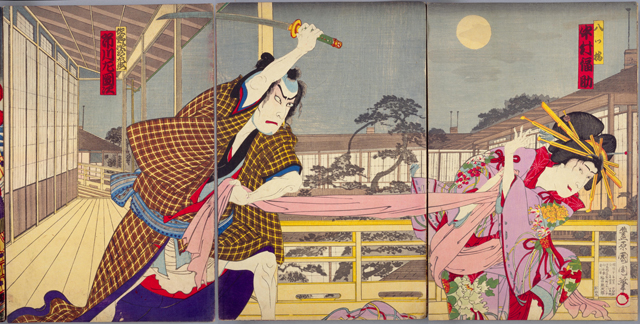
The legend achieved a wider audience in 1797 when it gained a prominent mention in a popular kabuki play Oblique Reflections of Brothel Lives (Satokotoba Awasekagami). Revived in 1815 and again in 1860 with slight variations, the story became a recurring staple of the Japanese theatre. The main narrative concerned a missing girl in the pleasure quarter, and an impoverished son of a merchant desperate to raise the money to buy his lover out of indentured servitude in a brothel. Mixed in with these basic plots are shadows of the Muramasa legend – a cursed Muramasa blade is sold by a hapless sword-dealer, who is soon murdered; it falls into the hands of one of the leading characters, and drives him into a serial-killing spree. As so often happened with kabuki theatre, real-world reportage is hidden within the melodrama. It drew inspirations from the collapse of an Edo bridge in 1807, and the 1820 murder of a capricious geisha by the man who had bankrupted himself to buy her freedom. By the nineteenth century, Muramasa swords were associated with a whole series of half-remembered macabre tales of murder and betrayal, and had come to be linked in the popular mind with the decline of samurai honour into bloody, inconsequential vendettas, and fights over bar-girls or petty debts.

Despite the superior quality of Muramasa blades, they became impossible to sell, and there are cases of some swords on which the smith’s name was doctored, Muramasa becoming altered to Masamune – another smith but without a tainted reputation. In fact, the anti-Tokugawa reputation of the Muramasa blades gave them an unexpected value among those who despised the government. Those few that survived the Tokugawa era, hidden in family vaults, are now worth millions.

Extract from A Brief History of the Samurai, by Jonathan Clements.

Flowers of Edo

The Sumida River was sure to rise every year, either directly endangering the Low City slums or increasing the spread of rat- or fly-borne diseases. But in a town of close-packed wooden houses, every one with a hearth, the greatest danger was fire. Periodic conflagrations destroyed entire districts of the city, and could be kicked off by a single errant spark. The most boggling was the Meireki Fire of January 1657 (like many such events, it derives its name from the reign-period in which it took place), which began, like some horror movie foreshadowing, with a haunted kimono.

This article of clothing had been owned by three girls in succession, every one of whom had met with a sudden death. Believing the kimono to be cursed, its new owners ordered it to be burned at a Buddhist temple. A gust of strong wind lifted up fragments of the burning silk and deposited them on a temple roof, which soon caught alight. The flames jumped from temple to tavern, over bridges and storehouses, burning down six entire districts. In the chaos, a second fire started, perhaps from a neglected cooking stove or a dropped tobacco pipe. With the populace already distracted by the first fire, the second raged through the samurai district, burning the inmates of the city prison alive, and even destroying Edo Castle. Over 100,000 people, a third of the entire population, died in the two days of the Meireki Fire, not merely from the flames, but from the wintry aftermath. Even as the wreckage still smouldered, snow began to fall with mocking irony, dooming many newly homeless residents to death by hypothermia.

Fires were so commonplace and so feared that the locals did not even dare to call them what they were. With a customarily poetic fatalism, they referred to them as ‘the flowers of Edo’. Many houses gained rooftop crow’s nests to allow the occupants to see how close nearby fires were getting. A common feature of every district was the hinomi-yagura (fire-watching tower), which looks to modern eyes like a pair of telegraph poles placed close enough together that the rungs of a ladder can run between them. At the top was a bell and a tiny perch no bigger than a footstool, allowing residents to peer into the next city block to see how great the risk was whenever they smelled smoke.

Eventually, Edo gained a new class of ‘firemen’ although their job description was somewhat different from what one might expect. Exhibiting a certain resignation about the impossibility of putting out a fire, they instead ransacked the house, carrying out the valuables to spare them the flames. Private enterprises rather than publically-funded do-gooders, the firemen existed as multiple rival brigades, often leading to scrums of contending rescuers at any disaster scene. Standard bearers carrying the standard of a particular firemen’s guild would perch as close to the burning building as possible, so that everyone could see who had arrived. Fire-hoses, using a relatively meagre hand-pumped stream from the nearest canal, were intended not to dowse the flames, but protect the firemen as they worked.

Over the years, it became apparent that the best way to protect one’s business was to strike a deal with the firemen in advance, so that they were sure to come quickly in the event of trouble. In order to make allegiances clear, many businesses started to hang the standards of particular guilds over their doors. This was the origin of the decorated noren, the half-curtain that can still be found at the entrance to many a shop or noodle bar.

From An Armchair Traveller’s History of Tokyo by Jonathan Clements, available now (US/UK).