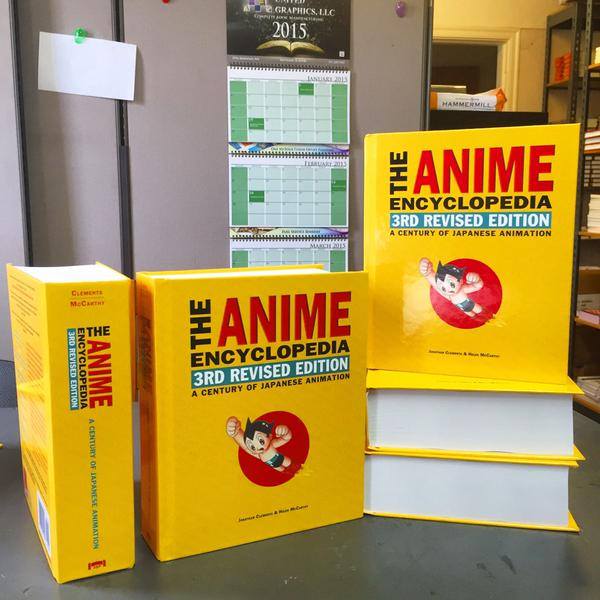
Copies have just arrived at Stone Bridge’s San Francisco offices of the new edition of the Anime Encyclopedia. Helen McCarthy just won the internet by saying: “And of course, it’s even bigger on the inside.” 1200 pages, 1.1 million words.
All That Matters
“Japan is still living five years into the future, but whereas that was once a breathless boast of oncoming technologies and trends, today it’s a warning of the crises that could also face the developed world as a whole.” Over at The Japan Times, I am interviewed by JJ O’Donoghue about my new book, Modern Japan: All That Matters (US/UK).
Speculate to Accumulate
It’s been less than a year since this column (NEO #123) called attention to the intricacies of J-LOP, a funding scheme designed to generate foreign revenue for Japan by helping the translation and marketing industries. Ever since the Aso administration, Japan has been particularly wise to the potential of intellectual property, and the excellent opportunities it offers a recession-hit economy to sell something without actually losing anything, all the better to sell it all again. Renting access to viewers and readers is the ultimate post-modern money-maker, and the Japanese government is determined to encourage the very sort of thing that you, dear reader, love.
Or is it? Already with J-LOP there was the faint whiff of jobs for the boys, with the money being handed in a “trickle-down” format, given to the bigwigs and copyright holders, and then passed on down to their minions. Now comes the news that Dragon Ball Z: Battle of Gods went into production with a new “Unijapan” development grant of fifty million yen. That’s almost £287,000.
Now let’s be honest, Akira Toriyama is hardly standing outside in the street with an eye-patch and a tin cup. Nor is Toei Animation on the skids. Battle of Gods got its money because 20th Century Fox was able to match it pound for pound, but it also came with a guarantee of success – first DBZ film for 17 years, sure to pack Japanese cinemas. Doubtless the movie earned back its money at the box office, and generated plenty of cash and tax and talk. But in backing such a self-fulfilling prophecy, wasn’t the funding body going for the easiest and least risky option? Maybe, if you were a Japanese tax payer, you would welcome the idea that arts funds were going on something that was sure to make a profit, but is that really what arts funding is for?
However, Unijapan isn’t about arts funding, it’s a hard-nosed scheme to generate capital investment. It’ll only give you a maximum of 20% of a film’s budget, which means four times as much money has to come from real investors. Perhaps more interestingly for us, its qualifications for animated productions do not require production in Japan – you can make the whole thing in China if you like, as long as the top staff are Japanese. Hmm… wonder how that’s going to work out…?
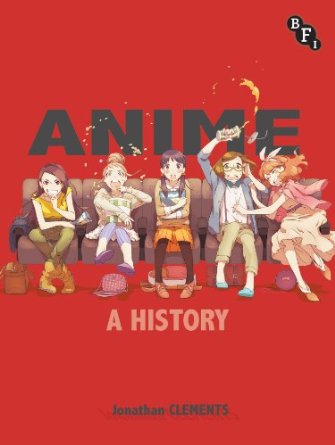
This article first appeared in NEO 132, 2014. Jonathan Clements is the author of Anime: A History, in shops now (UK/US).
Choice Award
Apparently my book Anime: A History (US/UK) has just been selected as one of 23 Palgrave titles receiving this year’s Choice Award, a recommendation dished out by Choice: Current Reviews for Academic Libraries, a publication of the American Library Association. “This list of publications reflects the best in scholarly titles and is designed to attract the attention of the academic library community,” quoth Palgrave.
Medieval Boobs
Because I wrote a book about Empress Wu, the LA Times quotes me as an expert on medieval boobs. Because my life can’t get any more surreal.
Undercover Manga
I’ve been wondering for a while when the Doraemon bomb was going to go off. Every time I’ve been to China in the last three years, amid ever-escalating sabre-rattling over the Senkaku Islands, I have found the locals avidly denying any interest in Japanese culture. I have found media students unprepared to work on papers about anime, for fear that the word “Japan” will be on their resumé ever more. And I have watched, every day, as two Japanese invaders march in right under Chinese noses.
One is Shimajiro, an infant tiger cub who appears in a hybrid kids’ show that is part anime, part live-action play school. I’ve watched Shimajiro sing songs about London Bridge and demonstrate how to go to the toilet, and nobody has noticed that he’s really Japanese, because the broadcasters have stripped out the original live-action framing footage and replaced it with Chinese people. Also, they don’t make the mistake of calling him Shimajiro, either. In China, he is known as Qiao Hu Dao, the “brave and clever tiger.”
The other is Doraemon, that time-travelling blue robot cat who recently enjoyed the surprising honour of a 12,000-page manga translation funded by Japanese government boondoggle money. Doraemon remains a popular movie and TV figure with anime audiences, but was also the subject of so much manga piracy in decades past that he is known by several different names in the Chinese world. My favourite is Ding Dang the Robot Cat (ding-dang, you see, being Mandarin for ding-dong, if you ever need it). He’s even the subject of an exhibition in Hong Kong, which trilled, unwisely, about his true origins.
The Japanese authorities, excited at the amount of love for Ding Dang all over the mainland, have made Doraemon a cultural ambassador, thereby pushing their soft power agenda by showing the Chinese that a perennial favourite was actually from the other side of the water. This has entertainingly backfired, with a schmuck-bait editorial in the Chengdu Daily pointing out the blindingly obvious – that Doraemon was an effort to make Japan look cute and less threatening – and several lesser newspapers getting increasingly irate about the idea, with the Global Times frothing “we must never let a little robotic cat take control of our minds.” Top tip.
This article first appeared in NEO 131, 2014. Jonathan Clements is the author of Anime: A History, in shops now (UK/US).
Empress Wu: Too Hot for TV?
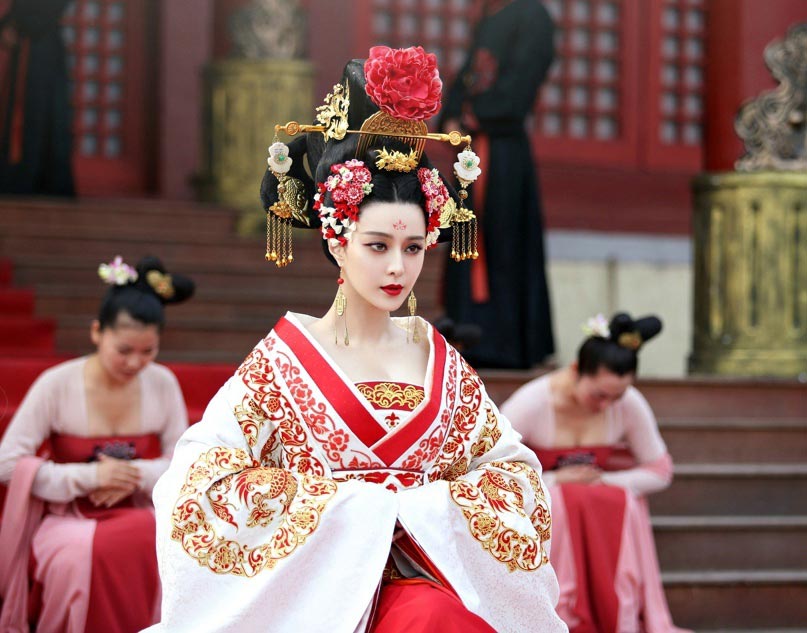
This week’s Telegraph reports that the new TV show Empress of China, all about the scandalous Empress Wu, has been taken off air amid scurrilous gossip over its revealing costumes and grotesque violence. Robert Foyle Hunwick in Beijing notes that: “The State Administration of Press, Publication, Radio, Film and Television (SAPPRFT), China’s chief censors, has issued regulations banning depictions of one-night stands, adultery, sexual abuse, rape, polyamory, necrophilia, prostitution, nudity and masturbation, as well as murder, suicide, drug use, gambling and even racy subtitles and puns.” Well, that pretty much covers a to-do list of any historically accurate account of Empress Wu. Oh, except gambling; I don’t remember any gambling.
For more about the historical Empress Wu, see my interview here, my article on film adaptations here, or listen to my Woman’s Hour interview here.
Romans on the Silk Road..?
From An Armchair Traveller’s History of the Silk Road:
The Book of Later Han records an expedition by an emissary of Ban Chao who set out in AD 97 to assess the legendary empire in the furthest west, which the Chinese called Da Qin, ‘Great Qin.’ The name is odd, and has confused even Chinese commentators. It may be a garbled reference to a particular place in the Roman Empire, although it is not clear where. Fan Ye made the unlikely suggestion that the people of the exotic west were tall and honest, a bit like the people of the Chinese state of Qin. But the term may have carried a more ominous implication. In the days of the Warring States, before China was unified, Qin was the name of its westernmost territory – a martially-minded, hard-headed soldier state that eventually conquered all the others. In calling the Roman Empire ‘Great Qin’, Chinese chroniclers may have been alluding to a distant threat, further west even than Qin, but potentially even more powerful.
The mission was thwarted partway, probably by wily Parthians who feared that an alliance between Rome and China would crush their own state, which lay between the empires. Instead, the explorer was told that Rome lay across a great sea that would take him three months to cross if he were lucky, or two years if the winds were against him. Perhaps some Parthian merchant hoped to sell him three years of provisions for such a great undertaking, although it seems more likely that he made it to somewhere on the Indian coast, perhaps the Parthian princedoms of Sind, where he received a garbled explanation of the need to wait for the monsoon winds. Whatever the reason, he turned back, reporting that in the west there were many ‘precious and marvellous things’, but he had not seen them. To help out a little, Fan Ye offered his own list of Roman marvels, which included shaven heads, crystal tableware (glass) and ‘kings who are not permanent’ but chosen from a list of the most worthy.
If such reportage seems doubtful or outright apocryphal, we might forgive them for having no other information about particular parts of the world. Historians and novelists, for obvious reasons, are liable to get particularly animated about possible contacts between Romans and Chinese, although certain travellers claiming to have come from ‘Rome’ might have actually been chancers picking an unverifiable home address in their dealings with local potentates.
Fan Ye, for example, also recorded that an embassy had supposedly arrived from Rome itself in AD 166. But reading between the lines of his account of these visitors from the ‘King of Great Qin’, everything starts to sound very suspicious. They claimed to have come from the land ruled by a man called Andun – if they meant Antoninus Pius, he had already been dead for several years, and had been succeeded by his adopted son Marcus Aurelius. Let us give them the benefit of the doubt, and assume that Andun is a garbled reference to the Antonine family. But these supposed ambassadors turned up far away from the Silk Road, on the coast of what is now Vietnam, and if they are the source of the Book of Later Han’s information on Rome, they seem to have known little more than the vaguest general facts about Syria and Egypt, and very little about Rome itself, which was apparently at the far end of a bridge that stretched for dozens of kilometres from Egypt.
They presented ‘tribute’ of ‘elephant tusks, rhinoceros horn and turtle shell.’ None of these commodities sound particularly Roman, nor did they much impress the Chinese, who regarded them as singularly undistinguished. Fan Ye gives the official line, which is that the embassy from Great Qin seemed rather shabby, and perhaps rumours of the empire’s splendour had been gross exaggerations. He even notes, with the faint signs of a disdainfully raised eyebrow, that this distant civilisation apparently makes cloth from the cocoons of ‘wild’ silkworms. He does not appear to have considered that the ‘ambassadors’ were not official diplomats at all, but a bunch of Indian sailors trying it on. Instead, he ends his section on Rome with a literary wave of the hand in exasperation, saying that he has heard of ‘many other peculiar and bizarre things that I will not record.’
An Armchair Traveller’s History of the Silk Road by Jonathan Clements is available now in hardback and on the Kindle (US/UK).
“The Half of What I Saw…”
Not even Marco Polo was able to edit his own life into an all-encompassing narrative. On his deathbed, surrounded by his weeping daughters and his long-serving manservant Suleiman, he was entreated by Venetian priests to admit he had made up many of the tall-sounding tales of his travel. The holy fathers were worried that “Marco of the million lies” would go to hell if he did not finally confess that he had made up his stories of a black rock that would burn, of oil that came out of the ground, of giant sea creatures and Chinese gods. His last words were a fitting epitaph: “I have not told the half of what I saw.”
Dozens of writers have grappled with the way to best tell his story. Luckily for me, I only had to write a biography, which begins with his birth and ends with his death. For the writer of fiction, there are myriad temptations. I’ve toyed with a one-act play, in which Marco and his collaborator Rustichello pace the floor of their opulent but confining house arrest, arguing over the best way to set his knowledge down on paper. Marco is all about facts and descriptions, a tedious village-by-village account of the way east; Rustichello, a former troubadour and Crusader, wants stories of derring-do and fortean curiosities, and in one sense, it’s Rustichello’s Marco that survived through the ages.
You could plump for Italo Calvino’s method, concentrating on the relationship between Marco and his patron, Khubilai Khan, as the aging monarch demands stories of Marco’s adventures. But what of the roads less travelled? What of Marco on his homeward route, escorting the mysterious Princess Kokachin to her doomed wedding, and plunged into local conflict in Persia and befriending his Muslim counterpart, Rashid al-Din? What of Marco the official in China under the Mongols, dealing with intrigues, crimes and murders in a nation under military occupation? And what temptations there are to the historical screenwriter to edge gently out of evidence and into reasonable speculation – what if we ignored the evidence that Marco never saw Japan for himself, and inserted him into the Mongol fleet that suffered the consequences of the first Kamikaze.
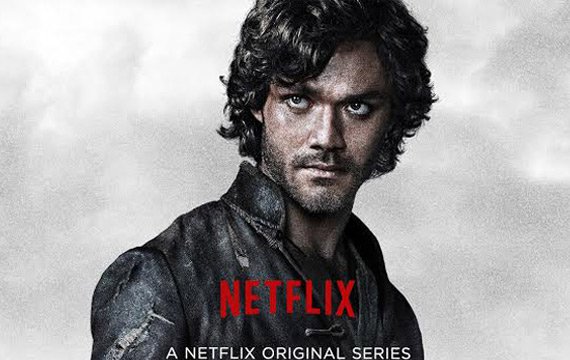
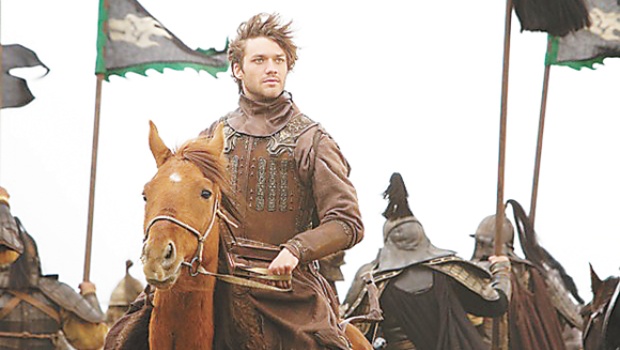
The new Netflix series tries and largely succeeds to have it all, opening with a prolonged throne-room scene in which Marco shows off his knowledge of Uyghur and Mongol, and in which the Polo family’s failure to keep their promises to the Khan lead to the effective handing over of Marco as collateral to save their trading contracts. But there are nods and foreshadowings, even in those opening few minutes, of the direction that John Fusco intends to take. Khubilai’s beloved wife Chabi, a Christian, stands at his side in her distinctive head-dress. An official called Ahmad is pointedly referenced, ahead of the downfall known to all readers of Marco Polo’s Travels. A lissom figure on the sidelines appears to be Princess Kokachin, thought by some to have been the woman who stole Marco’s heart, even as he was forced to convey her to her new husband. And then the credits begin, awash with impressionistic Chinese inks that create simulacra of his tallest tales – figures and creatures that may, or may not, only exist on paper or in his mind, even as the music soars and hints at Game-of-Thrones-y intrigues and Marco’s endless, infectious sense of wonder at the sights of the Far East.
Jonathan Clements is the author of Marco Polo (US/UK) and A Brief History of Khubilai Khan (US/UK). Marco Polo, the TV series, begins on Netflix on 12th December.
History vs Mystery
There will never be a 100% historically accurate Confucius movie. It would be in a dialect of ancient Chinese that literally nobody could understand. The manners and customs would be more alien than the wildest science fiction, and the character motivations truly inscrutable. And no matter how careful the scholarship, it would be open to attack from all sides, because the original source material is already riddled with holes, assumptions and later interpolations.
Our prime source for Confucius, The Analects, is a grab bag of anecdotes and quotations, assembled long after the famous philosopher’s death. A diligent scholar can rearrange the stories in a rough chronological order, revealing a narrative basis for Confucius’s life: his early career as a civil servant, his early successes, his fall from grace in his native state of Lu and his years of wandering. Take things to extremes, applying true academic rigour to the materials, and the historical Confucius evaporates altogether.
Hence, literally any biography of Confucius must involve dramatic licence. As with the First Emperor of China, we are forced to work from the thinnest of material, little more than snatches of overheard dialogue: a cluster of old sayings, and a few incidental details about the history of the period. Hu Mei’s film Confucius, starring Chow Yun-fat, is a brave effort that meticulously walks a difficult tightrope between historical accuracy and entertainment. Continue reading